Meaningful change often begins close to home. Through UConn’s Natural Resources Conservation Academy’s (NRCA) Conservation Ambassador Program (CAP), Connecticut high school students are identifying challenges in their own communities and developing projects that create lasting impact.
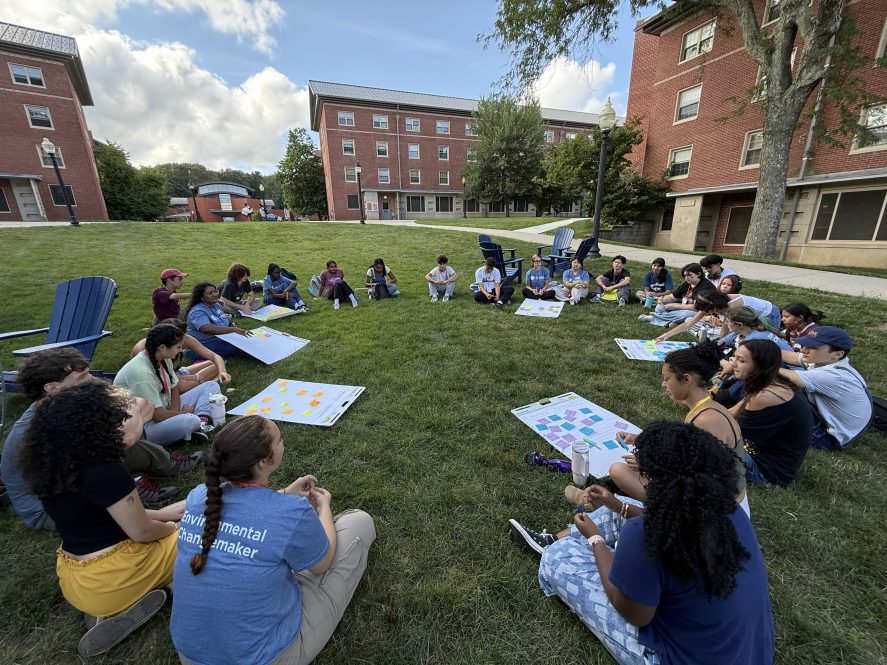
Each academic year, the NRCA selects students from grades 9-11 from high schools across Connecticut to participate in the 10-month Conservation Ambassador Program. The program consists of a week of field experience along with a student-led environmental action project. Within the program, students receive mentorship from the NRCA Staff, college mentors, and environmental professionals before presenting their work at the CAP Showcase Program.
Conversations with students from the 2025-26 CAP cohort revealed that the program emphasizes students forming meaningful connections and experiences while serving their local communities.
Turning Food Waste into Community Action
For Kris Lebron Romero, a student from Common Ground High School in New Haven, solving one environmental problem meant addressing another.
Romero noticed two issues at their school: food waste and food insecurity. Seeing an opportunity to tackle both issues simultaneously, Romero collaborated with three other students: Joel Tolman, Abdellah Aly, and Haley Jordan. Together they developed a system: Food Share Tables.
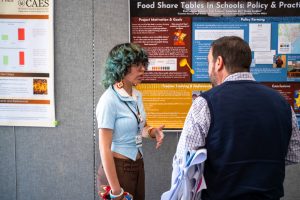
UConn NRCA Showcase Program. (Courtesy of Laura Cisneros)
The concept is simple: students place unopened food they do not plan on eating on a designated table in the cafeteria, where other students can take items that would otherwise go to waste.
“I actually began this project my junior year of high school after learning about all the aspects of food waste from an organization I interned at for two years, called the Green Job Corps,” says Romero. “I always knew that food waste was an issue, but I did not understand the extent of the issue until I worked with the organization.”
Although the idea showed promise, the school removed the table three days after it was introduced, according to Romero.
When they later participated in the NRCA CAP Initiative, they floated the idea of relaunching the Food Share Table. Once again, they were met with resistance.
“Schools have many different policies when it comes to food, including health, sanitation, and allergies that they need to keep in mind when implementing a project like this,” says Romero.
Rather than abandoning the project altogether, Romero chose to understand the policies that stood in their way. They realized that the only way they could make the Food Share Tables a permanent part of New Haven Public Schools was to introduce a policy change rather than seek the approval of an individual school.
The opportunity came unexpectedly while working at a local farmers market over the summer. A farmer connected Romero to a student government group within the New Haven Public Schools. Together, they developed a proposal that eventually became a bill, passed three months later.
The new policy gave Romero the opportunity to design training materials for teachers, which allowed everyone at the school to understand how the tables worked and how the process could be made as efficient as possible.
“There were many times where I had a lot of doubt on the success of the project,” says Romero. “There were a number of people who told me that this project was not possible and to pick a different one, so actually being able to do the project was something I was really proud of. The fact that I was able to experience the outcomes of my project and see how other students interacted with the share tables was incredibly fulfilling.”
The experience also changed how Romero approached challenges.
“If there was one thing I could take away from this experience, and one advice I could give to people who are also passionate about change, it’s to never let a setback be the end of it,” says Romero. “I received a lot of noise, but I used that to help me find another path to completion that made my project even stronger.”
Inspiring the Next Generation of Conservationists
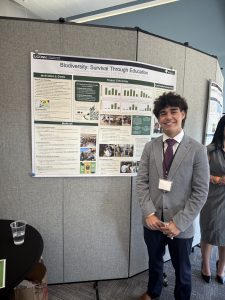
For Tomas Gutierrez, a student from Killingly High School, conservation began as a lifelong appreciation for biodiversity.
Growing up in a rural community, Gutierrez spent much of his time observing how plants, animals, and ecosystems interacted. Those experiences inspired him to pursue opportunities where he could make a change and protect what he cared about most. This eventually led him to the NRCA CAP Initiative.
“The way I think of biodiversity is that it is a wide variety of everything on earth that works together to create something beautiful,” he says.
He decided to focus his project on education. Believing that environmental stewardship begins at a very young age, Gutierrez reached out to a local middle school science teacher and developed an interactive workshop for 6th- and 7th-grade students focused on biodiversity.
“What I realized while doing these workshops was that teaching young kids is not as straightforward,” says Gutierrez. “It’s hard to keep them engaged, and so it gave me the opportunity to really think about how I want to approach this.”
Instead of simply lecturing his students, Gutierrez opted to design activities that encouraged students to think critically about their own definition of biodiversity and come up with their own reasons for valuing biodiversity.
“I wanted students to be able to come up with their own reasons as to why they thought biodiversity was important,” he says. “That way, they are able to develop a passion that is authentic.”
Eventually, his project led him to present at the Connecticut Land Conservation Council conference, where he connected with conservation professionals from across the state. His long-term goal is to incorporate biodiversity education into Connecticut’s public school curriculum.
His experience working with students secured him positions as a member of the State Student Advisory Council in Connecticut and as a student representative of the Killingly Board of Education, where he will continue to advocate for the importance of biodiversity education.
“One of the things I found extremely difficult at the beginning of this project was getting the attention of people who could make a significant impact in our local community,” he says. “That is why I shifted my focus to kids and ensuring they build that curiosity from a young age.”
Reflecting on his experiences, Gutierrez says that the experience strengthened more than just his knowledge of conservation.
“If there was one thing I take away from this project, it is my ability to interact with people of all ages and backgrounds,” says Gutierrez. “That is something I was able to experience with this project, and I’m grateful for that opportunity.”
Building Future Environmental Leaders
Each CAP project tackled a different environmental issue, but they all had a common thread: persistence. Whether the project was about biodiversity, food insecurity, or another local environmental issue, all solutions required the ability to collaborate, adapt, and persevere. The students who persevered through those challenges and found a different path to reach their goal ended up making their impact stronger than ever.
By encouraging students to identify problems in their own communities and develop creative solutions, the NRCA Conservation Ambassador Program is helping shape the next generation of environmental leaders.