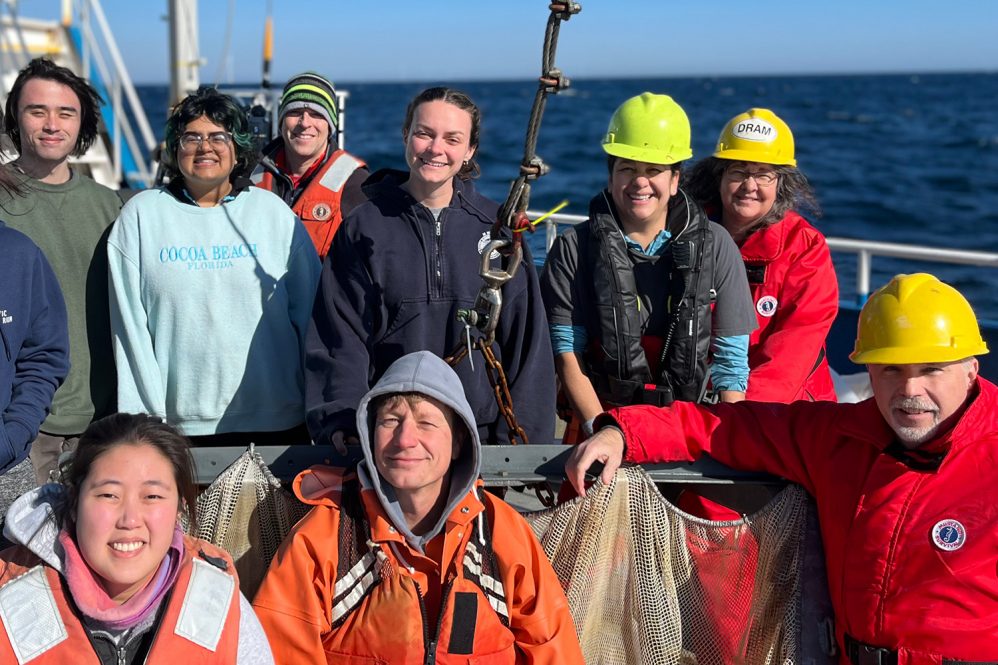
Graduate students Xavier Warren and Vicki You ’24 (CLAS) are enjoying the ocean this summer. But they’re not spending their days at the beach; they are aboard UConn’s Research Vessel (R/V) Connecticut(opens in new tab), helping study how offshore wind development may affect the marine ecosystem.
Warren and You are Ph.D. candidates in the oceanography program in the Department of Marine Sciences, taking part in a UConn-led study(opens in new tab)documenting the potential environmental impacts of Revolution Wind(opens in new tab).
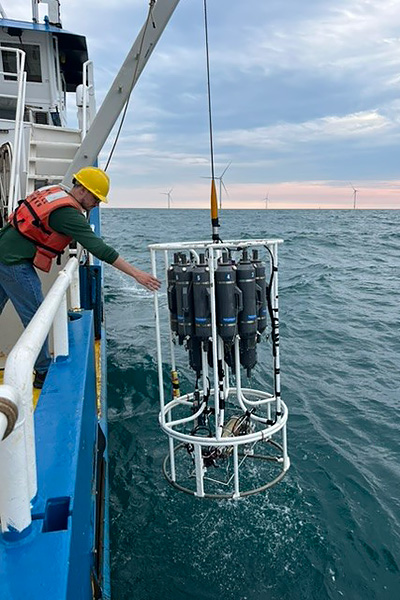
During a recent expedition from June 30 to July 2, they continued expanding their hands-on experience collecting various types of samples that researchers will use to assess marine ecosystem biodiversity during active construction of the wind farm.
This most recent research expedition marks the seventh cruise in a multi-year project funded by Revolution Wind. As offshore wind projects expand into areas like Connecticut, the project aims to inform how these developments interact with the marine ecosystem.
Paola Batta-Lona(opens in new tab), assistant research professor of marine sciences and the research program manager, says that the project aims to evaluate whether plankton diversity in the local marine ecosystem will change during and after construction.
“Thankfully, we were able to be there when they were constructing Revolution Wind, so we can get a sense of what it was like here during construction,” Batta-Lona says. “Now we’re looking at what comes after.”
Why Plankton?
While other projects focus on larger forms of marine life, this project’s focus is much smaller.
“Instead of looking at marine mammals or the bigger, more charismatic organisms, our study is looking at the food they eat,” says Batta-Lona.
Plankton represent the base of the marine food web, which makes them vitally important to the local ecosystem, according to You.
“Learning what organisms are present is very important in terms of helping researchers and agencies make informed decisions,” You explains.
This study aims to capture a comprehensive look at the impacts of wind farm construction on plankton and beyond. According to Batta-Lona, no study in the region has combined as many disciplines.
The researchers hope the interdisciplinary nature of the project will expand understanding that is more specific to our local environment.
“We’ve been referencing reports from European wind farms for years now, because that’s our baseline,” says Warren. “It would be really good if we could provide a more local reference for the Northeastern Shelf.”
Beyond the Boat
This expedition presents not only the opportunity to study the local environment, but also the chance for the students to gain vital hands-on experience.
Researchers on the expedition work in shifts, operating four to five stations per day. During these shifts, students and researchers use nets, drifters, specialized cameras, and other methods to collect plankton samples.
“These activities give students practical training on oceanography and field methods, helping them understand how different types of data are collected during a research expedition,” explains Batta-Lona.
Both students acknowledge the value of these hands-on experiences, citing chances to build their problem-solving skills in the field, where things rarely go according to plan.
“I was able to dive into the deep end of getting to know everyone and how these samples are collected,” says Warren. “In terms of sampling procedure, I came in with a good amount of experience. In terms of the nuances of what I’m actually collecting, I think UConn gave me that experience.”
This experience in the field will prove to be useful in the students’ prospective careers as well, says Batta-Lona.
“I started going to sea when I was in grad school, and I have been able to present that experience to employers,” she says. “People saw that I already knew how to go to sea, so they wanted me for those projects.” For Warren and You, this was not their first research expedition, but another opportunity to build on the applied research and collaboration they have experienced at UConn.
“I’ve really fallen in love with the community here,” says You, who came to UConn for an undergraduate degree in marine sciences. “It made me want to pursue the field as a Ph.D. student.” “We’re a nice tight-knit cohort; we do a lot of activities together,” says Warren.
That sense of connection mirrors the larger purpose of the project: building knowledge that can help guide communities in their long-term decisions about the state’s marine environment, starting with some of its smallest residents.
“You start with these little organisms and fish and over months of analysis you start building these data points,” says You. “I hope that what we find here can be used by other researchers and can contribute to long-term ecosystem management.”