
Connecticut has taken a historic step toward recognizing menopause, perimenopause, and postmenopause as public health, workplace, and equity issues with the passage of two landmark bills: SB 353 and HB 5389. These measures are the result of a sustained partnership between State Representative Kai Belton, the UConn Health Disparities Institute’s Menopause Equity Initiative (MEI), and the lived experiences of community members whose stories we carried from events directly into the legislative process.

For the UConn Health Disparities Institute (HDI), this moment is both a win and a responsibility: a signal that community voice can shape policy, and a call to ensure implementation leads to real change in people’s lives.
From community rooms to the Capitol
HDI launched the Menopause Equity Initiative as a year-long, community-led effort to raise awareness about menopause, perimenopause, and postmenopause as public health and health equity issues in Connecticut. Through the MEI, HDI and partners convened events across the state, hosted screenings and shared learning sessions, and listened to residents, particularly Black women and other marginalized communities, describe navigating symptoms with limited information, stigma, and uneven provider support.
Participants shared that they often went into menopause “in the dark,” unsure which symptoms were normal, where to find trustworthy information, or how to talk about what they were experiencing at work and in health care settings. Many described feeling dismissed, misdiagnosed, or told their symptoms were simply “stress” or “getting older.” They identified clear priorities: better provider training, insurance coverage for evidence-based treatments, and workplace accommodations that allow people to stay in their jobs with dignity.
To ensure this work was fully community-driven, HDI established the Menopause Equity Collective (MEC), a multiracial, multicultural, intergenerational, and multisector group of community members, advocates, providers, researchers, and partners who guided MEI’s priorities. MEC members played a key role in identifying gaps in care, workplace support, public awareness, and policy, including how those insights would show up in the legislative session.
Turning lived experience into legislation

Through the MEI, HDI heard more from residents and recognized that education alone would not be enough. A statewide and nationwide policy scan, conducted by HDI, highlighted major gaps in provider education, insurance coverage for menopause care, and workplace protections, as well as emerging momentum in other states. Those findings helped shape legislative concepts and testimony that would eventually inform SB 353 and HB 5389.
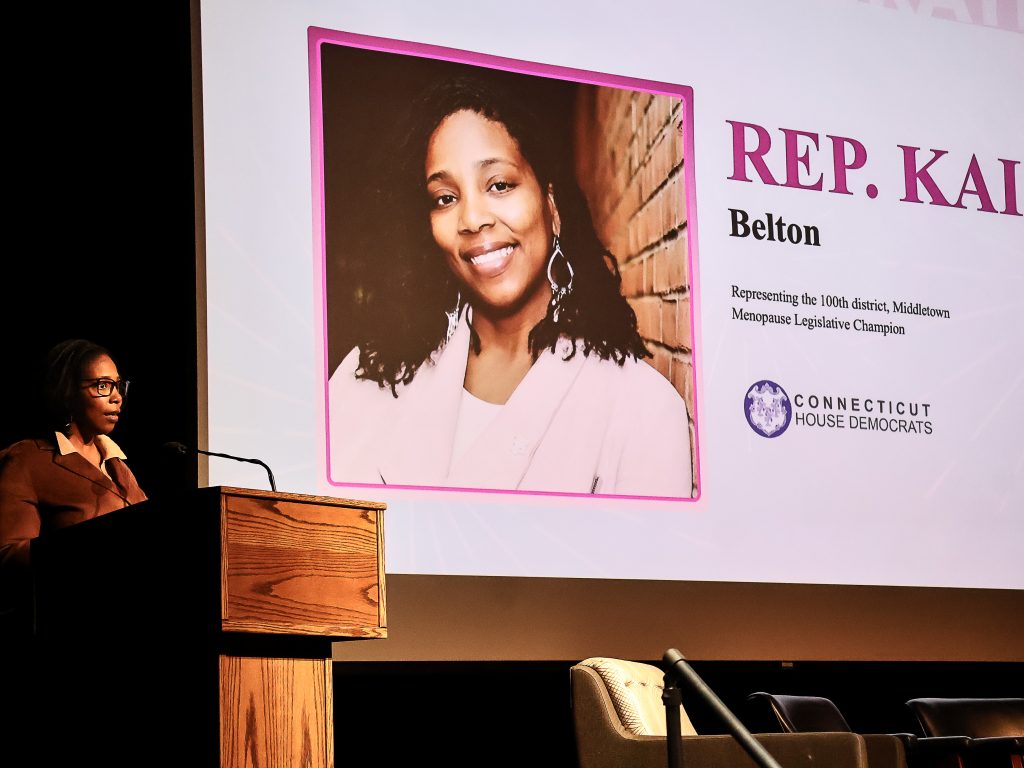
Rep. Kai Belton’s partnership with HDI began at an MEI event, where she heard firsthand how community members were using storytelling and data to name the gaps they were facing. Drawing on MEI’s statewide policy scan, community survey data, and MEC input, HDI worked with Rep. Belton and legislative partners to refine bill language, provide written and oral testimony, and ensure that the proposed policies reflected community-identified needs and equity-focused solutions.
“As a clinician and as someone who has personally navigated menopause symptoms that were dismissed or misunderstood, I know how painful it is to feel invisible in the systems that are supposed to care for you,” said Rep. Belton. “These bills are about more than policy. They are about dignity. They say to people in midlife, especially Black women and others who have been historically unheard, that your symptoms are real, your lived experience is real, and this state is willing to change how it shows up for you.”
HB 5389, now Section 18 of Public Act 26‑13, directs the state to develop a provider toolkit for the diagnosis and treatment of menopause, perimenopause, and postmenopause. The toolkit will include evidence-based guidance for clinicians across disciplines, information on hormonal and non-hormonal treatments, and best practices for culturally responsive care. HDI has been named a partner in this effort, with Trisha Pitter, HDI’s Health Equity Learning Strategist, leading the toolkit’s overall learning design, development, and implementation.
“For me, this work is about honoring what people trusted us with in community spaces and making sure it changes what happens in clinical spaces,” said Pitter. “Through the Menopause Equity Initiative, we heard again and again from people who felt unprepared, unheard, or misdiagnosed. The provider toolkit is one way we can respond back with something concrete: resources that are shaped by lived experience, grounded in evidence, and designed to help providers show up with more awareness, respect, and care.”
SB 353, Sections 30 & 31 of Public Act 26-12, advances protections for workers experiencing menopausal symptoms by clarifying that these symptoms can qualify for workplace accommodations under Connecticut law. While federal law and case precedent recognize this in principle, many workers remain unaware of their rights, and many employers lack clear guidance on how to respond.
Connecticut’s legislation closes that gap in two ways: it explicitly includes menopause-related impairment within the state’s workplace accommodation protections and requires employers to notify workers of those rights. The law also directs the Commission on Human Rights and Opportunities to develop model workplace policies and educational materials to help employers implement those protections.
With this legislation, Connecticut joins a growing number of states recognizing that menopause symptoms can affect people’s ability to fully participate in the workplace, and that clear guidance and reasonable accommodations are essential to equity. Rhode Island was the first state to explicitly require employers to provide such accommodations. Connecticut builds regional momentum as part of a broader menopause equity agenda that includes a statewide provider toolkit, and a community-driven initiative grounded in racial equity to advance health for all women in the state.
Together, these measures move the state beyond treating menopause as an individual problem and toward building workplaces and care systems prepared to support people through this life stage so women and gender-diverse people experiencing symptoms no longer have to choose between their health and their careers.
A report and a roadmap for what comes next
HDI has released From Community Concerns to Legislative Action: The UConn Health Disparities Institute’s Menopause Equity Initiative, a statewide menopause equity report developed through the MEI. The report documents what residents, particularly Black women and other marginalized communities, shared about menopause; maps how those insights informed SB 353 and HB 5389; and offers an equity-centered roadmap for ongoing systems change. While a small number of other states, such as Michigan, have released statewide menopause reports focused on workplace and employer recommendations, HDI’s report is among the first to combine community-based participatory research, a racial and ethnic equity lens, and direct legislative impact.
“For me, menopause equity is part of a broader conversation about whose health matters and who is included in the decision-making that shapes health and social systems,” said Dr. Linda Sprague Martinez, HDI Director. “Through my work as a health equity researcher, I’ve seen communities asked to share their experiences without seeing meaningful change. What feels different now is that community voices didn’t just inform the initiative; they helped drive policy. Our responsibility now, moving forward, is to ensure that implementation remains accountable to the people who made this progress possible.”
Martinez added, “As Connecticut moves into implementation, HDI will continue working with community members, providers, state agencies, policymakers, and partners to ensure that the provider toolkit and workplace protections are practical, culturally responsive, and grounded in lived experience. The passage of these bills marks more than a legislative achievement; it represents a turning point in how Connecticut talks about menopause, prepares providers, supports workers, and advances equity across the life course.”
About the Health Disparities Institute (HDI)
The Health Disparities Institute at UConn Health works to advance equity and improve health outcomes by addressing the root causes of health disparities. Through research, data, workforce development, and strong partnerships with communities disproportionately impacted by inequities, HDI leads efforts to create systemic change. HDI’s vision is equitable health, education, and economic opportunity for all in Connecticut. The institute partners with communities across Connecticut to address the structural and social factors that shape health, with a focus on ensuring that those most affected by inequities are centered in defining problems and leading solutions.
HDI’s Menopause Equity Initiative is part of this broader commitment. The initiative seeks to transform how menopause and midlife health are understood, discussed, and supported by expanding access to accurate information, improving care pathways, and elevating the lived experiences of women and gender-diverse people navigating midlife transitions. Through community-driven programming, partnerships, and public education, HDI is working to ensure that menopause is recognized as a critical health equity issue rather than a private struggle.