Connecticut is facing a healthcare workforce shortage, and the current pipeline of new graduates will not be sufficient to meet the growing demand. The Connecticut Area Health Education Center (CT AHEC), based at UConn Health, has long played a leading role in strengthening this pipeline by offering health career pathway programs for high school and college students, targeted training for health professions students, and continuing education for health and public health professionals. Three years ago, CT AHEC expanded its work to include a student loan repayment initiative after recognizing that the cost of education and training was a significant barrier to building a strong healthcare workforce pipeline.
“After successfully administering the Connecticut Department of Public Health’s Student Loan Repayment Program, we recognize that no single organization can solve the challenge of educational loans alone,” says Petra Clark-Dufner, CT AHEC director. “Collaboration among state agencies, support service providers, academic institutions, workforce training organizations, employers, and students is essential to addressing the root causes of the shortage and implementing effective, lasting solutions,” says Clark-Dufner.
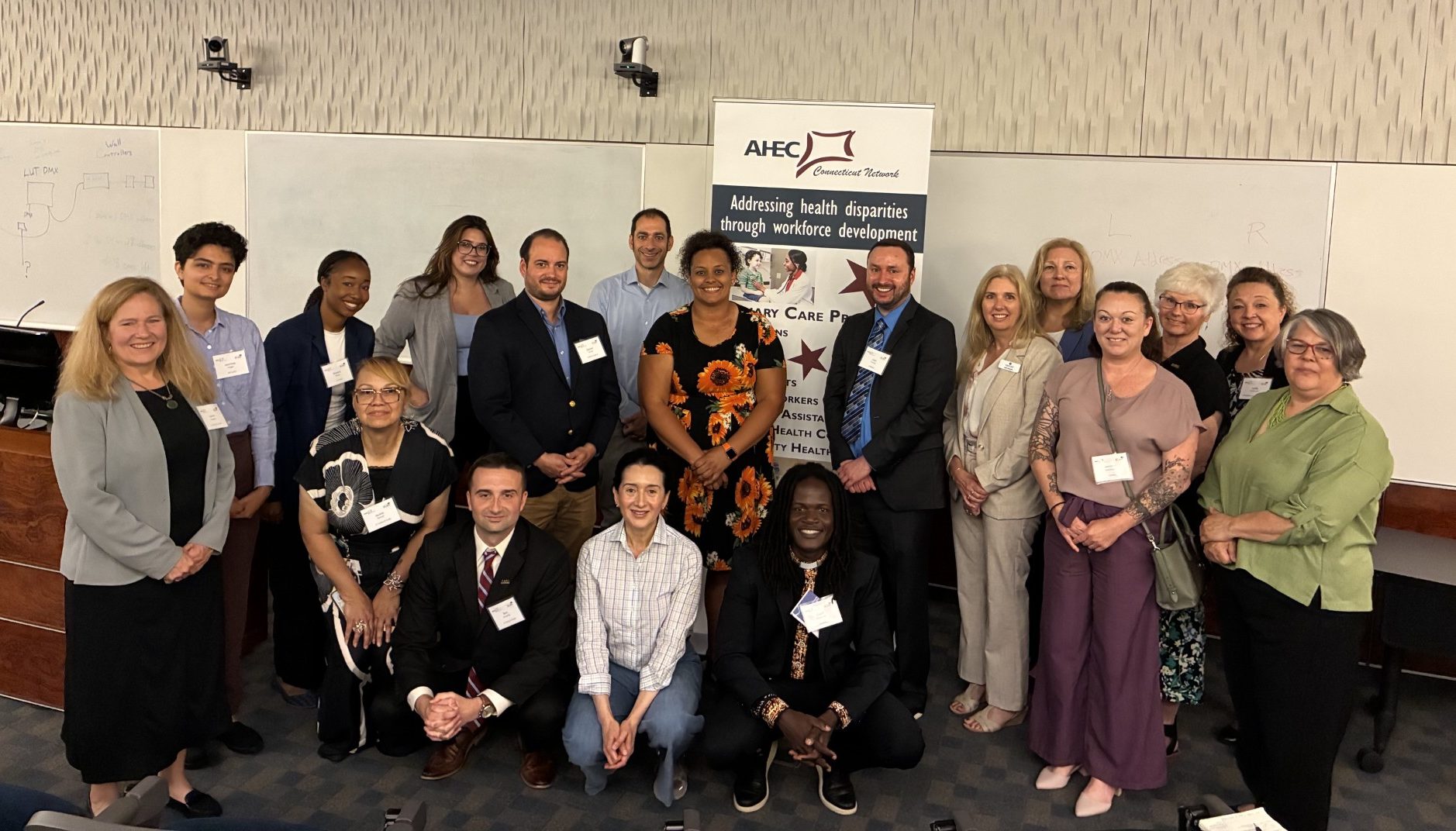
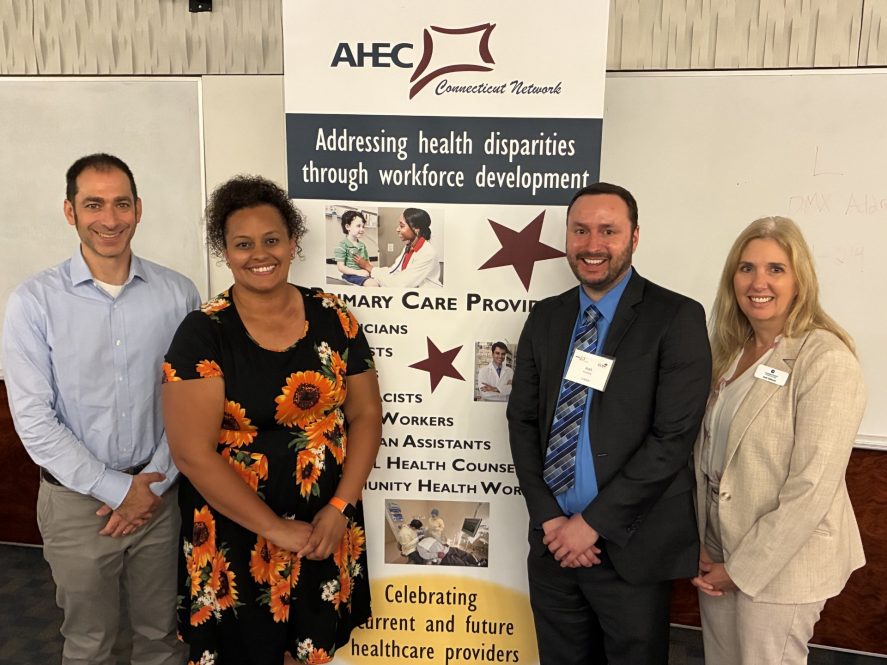
To support this type of collaboration, CT AHEC organized The Interagency Symposium–Aligning CT Workforce Financial Incentives & Loan Repayment Strategy that was held at UConn Health on July 31. They invited speakers from the Connecticut Office of the State Comptroller, Connecticut Office of Workforce Strategy, Connecticut Higher Education Supplemental Loan Authority, and Connecticut Office of the Student Loan Ombudsperson to talk about their programs and challenges with stakeholders and healthcare professionals from across the state. The consensus was that the reasons behind the healthcare workforce shortage are complex and addressing them will require creativity and collaboration.
Connecticut’s Chief Workforce Officer from the Office of Workforce Strategy (OWS), Kelli-Marie Vallieres, Ph.D., said “there is a lot of amazing work happening all over the state, but it’s happening in many, many silos and buckets.” One of the aims of her agency is to build a unifying strategy for the state that encompasses all the workforce sectors and their needs. She said “Connecticut, like most states, has a ‘push’ approach where we educate students on what we think the world needs and what students might be interested in, and then we present them at the end of their educational experience and say okay employers, here’s what we produced for you. They may or may not match.” Her agency is developing a ‘pull’ system through their Career ConneCT portal, https://portal.ct.gov/careerconnect where they bring together employers to understand what they need to build programs that match their needs.
Access to healthcare training and the financial support needed to pursue it were addressed in many ways. Michelle Jarvis-Lettman, Connecticut’s first student loan ombudsperson who moderated the discussion, said she is an “office of one” along with 520,000 plus student loan borrowers. She said students often tell her that it is cheaper for them to go to school out of state. “Why is that?” she asked. “We have amazing state colleges and universities, private universities. We have free community college. Why aren’t we using all of our tools and resources together to keep our students here, to form partnerships with all these great agencies and keep them here and funnel them through the pipeline?” She added that it is important for students to know they can begin their educational journey at a community college, earn credentials there, and then move on to a state college or university. She also believes it is important to ensure the students understand educational financing terms early on so that when it comes time to repay their loans they understand their responsibilities.
As CT AHEC is winding down the three-year Connecticut Student Loan Repayment Program (CT SLRP), many lessons have been learned. Funding for this program came to Connecticut through the Connecticut Department of Health and was administered by CT AHEC to 188 awardees. The program was modeled after the National Health Service Corps and provided debt relief, training, and professional development for awardees serving a two-year service period in one of the State’s federally designated Health Professional Shortage Area (HPSA). HPSAs are designated geographic areas, subgroups of a population, or specific facilities where there is a shortage of primary care, dental health, or mental health providers.
The Connecticut Department of Corrections (DOC) is a HPSA agency that received CT SLRP support for 41 (22% of awardees) health services staff members. Lydia Rostkowski, DOC regional chief operating officer, attended the symposium and shared that she was excited to offer this program because it helped ease her staff’s student loan burden while they provided essential services to an underserved population.
“Of the 188 awardees in the CT SLRP program, nearly one-third will have all their outstanding student loan debts paid off by the end of their service period,” said Karen Pasquale, CT SLRP administrative officer. She added that there are others in the program who will still have a significant amount of loan debt. “We know that debt burden plays a big role in health professionals choosing where they are going to work,” she says. CT AHEC has received additional student loan repayment funding but the details of the program are not yet determined.
CHESS is another student loan repayment program offered to employers by the Connecticut Higher Education Supplemental Loan Authority (CHESLA) that helps strengthen workforce recruitment and retention efforts. “CHESS provides employers with a simple solution and the infrastructure necessary to implement student loan repayment assistance into their benefits packages,” said Josh Hurlock, CHESLA deputy director. “Under federal law, employers may provide up to $5,250 per employee annually in tax-free student loan repayment assistance and state tax credits may also be available,” he adds.
While these programs address education debt for healthcare providers who are already working in healthcare, Hurlock says his organization also addresses financial barriers to a healthcare career for people before entering the workforce. “Healthcare workforce challenges can begin long before someone enters the workforce. They begin with whether students can access the education and training that is necessary to enter these professions in the first place. Educational debt influences who enters healthcare professions, which specialties they pursue, where they practice, and ultimately whether they remain in those professions,” said Hurlock.
CHESLA recently introduced MyCHESLA Grad Loan that considers a borrower’s future earnings potential based on their academic program. “So rather than relying solely on traditional credit metrics, we’re recognizing the long-term earning capacity associated with certain graduate and professional degree programs,” said Hurlock. “That approach helps qualified students gain access to financing that might otherwise be unavailable. In other words, we’re helping individuals enter professions that Connecticut desperately needs,” he adds.
Helping professionals get into their chosen careers is the goal, but it is also important to move these professionals into areas with highest need. Primary care is linked to better population health and more equitable health outcomes, yet primary care is one of the healthcare areas in most need of providers. The Association of American Medical Colleges estimates the country will need up to 48,000 more primary care physicians by 2034.
Alex Reger, director of health care policy and innovation at the Connecticut Office of the State Comptroller (OSC), shared data from 2016-2023 that showed Connecticut was below the national average in terms of physicians, nurse practitioners, and physician assistants working in primary care. He also shared data that indicated there is a “leak” in the residency-to-practice pipeline. “We are second to last among regional states in the percentage of physicians we put through residency at one of our excellent med schools who choose to stay in state. Less than half stay in state. And this is specific to residency, this is not about med school,” said Reger. He admits there are no “magical solutions” but suggested there are advantages to learning from what other states are doing. “It’s hard to take any solution and pop it from one state to the next because economies are different, and politics are different, and culture is different, and all of these things, right? But we need to be learning from all the options out there, get all the people to the table, and see what we can make work,” he said.
Cecil Tengatenga, CT AHEC’s associate director, used the phrase “we are all in, and last out” in his opening and closing remarks as a call for getting everyone in the room to commit to working together on the healthcare workforce shortage. He emphasized that CT AHEC is fully “in” and committed to being the “last out.” The consensus at the end of this symposium was that CT AHEC will not be alone.