Just a few weeks after graduating from UConn Neag School of Education’s Integrated Bachelor’s/Master teacher preparation program, Lynna Vo ’24 (ED), ’25 (MA), began her first year of full-time teaching on the other side of the globe, in a country she felt unfamiliar with, yet deeply connected to.
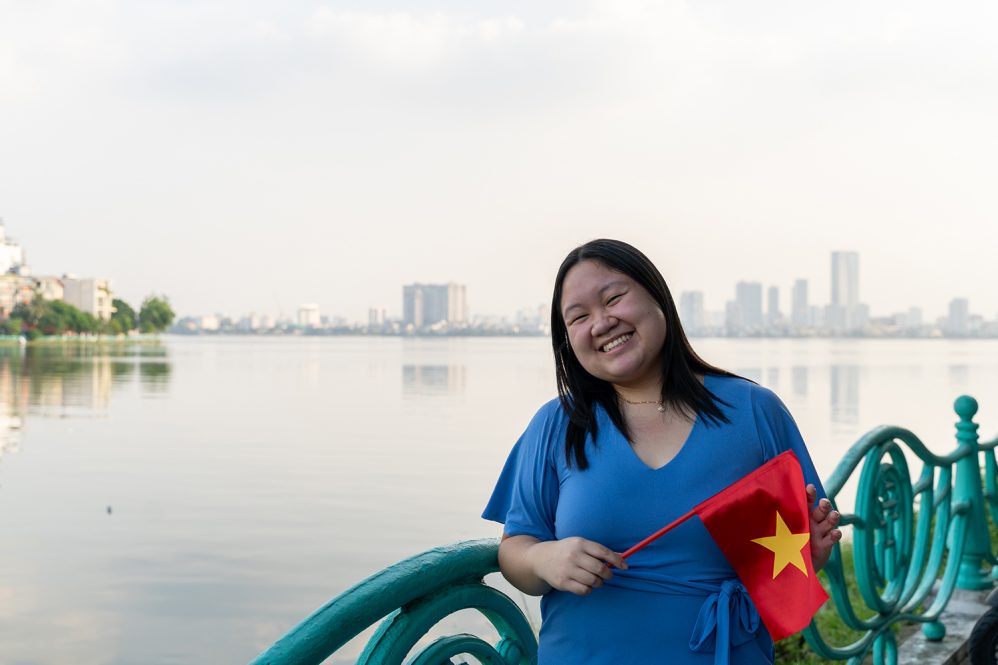
Vo, a Fulbright scholar and Vietnamese American from Meriden, Connecticut, served as an English teaching assistant at Hong Duc University in Thanh Hóa City, Vietnam, during the 2025-2026 academic year.
“I feel like it was an experience that was meant for me,” Vo says. “I was excited to challenge myself. I was ready to just take in everything from everyone that I met and every experience that came up.”
The Fulbright Program is a cultural exchange program that provides scholars with merit-based grants to teach or research abroad. Vo says she saw the Fulbright as an opportunity to broaden her horizons and explore her own cultural heritage. Her passion for teaching was inspired by both of her parents’ emphasis on education and seeing a need for more Asian American representation in teaching roles.
“I wanted to be the person that I needed in the classroom,” Vo says.
Vo’s grant began in August 2025 with a three-week orientation session with her Fulbright cohort in Hanoi, Vietnam’s capital. Vo then taught phonetics and speaking and listening courses at the college and elementary school levels at Hong Duc University and its K-12 school on campus. She rotated through about 500 university students and 300 first, second, and third grade students.
The large class sizes of up to 40 elementary school students were challenging, but Vo still recognized her ability to have a positive impact on students.
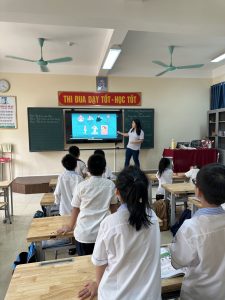
“Even though you might not have in-depth conversations with all of these students, even hearing from a native speaker will make a difference in their language learning,” Vo says.
Another unfamiliar aspect of teaching in Vietnam for Vo was the lecture-based, teacher-led, and testing-focused approach in the classroom. While this was a stark contrast from the student-centered model she was accustomed to in the U.S., she was grateful for the exposure to another system.
“It was insightful as an educator to learn how different education looks everywhere and to realize that there is truly no one way of teaching,” Vo says. “There is not necessarily a right or wrong either. It’s just different.”
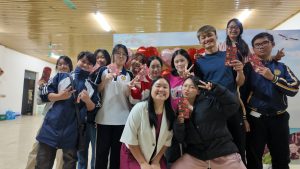
Vo found that responsiveness to students’ needs is a common factor between the two countries. She also served as a cultural ambassador for students, creating and facilitating learning and cultural exchange opportunities outside of the classroom. She says building relationships with students was one of the most crucial and rewarding aspects of her time in Vietnam.
“Making sure that your students feel valued and seen will help them take risks in your class, make mistakes, and be able to grow,” says Vo, who connected further with students by living on campus and visiting their hometowns at their invitation.
Vo says seeing some of her students’ home lives made her more compassionate. Some of her students had full-time jobs, long motorbike commutes, or families who have made significant sacrifices in pursuit of higher education.
“It was another opportunity for me to learn about them, their community, and what shaped them to be the people they are,” she says.
While in Vietnam, Vo was able to visit family members in the country for the first time in her adult life. What she knew about the country was shaped by her parents’ stories following the Vietnam War.
“I was learning through their stories but realizing that Vietnam has transformed into a different country than what they once remembered,” Vo says. “It was really cool going as an adult and being the curious person I am and asking all the questions that I wanted answered.”
Leaving Vietnam was bittersweet for Vo. She was excited to return to the U.S. and reconnect with her parents, but Hong Duc had become a second home for her. She did stay in Southeast Asia for some time after her grant ended, traveling with a student to their home country, Laos, and visiting her family in southern Vietnam again before returning to the U.S.
“The people that I saw every day or on a weekly basis, they were my community,” Vo says. “So, saying goodbye to that was really difficult and emotional. This is not, ‘Bye forever.’ This is just, ‘I’ll see you when I see you. I’ll see you the next time I’m here.’”
Now, Vo is settling back into life in Connecticut and looking forward to continuing her teaching career as a sixth grade math teacher. She says that many of the lessons she learned in Vietnam will be evident in her Glastonbury classroom this fall. She intends to highlight the power of connection and open-mindedness to her students.
“We have so many similarities to one another even though there’s a lot of differences,” Vo says. “Connecting to one another, seeing those differences as a beautiful thing, cultural humility, being open — those are definitely the things that I hope to share with my students as well.”
Vo says she also wants to provide her students with a multidisciplinary education, lead extracurricular activities, and turn everyday experiences into learning moments.
“I’m excited to emphasize this idea that learning extends beyond the four walls of the classroom,” she says. “I have to inspire students to always stay curious and seek out and embrace new opportunities, new perspectives.”
It’s advice she also intends to heed herself.
“That is the biggest overarching theme of my experience: learning,” Vo says. “Even as a teacher, never stop being a learner. Always be curious.”