For Jinhyung Lee, years of research into how therapeutic materials reach and work inside cells have continually returned to one fundamental challenge: a treatment can only help if it reaches the right place and can function once it gets there.
Now, as a 2026-27 Bethel Musculoskeletal Research Center/Orthopaedic Research Society (BMRC/ORS) Fellow, Lee will apply that principle to a new challenge, osteoarthritis.
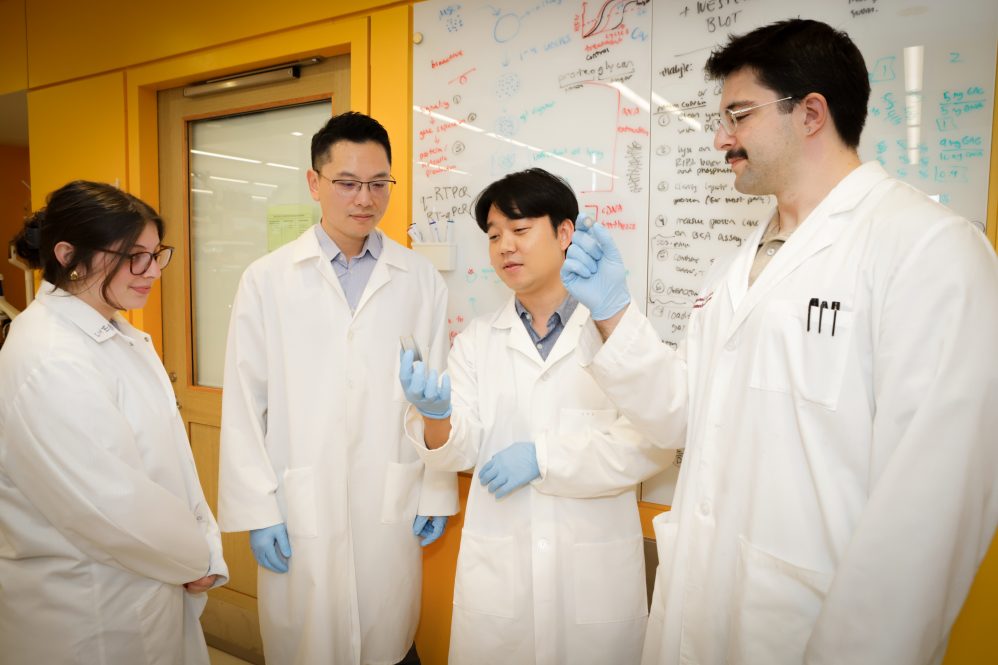
Lee, a postdoctoral fellow in biomedical engineering professor Yupeng Chen’s Nanomedicine Lab, will spend the one-year fellowship investigating an mRNA-based approach designed to help protect cartilage, the smooth tissue that cushions our joints, and support its repair.
“For me, this fellowship is a chance to bring two parts of my research together: getting a possible treatment into cells and understanding what those cells do next,” says Lee. “I have worked on drug delivery since graduate school. Now I can lead a project that asks whether our approach can help protect cartilage.”
The fellowship, which runs from October 2026 through September 2027, will allow Lee to work with professor Yupeng Chen at UConn and professor Chuan-Ju Liu at Yale School of Medicine. For Lee, the project also represents an important step toward building an independent research program.
Osteoarthritis can make everyday activities like walking and climbing stairs painful, as the disease damages cartilage and other structures within a joint. Current treatments, including exercise, physical therapy, medications and – in advanced cases – joint replacement, can reduce pain and improve mobility. Repairing damaged cartilage, however, remains difficult.
Lee’s project will investigate whether messenger RNA, or mRNA, can be used to give cartilage cells temporary instructions to produce a protein called Atsttrin.
Earlier animal studies suggest Atsttrin may help protect cartilage and support its repair. Lee and his collaborators want to explore that possibility using living human cartilage cells.
Delivering those instructions presents another challenge. Cartilage is densely packed, making it difficult for potential treatments to reach cells within the tissue.
To address that problem, Lee’s approach packages mRNA inside tiny, rod-shaped carriers called Janus base nanoparticles. Made from materials inspired by DNA, the nanoparticles are designed to protect the mRNA and help deliver it into cells. The mRNA provides temporary instructions and does not alter the cells’ DNA.
Once delivered, researchers can study how the cartilage cells respond using a human cartilage-on-a-chip model.
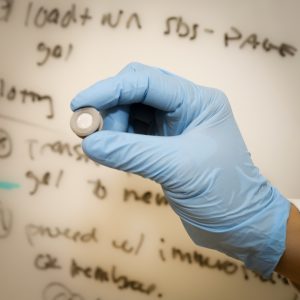
Tissue chips create small laboratory environments that reproduce selected features of human tissue, allowing researchers to study potential treatments under carefully controlled conditions. Lee’s project uses a chip containing gels with living human cartilage cells surrounded by nutrient-containing culture medium.
The system does not require tubing or syringe pumps. Instead, nutrients reach the cells through passive diffusion, spreading from the surrounding medium into the gels.
Lee is working with biomedical engineering Ph.D. candidate Maxwell Landolina, who is developing the new cartilage-on-a-chip model.
Beyond providing a platform for Lee’s osteoarthritis research, tissue chips could eventually help streamline drug development and reduce reliance on animal testing. The long-term goal is to develop models capable of reliably answering specific research questions that might otherwise require animal experiments.
Lee’s fellowship project brings together several areas of research he has pursued at UConn.
His work in Chen’s lab has included developing tiny carriers that help RNA reach the locations where it needs to function inside cells.
In a 2021 study featured by UConn Today in “Escape From the Endosome!,” Lee and his colleagues demonstrated how their materials could help RNA escape small compartments that can trap it after entering a cell.
Later research explored how the shape of a carrier affects its movement through dense tumor tissue and how nanomaterials can deliver a drug and RNA together. At the same time, Lee studied materials designed to support cartilage cells and presented the team’s osteoarthritis research at the 2024 Orthopaedic Research Society meeting.
“My research has kept returning to the same problem: a treatment can only help if it reaches the right place and can work there,” Lee says.
The Bethel Fellowship gives him an opportunity to bring those research paths together.
In early experiments, the researchers detected Atsttrin protein after delivering the mRNA instructions. The next step is determining whether that protein can help human cartilage cells protect and rebuild the tissue surrounding them.
The fellowship will also build upon the lab’s work developing tissue-chip technologies.
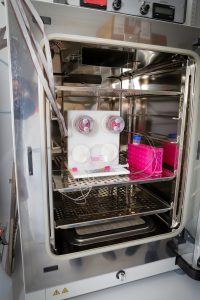
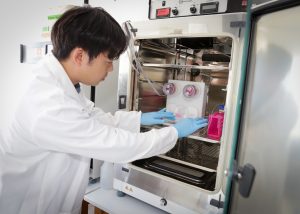
The lab’s first-generation tissue-chip system operates inside an incubator that maintains controlled conditions for the cells. Researchers have also been developing a smaller version for experiments in space, where space and supplies are limited.
Chen’s lab has partnered with NASA, the International Space Station National Laboratory, and Axiom Space to study its Janus base nanomaterials in microgravity. Experiments aboard the ISS allow researchers to explore how the materials assemble in space and whether those insights could improve their therapeutic applications back on Earth.
The newer design uses a compact housing for the gels and culture medium, requiring less material while making the system easier to package and transport. For the fellowship project, Lee plans to adapt those features to allow researchers to test more samples and treatment conditions simultaneously.
During the fellowship, Lee plans to compare the Atsttrin mRNA treatment with another experimental mRNA approach designed to reduce inflammation. Researchers will investigate whether Atsttrin offers an additional benefit by helping cartilage cells produce and preserve the supporting structure that gives cartilage its strength and cushioning.
The team also plans to test cartilage cells from younger and older female and male donors with osteoarthritis, using tissue removed during joint replacement surgery.
Running multiple experiments will allow the researchers to repeat tests using cells from the same donor while also comparing results among different people. Repeating experiments can help determine whether findings are consistent, while studying multiple donors may provide early clues about whether responses differ based on factors such as age or sex.
“This is still an early laboratory study, and we need more testing to learn whether the approach could safely and effectively help people with osteoarthritis,” says Lee. “The long-term hope is to help people keep their joints working well.”
Promising findings could eventually lead to larger studies examining safety, dosage and treatment effects.
Lee and his collaborators also envision increasingly sophisticated tissue-chip systems. Future versions could incorporate additional structures within a joint, including bone and the synovium, the tissue lining the joint.
Adding those components could allow researchers to investigate how inflammation in one tissue affects another and what happens at the interfaces between different joint tissues, while maintaining a compact system capable of running multiple experiments.
For Lee, the fellowship provides an opportunity not only to investigate those possibilities but also to take another step toward establishing his own research direction.
By combining nanomedicine, mRNA delivery and tissue-chip technology, he hopes to better understand what happens after a potential therapy reaches its target and whether that knowledge can ultimately help researchers find better ways to protect and repair damaged cartilage.