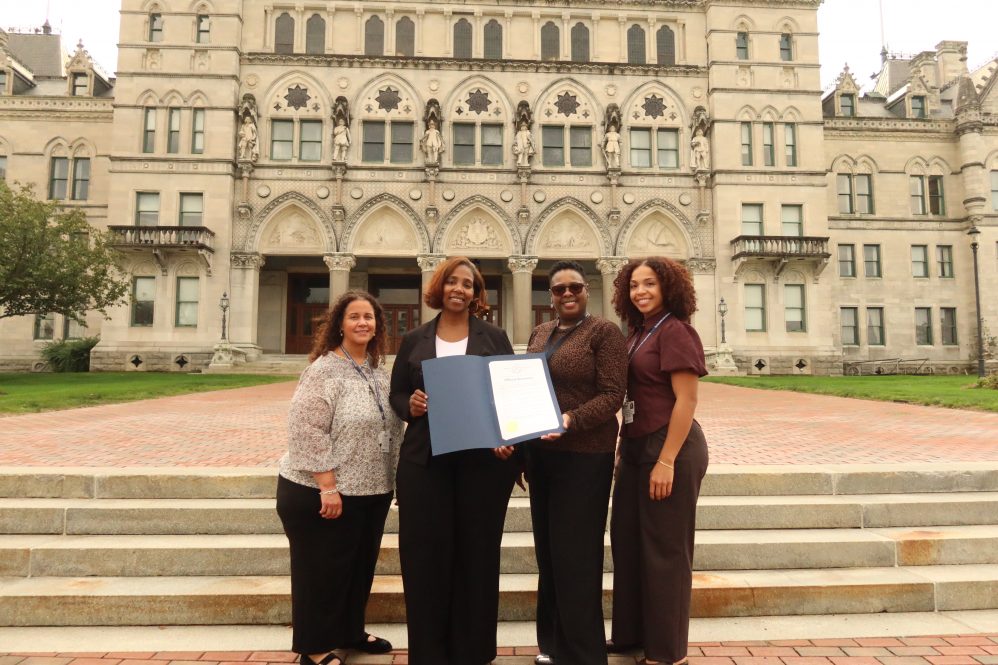
Gov. Ned Lamont recognized the UConn Health Disparities Institute for its leadership and commitment to addressing women’s health during menopause in community, workplace, and policy settings throughout the state of Connecticut in an official proclamation on Oct. 1. The governor proclaimed October 2026 as menopause awareness month, and recognized the Health Disparities Institute (HDI) and its Menopause Equity Initiative for commitment to advancing policies that recognize and support women’s health during menopause.
Menopause is clinically defined as one year after a woman has her last menstrual period. But in many women’s lives it has a much broader impact, affecting them socially, emotionally, and in terms of their health. The governor’s proclamation points to menopause as a critical public health issue, and in concert with the passage of Section 18 of Public Act 26-13, directs HDI to develop a statewide menopause provider toolkit in consultation with the Connecticut Department of Public Health, healthcare providers, and people who have experienced symptoms of perimenopause, menopause, and post menopause.
“This recognition underscores the importance of connecting medical education and clinical practice with the needs of the people we serve. HDI’s work brings community perspectives and health expertise together to help strengthen menopause care and build education across Connecticut,” says UConn School of Medicine dean Bruce T. Liang.
The proclamation also acknowledges the initiative’s community outreach and engagement, as documented in HDI’s 2026 report, From Community Concerns to Legislative Action.
The initiative’s first partner, the Connecticut Commission on Women, Children, Seniors, Equity and Opportunity (CWCSEO), co-hosted a community event with HDI on May 3, 2025, at the Legislative Office Building, bringing women together to address menopause openly.
“When we partnered with HDI to open this conversation at the Capitol, we knew women across Connecticut were waiting to be heard and seen. This proclamation shows what happens when their experiences are taken seriously and carried into policy,” said Melvette Hill, executive director of CWCSEO.
State Representative Kai Belton, representing the 100th district (Middletown), partnered with HDI and community members to advance menopause equity policy and presented the proclamation to HDI on October 14, 2026.
Community members, health care providers, and HDI helped bring the realities of menopause into our policy discussions. This proclamation recognizes their contributions and the importance of following through with practical support for people navigating this natural stage of life,” said Belton.
What started as listening and community-building has become a broader movement for awareness, support, and systemic change. The next step is developing the toolkit, which will provide providers with practical, evidence-based, and culturally appropriate guidance for menopause care.
“The proclamation is an important milestone, but it also reminds us that there is more work ahead. Our next step is to bring clinical evidence, provider perspectives, and lived experience together to design a toolkit that is useful in everyday practice and menopause care,” said Trisha Pitter, health equity learning strategist/instructional design specialist of the UConn Health Disparities Institute.
For HDI, the proclamation acknowledges progress and reinforces the ongoing collective effort required.
“This proclamation reflects what is possible when community members, policymakers, health care providers, and academic institutions come together with a shared commitment to equity. It honors that collective effort and reminds us of what can happen when people’s lived experiences help shape a healthier future for Connecticut,” said Linda Sprague Martinez, director of the UConn Health Disparities Institute.