One of the main queries of any student is deciding on what comes after graduation, and the University of Connecticut’s Center for Career Readiness and Life Skills is in the business of helping provide answers to that question for students at Storrs and the regional campuses.
The center’s vision is described as “a coordinated University-wide ecosystem where career readiness is embedded across every student’s curricular, co-curricular and extracurricular experience,” according to the center’s website.
Nancy Bilmes is the senior director of the center. Bilmes says they offer an abundance of services to students, including career coaching, fairs and workshops. Bilmes also says they offer a comprehensive virtual career center, a chance for students to receive information, wherever, whenever.
“We know that a lot of students want to get information at 11 at night, or any time,” Bilmes says. “We have virtual resources for writing your resume, developing your LinkedIn profile, interviewing, basically any topic students are interested in learning more about.”
All five UConn campuses also offer micro-internship programs, Bilmes said. Learning about these resources as soon as possible is very important, Bilmes says.
“A lot of time students think they don’t need to come to the Career Center until senior or junior year,” Bilmes says. “The earlier students come, [specifically in] their first year, the better. Students who engage with the Center earlier in their college experience have more time to consider career options and gain experiences and skills that help them become career ready.”
Along with that, Bilmes says many students at UConn know the center by the phrase, “the resume people.” Explaining to students who visit for help with their resumes that this is only a fraction of what the center offers has proven to be successful in having those students return, Bilmes says. Those return visits are important: Career development is an ongoing process that doesn’t conclude with just one meeting, Bilmes says.
As an example, one of the one-on-one offerings the center has for students is helping them search for what they are looking for, whether that’s a job, an internship, or even a club. This is something that usually surprises students that visit the center, Bilmes says.
Career coaches also offer preparation when it comes to the all-important job interview, helping students become aware of the different interview styles in different fields, Bilmes says. This includes helping with applications, and knowing what sets your application apart from the rest.
The center also hosts smaller events, including one called “Headshots and Hot Fudge.” This was a chance for students to get a professional-quality photo for their resumes, LinkedIn profiles, and applications through the center, free of charge, Bilmes says.
Bilmes adds that the center is not 100% career-related. Gaining skills that are applicable to multiple areas of a student’s journey is just as important.
Bilmes’ point is highlighted with the updated name of the center. As of Sept. 2024, the center’s name was changed from the Center for Career Development to the now Center for Career Readiness and Life Skills.
This was a direct change to not only emphasize that the center is a resource for career development, but also students’ personal challenges and post-graduation success as a whole. Serving as a resource for not only undergraduate students but master’s students, doctoral candidates, and post-doctoral scholars as well is also a part of the center’s mission, Bilmes says.
“Helping students understand the skills they’re learning in a classroom or at a job are skills that are going to relate to future jobs, even if the current experience is not in the field they are interested in going into,” Bilmes said.
Another resource on campus, the UConn Academic Center for Exploratory Students (ACES) partners with the center on helping students decide on a major or choosing courses. If a student is having a tough time deciding what classes to take or similar questions, Bilmes said they usually refer them to ACES.
Recently, the center has also been doing work with not only students, but staff and faculty as well to help them understand the center’s mission so they can further help students in the classroom, Bilmes says. That way, the development of a student’s career is not just limited to the career center.
“Creating opportunities, resources, and programs for students to be successful,” Bilmes says when asked about her favorite part of her work. “Being a part of the smaller and larger successes and knowing I had a part in making that happen. Because that’s what we want: for all students to succeed.”
UConn Career Fair Gives Students a Place to Explore and Build Confidence
By Leah Williams, for UConn Today
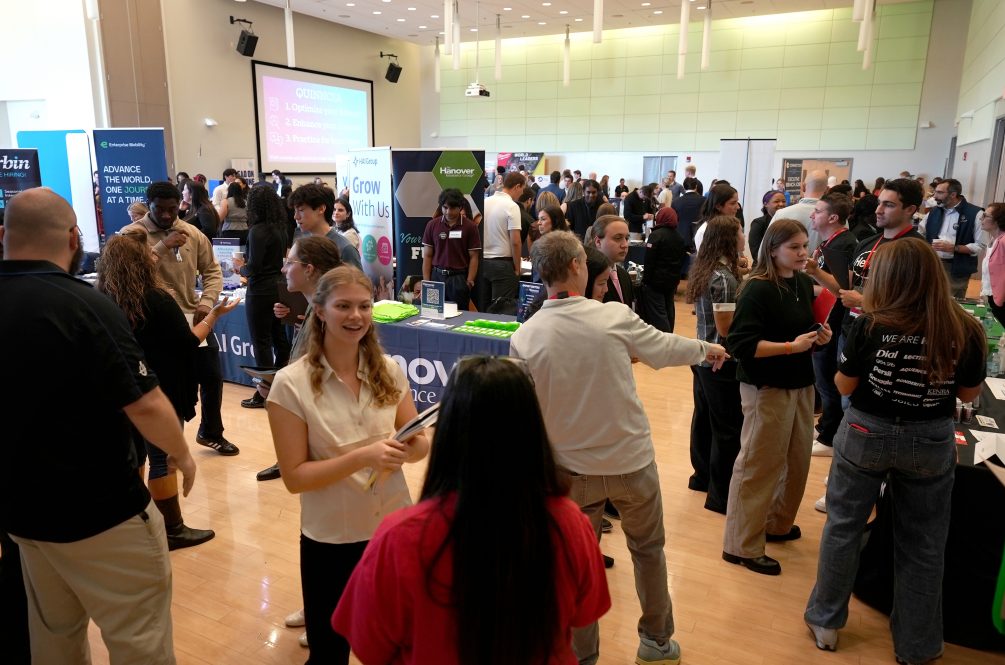
One of the most visible ways the Center for Career Readiness and Life Skills helps students prepare for the next chapter is by hosting regular career fairs.
UConn’s fall career fair gave students more than an opportunity to search for jobs and internships. For many, it became a place to practice networking, explore unfamiliar career paths and gain confidence speaking with employers. The two-day event brought more than 175 employers to campus and included an All Majors Fair and a STEM Fair, with around 100 employer tables each day. Evan McMunn, the publicity and marketing administrator for the Center for Career Readiness and Life Skills, says the fair is especially useful for students who may not yet know exactly what they want to pursue.
“We want them to introduce themselves, ask questions and explore opportunities,” McMunn says.
He said students tend to have a better experience when they prepare ahead of time by researching employers and practicing a short elevator pitch.
“When they go in with a game plan, they have a better experience,” McMunn says.
Students who attended the fair said they found value in sharing resumes and connecting on LinkedIn with prospective employers, and even simply seeing the range of options and opportunities that exist.
McMunn says researching employers before the event can help students decide where to spend their time and avoid missing companies that may fit their goals. Employers are also continuing to place value on communication, teamwork and leadership, even as technology and artificial intelligence become more common in the workplace.
“At the end of the day, employers still need that human element,” McMunn says.
The experiences of students at the fair showed that success did not always mean leaving with an interview or job offer. For some, it meant becoming more comfortable starting a conversation,learning what opportunities were available and leaving with a clearer idea of what to do next.