Seth Warner, Ph.D.
Assistant Professor of Political Science
- Storrs CT UNITED STATES
- Political Science
Dr. Warner's research focuses on polarization, party politics, public opinion, and subnational government.
Contact More Open optionsBiography
Seth Warner is an assistant professor in American politics. His research focuses on polarization, party politics, public opinion, and subnational government.
Much of his work examines how citizens relate to political parties as both ideological organizations and social groups, with particular attention to affective polarization, issue ownership, election outcomes, and protest participation. Several of Warner’s projects use original data on affective polarization across states, congressional districts, counties, cities, and towns to study politics as people experience it in their communities.
At UConn, Warner teaches state and local government and Connecticut state and municipal politics, where students hear from many of the state’s key leaders and policymakers. He also teaches public opinion and electoral behavior, speaks regularly with the media, and contributes public-facing commentary on elections, polarization, and state politics.
Warner grew up in Connecticut and is a proud product of the state’s public schools. He earned his Ph.D. from Penn State in 2023.
Areas of Expertise
Education
Pennsylvania State University
Ph.D.
Political Science
2023Pennsylvania State University
M.A.
Political Science
2020Vassar College
B.A.
Political Science
2014Accomplishments
Tom Carsey Scholar, State Politics & Policy Section
2022 Awarded by American Political Science Association
Robert S. Friedman Award for Excellence in Teaching
2022 Awarded by Penn State Department of Political Science
College of Liberal Arts Enhanced Graduate Fellowship
2018-2023 Awarded by College of Liberal Arts at Penn State
Susan Welch / Nagle Family Graduate Fellowship
2022-2023 Awarded by College of Liberal Arts at Penn State
Raymond and Roberta Lombra Outstanding Graduate Research Award
2023 Awarded by College of Liberal Arts at Penn State
Links
Social
Media



Media Appearances
Blumenthal says ‘begin impeachment today of Pete Hegseth' as Congress returns to Washington
NBC Connecticut tv
2026-11-09
Then there's the budget, with a partial shutdown looming in mid-December. Seth Warner, a professor at the University of Connecticut, said the results of the midterm elections could influence whether Republicans are willing to work with Democrats, despite still holding power. "When the federal government does something well, when things are going well, it tends to be the president and the president's party that benefits," Warner said.
Sore-Loser Effect: High Election Expectations Tied To Lasting Partisan Hostility
StudyFinds online
2026-11-08
Political scientist Seth Warner of the University of Connecticut combed through decades of national survey data and found that voters on the losing side usually come out of an election a little less hostile toward the other party than the winners do. Losers who had expected victory broke that pattern. Their dislike of the opposing party held steady after the defeat, and in some cases may have grown.
Election Night 2026: Breaking down the results of the Midterm Elections
FOX 61 tv
2026-11-04
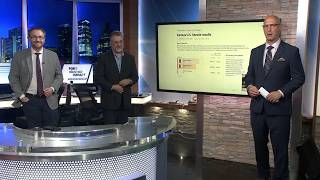
Election night coverage of the 2026 Midterms, featuring Prof. Kevin McMahon, Trinity College, and Prof. Seth Warner, UConn.
The epidemic of partisan wishful thinking
Good Authority online
2026-10-21
Imagine it’s 2028 and you’re asked this survey question: “Who do you think will be elected president in November?” In this era of ubiquitous polling, forecasts, and prediction markets, it is possible to give a reasonably data-driven answer. But many people instead engage in “partisan wishful thinking”: Predicting that their party’s candidate will win. What is perhaps more surprising is just how prevalent that tendency has become. That’s the finding of new research by political scientist Seth Warner. He examines responses to this question from 1952 through 2024.
Everyone Thinks They’re Going to Win
Wake Up To Politics online
2026-10-19
“You know, we’re all a little grumpy when things don’t go as planned,” Warner told me in an interview. But in this case, the grumpiness could have large-scale democratic consequences, especially if it’s fueling partisan polarization, undermining trust in elections, and perhaps even supercharging election denialism. It’s going to be much easier to prime voters to distrust the results of an election they were sure they were going to win, versus one they had already steeled themselves to lose."
The Convicted Connecticut Bureaucrat Who Fled to Greece—and Won’t Stop Talking
The Wall Street Journal print
2026-10-08
The saga offers a glimpse of a Connecticut far removed from the hedge-fund wealth and old-money hamlets for which the “Land of Steady Habits” is often known. It features cash payoffs at a Dunkin’ Donuts and secretive meetings at the Capital Grille bar in Hartford (and, on one occasion, in its men’s room). “We’re not New Jersey. We’re not Mississippi,” noted Seth Warner, a local-politics expert at the University of Connecticut, referring to other states with at times unsavory reputations for corruption. Still, he said: “There’s a lot of different interests that want to get a hand in the pie.”
Amount of public testimony on bills is growing, but who’s writing it?
AP News online
2026-05-22
Seth Warner, an assistant professor in the University of Connecticut’s Department of Political Science, said the increase might not be a result of individual civic engagement.
Study finds partisan hostility drives protest participation in the United States
Psy Post online
2025-09-02
A new study published in Social Forces suggests that in the United States, people are more likely to protest not simply because they identify with a political party, but because they feel anger or threat toward the opposing one. Drawing from three large survey-based studies conducted between 2014 and 2022, political scientist Seth Warner found that partisan animosity—feelings of hostility toward the other party—consistently predicted whether someone participated in a protest. In contrast, merely identifying strongly with a party had little or even negative effects on protest participation.
Event Appearances
Does Exposure to Local Politics Reduce Affective Polarization?
Elections, Public Opinion, and Voting Behavior St. Louis, Missouri – May 2026
Wishful Thinking in Polarized Times
Midwest Political Science Association Annual Meeting Chicago, IL – April 2026
Affective Polarization across Time and Place in the United States
Midwest Political Science Association Annual Meeting Chicago, IL – April 2026
Affective Polarization across Time and Place in the United States
Midwest Political Science Association Annual Meeting Chicago, IL – April 2025
Affective Polarization and Legislative Behavior: Does Citizen Heat Meet with Elite Red Meat?
Elections, Public Opinion, and Voting Behavior Talahasee, FL – March 2024
Articles
The election result Americans refuse to imagine: losing
CT Viewpoints – CT Mirror2026-11-03
With the outcome of the midterm elections fast approaching, it’s only natural that many of us have taken up political forecasting as something like a second job. Will Democrats win the Senate? How deep into Trump country can their House candidates compete? Why does Susan Collins, the Republican senator from Maine, seem so resilient?
Partisan Wishful Thinking in Polarized Times
Political Behavior2026 Partisans engage in “wishful thinking” ahead of elections, being more likely to expect their party to win than lose at the polls. This article asserts high expectations as endemic to the current polarized era in US politics. In today’s presidential races, 90% of voters expect their preferred candidate to triumph, a sharp increase from just two decades ago. Drawing on the American National Election Study’s 2016–2024 panel survey, I show that partisan animosity (or out-party hate) is robustly associated with high electoral hopes, and using surveys from 1980 to the present, I show that it corresponds with a sizable share of the increase in these expectations over time. Finally, I explore reciprocity in this relationship.
Governing Party Issue Ownership and How Citizens Assess Conditions
Political Research Quarterly2026 It is well-documented that Americans perceive conditions more favorably when their preferred party is in power. This study considers a second, more subtle, but potentially impactful partisan bias: that the governing party’s policy reputations lead voters to perceive better conditions on the issues it “owns.” In US politics, voters trust Democrats more on environmental, healthcare, education, and safety net issues while Republicans are favored on immigration, crime, defense, and keeping taxes low. In two studies, I observe whether these reputations also impact perceptions when each party is in power.
Whose Party Is This? Explaining Perceptions of US Party Ideology Get access Arrow
Public Opinion Quarterly2026 How do Americans perceive the parties ideologically? Using a multiverse analysis of 720 models, I observe how citizens’ ideological placement of the parties varied from 1990 to 2020 as a function of party ideologies at different levels: in Congress, in state legislatures, and in the electorate. Although public perceptions associate somewhat with elite ideology, more variation is attributable to how citizen-level partisans identify ideologically.
Election outcomes and affective polarization in the United States
Political Research Quarterly2026 Do election outcomes exacerbate affective polarization? While polarization often rises during campaigns and correlates with democratic backsliding, isolating the effect of winning or losing has proven difficult because of the need for a pre-election baseline and to generalize across multiple elections. In this study, we leverage pre- and post-election questions about partisan affect in the American National Election Study between 1996 and 2024. Our first analysis studies how respondents’ attitudes changed based on their party’s success in its bid for the White House. Our second analysis extends this to hundreds more races, applying a regression discontinuity design to attitudes after close subnational election results.
Why are there so many protests? The US public is highly polarized, and that drives people to act
The Conversation2025-09-22
Protests are becoming a routine part of public life in the United States. Since 2017, the number of nonviolent demonstrations has almost tripled, according to researchers with the nonprofit Crowd Counting Consortium. And more people are joining than ever. The Black Lives Matter marches in 2020, after George Floyd was killed by police in Minneapolis, have been described as the largest nonviolent mobilization in U.S. history. The No Kings protests against Trump administration policies on June 14, 2025, were not far behind, with between 2 million and 4.8 million Americans protesting nationwide What explains this surge of protest activity?
Partisan animosity and protest participation in the United States
Social Forces2025 In the United States, partisans are more likely to protest than other citizens. This study compares the relative strength of two explanations for why. One contends that partisanship, as a group identity, may lead people to protest in support of their party’s interests. Another suggests that partisans may perceive a greater threat from the opposing party’s actions, leading them to protest more in response. Drawing from research on affective polarization, this study favors the threat-based explanation. Three studies of surveys fielded between 2014 and 2022 highlight the link between partisan animosity—or hostile feelings toward the opposing party—and protest participation. Studies 1 and 2 use panel data to show that citizens who hold greater partisan animosity at one point are more likely to report having protested in the years to follow.
Analyzing public support for school-based mental health services
Journal of Health Politics, Policy and Law2025 Context: Public schools play a central role in addressing the mental health crisis among American youth, but most schools are limited in the services they provide. As of 2019, 44% of administrators cited concerns about the public's reaction as an obstacle to expanding these services. Methods: The authors draw on observational data from three national surveys to study the individual-level characteristics that are associated with support for these programs.
Toward an Ideological Common Space: Extending Bonica’s CFscores to the Citizen Level
Political Behavior2024 Bonica’s (Am J Polit Sci 58(2):367–386, 2014) campaign finance-based ideology scores, or CFscores, create an ideological common space that allows researchers to compare a wide variety of actors. Because relatively few citizens donate to candidates, however, the public is not well represented in this common space. This paper addresses that gap. It uses random forest machine learning on data from the 2012 Cooperative Congressional Election Study to impute CFscores for respondents who did not donate to candidates, based on how their policy views compared to those who did.