Originally published @ The Materials Science and Engineering Department
By Amanda Olavarria
MSE seminar speaker guest and alumna Janet Callahan, Ph.D., returned to UConn to give a seminar and also lead a discussion panel for senior MSE students in Associate Professor Rainer Hebert’s senior design class.
Originally published @ The Materials Science and Engineering Department
By Amanda Olavarria
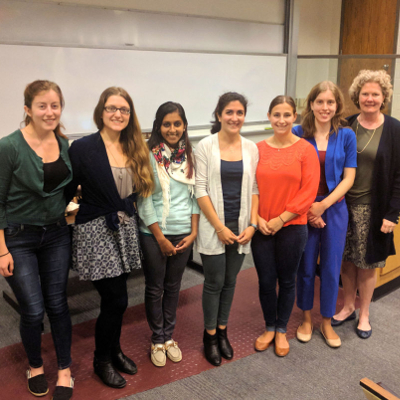
MSE seminar speaker guest and alumna Janet Callahan, Ph.D., returned to UConn to give a seminar and also lead a discussion panel for senior MSE students in Associate Professor Rainer Hebert’s senior design class. Professor Janet Callahan is the Chair of the Micron School of Materials Science and Engineering at Boise State University.
The panel consisted of MSE graduate students Tulsi Patel, Bahar Deljoo, Alexis Ernst, Pamela Dyer, Hannah Leonard, and Alexandra Longacre. In the panel, each of these graduate students spoke about their experience and what led them to pursue engineering.
Panel questions ranged from asking about a graduate student’s daily schedule, to asking about possible internship opportunities. Since these seniors will either be graduating soon or applying to graduate school this was a very important discussion that gave guidance and instruction to these soon-to-be graduates.
This discussion made seniors aware of all the opportunities they have in different areas of the field. The graduate students also set straight any misconceptions about graduate school and provided more information about the process.
In the seminar titled “Student Success-and Myth Busting”, Callahan spoke about what determines student achievement. In the seminar, Callahan refuted a common myth that one needs to take Calculus in high school or in their first semester at college to be successful in engineering. Her research showed that a student’s success as an engineering student could be predicted by strong performance in the first math class taken in college- regardless of math course level. The same is true for English coursework; doing well in the course is what matters most. Dr. Callahan’s advice for freshmen is to “Go to class, do your homework, and focus on your learning.” She also said “Don’t push yourself into a course for which you are not fully prepared!”
According to Callahan a student’s self-efficacy influences the way students respond to tasks and challenges. She described self-efficacy as an individual’s belief in his or her capacity to execute behavior necessary to produce specific results. Her talk was focused on student persistence and how this influences later success.
She later went on to describe how a complete overhaul in a first year course at Boise State University led to a nearly 10% increase in retention for women and minorities in STEM fields. The overhaul was accomplished through strong and sustained instructor interactions, leading to active learning, a strongly coordinated course and more.
Professor Callahan graduated from UConn with degrees in chemical engineering (BS) and metallurgy and materials science (MS and Ph.D.). Her Ph.D. advisor was Dr. Donald Potter and her thesis focused on ion implantation effects of reactive elements in alloys. After a post-doc in Australia, she was Assistant and Associate Professor at Georgia Tech until 2004 when she joined Boise University to help establish the BS program in Materials Science and Engineering.
Her research interests include surface modification of materials, combustion chemical vapor deposition of oxides, biomaterials, engineering education, and institutional change. Callahan is not only a member of the University of Connecticut Academy of Distinguished Engineers, but she also is a NSF CAREER awardee, and is on the Engineering Accreditation Commission for ABET.
MSE Department head, Pamir Alpay was pleased with the event and said, “We are very proud of Professor Callahan and her many achievements. Having her back on campus was a pleasure and we benefited greatly from her visit. The panel she set up was terrific and the discussions inspired all our seniors.”
Our websites may use cookies to personalize and enhance your experience. By continuing without changing your cookie settings, you agree to this collection. For more information, please see our University Websites Privacy Notice.
Web cookies (also called HTTP cookies, browser cookies, or simply cookies) are small pieces of data that websites store on your device (computer, phone, etc.) through your web browser. They are used to remember information about you and your interactions with the site.
Purpose of Cookies:
Session Management:
Personalization:
Tracking & Analytics:
Types of Cookies:
Session Cookies:
Persistent Cookies:
First-Party Cookies:
Third-Party Cookies:
Authentication cookies are a special type of web cookie used to identify and verify a user after they log in to a website or web application.
What They Do:
Once you log in to a site, the server creates an authentication cookie and sends it to your browser. This cookie:
What's Inside an Authentication cookie?
Typically, it contains:
Analytics cookies are cookies used to collect data about how visitors interact with a website. Their primary purpose is to help website owners understand and improve user experience by analyzing things like:
What They Track:
Some examples of data analytics cookies may collect:
Here's how you can disable cookies in common browsers:
1. Google Chrome
2. Mozilla Firefox
3. Safari
4. Microsoft Edge
5. On Mobile (iOS/Android)
Be Aware:
Disabling cookies can make your online experience more difficult. Some websites may not load properly, or you may be logged out frequently. Also, certain features may not work as expected.