Thomas Craemer first traveled to Haiti in the aftermath of the country’s devastating 2010 earthquake, as part of an aid group. Most of what he knew about the country came from the US media, which emphasized familiar themes: poverty, corruption, and violence.
Craemer, who is an associate professor in UConn’s School of Public Policy (SPP), expected to find the nation in a state of complete disrepair, with its citizens completely dependent on foreign aid to help rebuild from the chaos.
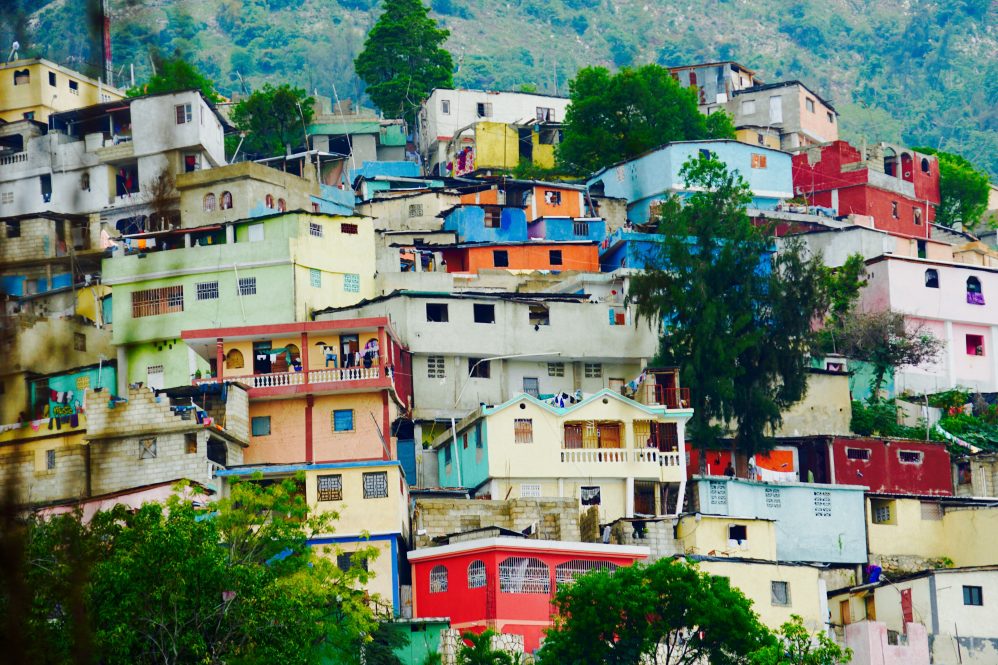
Instead, what he found was “a beehive of activity,” filled with “well-dressed, active people walking the streets and going about their business.”
“Obviously,” he says, “people were working and doing business and building houses without any foreign aid. Neighborhoods were pulling together and rebuilding. And I saw this nowhere in the news coverage I had read. The coverage I had read did not prepare me for what I saw in Haiti.”
He realized quickly that life in Haiti – even after a natural disaster – didn’t align with the US media portrayal of rampant violence and squalor. People were actively organized in rebuilding their own communities, and the cities bustled with vibrant informal economic, social, and political activity.
As he returned to Haiti many times over the next few years (with UConn students in tow), Craemer got curious about how US news coverage had gotten so far off course. Weren’t the American journalists writing about Haiti walking the same streets he was? Couldn’t they see the political complexity playing out in front of them?
Through the media’s lens, Craemer noticed, the very same action – burning tires, for instance – could be interpreted as a bold, nonviolent protest when undertaken by French demonstrators in Paris, and as a symbol of unchecked violence when undertaken by Haitian demonstrators in Port-au-Prince.
This year, Craemer has completed a decade-long research project investigating the stereotypical narratives embedded in US media coverage of Haiti. The 2010 earthquake provided an interesting case study for his work:
“An earthquake is a random event — it has no relevance to ethnic or racial stereotypes,” Craemer says. “So, I was looking whether the coverage of the earthquake was biased in terms of these stereotypes, and I found out that yes, it was quite significantly biased.”
Craemer analyzed American news coverage (newspapers, TV, and radio) spanning six years, looking for six stereotypes about Haitians: “poverty”; “lack of intelligence”; “laziness”; “being unfit for self-government”; “criminality”; and “violence.”
In the aftermath of the 2010 earthquake, he found, a baseline of 66% of references to Haiti in all American news media conformed to these stereotypes; in newspapers, where the bias was most pronounced, the figure was 76%. The newspaper bias ratio increased to roughly 80% in the periods following the assassination of President Jovenel Moïse in 2021 and a period of heightened gang violence in 2022-2024.
A Thorny History
To understand Haiti’s place in present-day American consciousness, turn back a couple centuries: to the Haitian Revolution in 1791-1804. For scholars like Craemer, the Haitian Revolution represents a sea change in global politics – one whose impacts have been historically understudied.
Craemer’s doctoral research focused on implicit and explicit racial biases in the United States, and how these biases influence people’s opinions on race-related policies such as affirmative action and reparations. During this research, he found that all roads were leading him back to the Haitian Revolution.
“I was surprised that I knew so little about it and that it’s so under-emphasized, when it is really an earth-shattering event,” he says.
It was a turning point in the system of transatlantic slavery, which relied on false stereotypes of Black workers as docile, simple-minded, and lazy. Yet in Haiti, over the course of a thirteen-year struggle, this supposedly inferior group demonstrated their political consciousness and military might. This struggle emancipated the nation (and later, arguably, the world) from slavery, and left Haitians vigilant defenders of their hard-won freedom ever since. (For more information on this, Craemer recommends Jean Casimir’s 2020 book The Haitians: A Decolonial History.)
I was surprised that I knew so little about [the Haitian Revolution] and that it’s so under-emphasized, when it is really an earth-shattering event.
The Haitian Revolution exposed the previous stereotypes about Black people as the lies they were.
“The Haitians, as newly liberated captives, defeated the three colonial world empires of the day: the French, the Spanish, and the British,” Craemer says. “And they were successful. They defeated Napoleon 10 years before any European power matched that feat, and they maintained their independence with little means. They were clearly superior, there’s no question. And the only way to deal with this fact was to write them out of history.”
The victory of the newly self-emancipated Haitians caused the slaveholding Western world to scramble. In order to discount the significance of the Haitian Revolution, they had to forcefully revive the stereotypes of Black people as “incompetent” and “unfit for self-government,” and reinterpret Haitian success as inherent “Black violence” and inherent “Black criminality.”
Craemer suggests that at the turn of the nineteenth century, these stereotypes were intentionally perpetuated in US media, as part of a coordinated campaign against the abolition of slavery. At the time, Frederick Douglass said that Americans spoke of Haiti as “a very hell of horrors.”
But the stereotypes were passed down to today’s media.
Craemer remembers one instance where he discovered a rash of articles all repeating the same statistic – a staggering (and untrue) claim that 50% of the women in Port-au-Prince had been subject to rape.
“I traced where that number came from, and it turned out that the original number was from 2004, when paramilitaries attacked Cité Soleil, which is a poor neighborhood, because it had supporters of [the soon-to-be-ousted] President Aristide,” Craemer says. “They attacked the supporters of Aristide, and they used coordinated rape as a weapon. So yes, in Cité Soleil at the time, 50% or more of women were subject to rape, because it was a militarized campaign. That number was later quoted by various journalists, taken out of context as, ‘In poor neighborhoods, 50% of women are raped.’ That makes it appear as though the neighborhood is out of control – as if poverty is leading people to be savages. And later on, it was just generalized as, ‘Haiti is violent.’
“Sloppy fact-checking leads to stereotypical reporting,” Craemer says.
Toward a More Nuanced Portrayal
What can American news-producers and news-consumers do to combat these stereotypes?
The first step is thinking critically about the media narratives we are exposed to – are they simply repeating the same tropes as other sources? Because these stereotypes are so pervasive, they can create an echo chamber of statements that seem true, simply because they are so often repeated.
Secondly, Craemer suggests that we should seek out and emphasize counter-narratives – stories that celebrate positive events taking place in Haiti, rather than portraying the entire country as a monolithic “hell of horrors.”
“There are evil people in every country, and there are good people in every country, but we need to portray them as independent agents of their fate. Haitians have proved this more than any other country in the world,” Craemer says. “We need to take these motives and these interests into account, and treat them in our storytelling as people of flesh and blood.”
A pilot study covering U.S. media coverage in the wake of the earthquake was supported by the Ford Foundation. Updating the research for the years 2020-2024 was made possible by a generous grant of the Haitian American Foundation for Democracy (HAFFD). Craemer extends particular thanks to Ariel Dominique, HAFFD’s executive director, and Amber Lynn Munger of the American Jewish World Service (AJWS) for encouraging and logistically supporting the research. He would not have made their acquaintance without introductions by UConn anthropology professor Samuel Martinez, with whom he collaborated on an extension of the approach to study anti-Haitian stereotypes in daily newspapers in the Dominican Republic. Craemer is also thankful for logistical support from the University of Connecticut.