Learning to read in English is challenging for children because of its partly regular, but also inconsistent, relationship between print and sound. Words like “suede” and “yacht” are difficult to sound out, requiring multiple strategies. While some words are harder than others, a lack of detailed data has limited the guidance that teachers can offer their students.
To better understand these challenges and provide clearer guidance for educators, a new project co-led by Laura Steacy, an associate professor in the UConn Neag School of Education’s Department of Educational Psychology, aims to close this gap. The Developmental English Lexicon Project (d-ELP) is a publicly available database that places nearly 10,000 of the most frequently printed English words for U.S. children on a continuous difficulty scale, paired with detailed word characteristics.
It is the most comprehensive resource to date showing how English-speaking children in first through fifth grade read individual words, and what those patterns reveal about early literacy development. The d-ELP is funded by the National Institutes of Health through a Learning Disabilities Hub grant involving UConn, Florida State University, and Hebrew University of Jerusalem. Steacy has been part of the research team since the project began.

“In the first cycle, we looked at how children navigate English writing from a different angle through the use of small scale experiments,” Steacy says. “That work showed we needed a large resource that placed words on a common scale, leading directly to this project.”
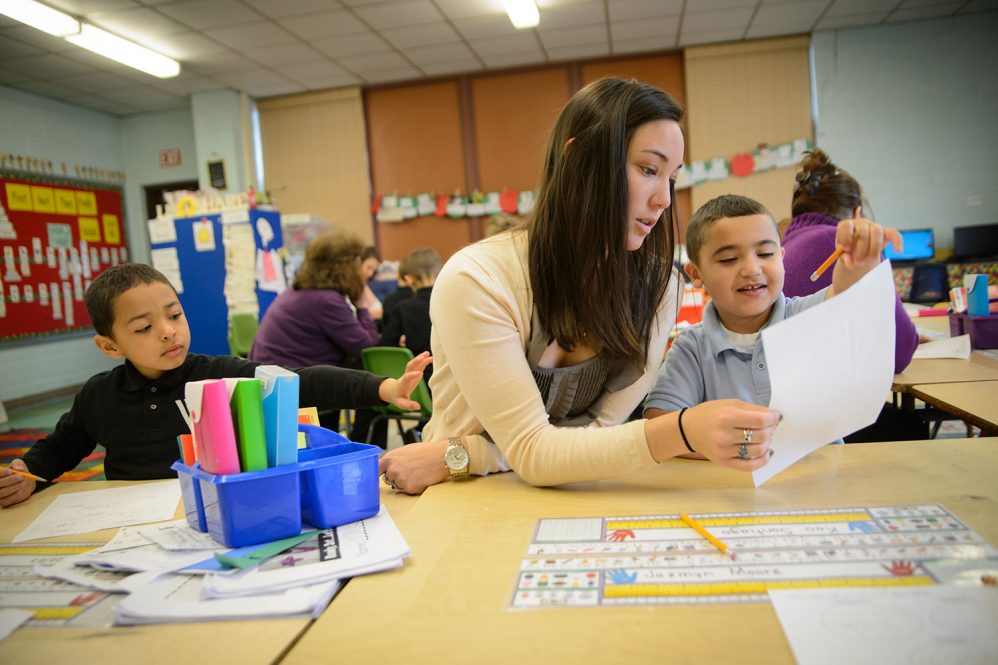
The team collected isolated word-reading data from about 2,000 children in grades one through five at multiple U.S. schools, intentionally including a broad range of reading abilities and oversampling students at risk for reading difficulties, including dyslexia.
“We wanted to capture the full range of reading ability,” Steacy says. “Including both typical and struggling readers is essential for developing effective tools. Working with students in different contexts allowed us to include a diversity of reading profiles.”
A defining feature of the d-ELP is its use of item response theory (IRT) to estimate difficulty for nearly 10,000 words. Because no child could feasibly read every word, researchers designed assessments that included items below, at, and above each student’s reading level, along with a set of linking items read by all children. This design enabled the team to place every word on one difficulty scale, even though students encountered different subsets of the list.
The resulting dataset provides a scientific infrastructure that did not previously exist, allowing researchers and educators to better match reading materials to student needs. For the first time, they can examine how word difficulty varies across thousands of items and how characteristics such as spelling patterns, the meaningful parts of words (such as roots, prefixes, and suffixes), and the complexity of a word’s sound structure predict children’s reading behavior — ultimately guiding more effective literacy instruction.
“English has a lot of inconsistency between print and speech,” Steacy says. “The d-ELP helps us see which words are particularly challenging and why.”
Steacy emphasizes that the project was designed to benefit a wide range of users, including teachers, school leaders, educational publishers, and policymakers. The database is publicly available for noncommercial use, providing all these stakeholders with practical, actionable information to support literacy development.
English has a lot of inconsistency between print and speech. The d-ELP helps us see which words are particularly challenging and why. — Laura Steacy
“We aimed for a user-friendly resource,” she says. “Teachers can select words by difficulty, spelling, or morphology to plan targeted instruction or assessments. It can support students with specific decoding struggles and help teachers design appropriate materials.”
Although Steacy joined the Neag School this fall, UConn has long been connected to the project.
“There was a UConn relationship before I arrived,” she says. “Dr. Jay Rueckl in psychological sciences has been a project co-leader on this grant since its inception. There are many here in the Neag School who are interested in literacy. I’m excited to collaborate and see how others use this resource.”
The d-ELP database and its accompanying research paper — currently under review after being released as a preprint on the Open Science Framework — are now publicly available. Steacy expects the resource to grow as educators, researchers, and other stakeholders begin using it and providing feedback. Future directions include instructional tools and more linguistic features.
“This is an open resource, and we welcome suggestions,” she says. “Expansions may come as people use it, making it more accessible or useful.”
As she continues her first year at UConn, Steacy says that the Neag School is very welcoming and has a long tradition of impactful reading research. She is also energized by the opportunities the d-ELP offers, such as providing teachers with targeted strategies to address word difficulty and support children’s reading progress.
“Understanding what makes words difficult — and how to support children — is essential,” she says. “I hope this project will be a valuable tool for teachers and anyone helping children become confident readers.”