 UConn Health’s expanded palliative care services continue to grow, spanning hospital patients to ambulatory patients, with or without cancer.
Palliative care referrals in the Carole and Ray Neag Comprehensive Cancer Center are up 31% from last year, and 600% since inception in 2017.
Referrals for inpatient palliative care consultations, which started two years ago, are up 35% from last year.
A year ago, Dr. Mary Buss and Dr. Germaine Soliman established an outpatient palliative care clinic for patients dealing with conditions other than cancer. Since opening, it has seen more than 130 patients over nearly 450 visits.
“The data for palliative care is very strong,” Buss says. “People who get palliative care earlier live better. By better, we mean improvement in quality of life and reduction in symptom burden. They tend to avoid using health care as much at the end of life, which, most people, that’s their preference…. And by ‘earlier,’ we mean, ‘outpatient.’”
Palliative care can be provided to anyone at any point in a serious illness. — Sarah Loschiavo
It was Sarah Loschiavo, nursing director of palliative medicine, supportive care and hospice services, who started what today is the Supportive Cancer Services and Palliative Care program in the Neag Comprehensive Cancer Center nine years ago as a team of one palliative care nurse practitioner.
“Palliative care can be provided at any point during a serious illness, regardless of the stage or if the illness is curable, and that’s really important.” Loschiavo says. “Whether the plan is cure into cancer survivorship or improved quality of life during a chronic, progressive disease, palliative care adjusts to the disease trajectory which improves outcomes.”
Today, UConn Health’s palliative care services collectively include two physicians, five nurse practitioners, a registered nurse, a social worker, a chaplain, and a palliative care pharmacist. In 2026, two additional physicians and a nurse practitioner are expected to join the team.
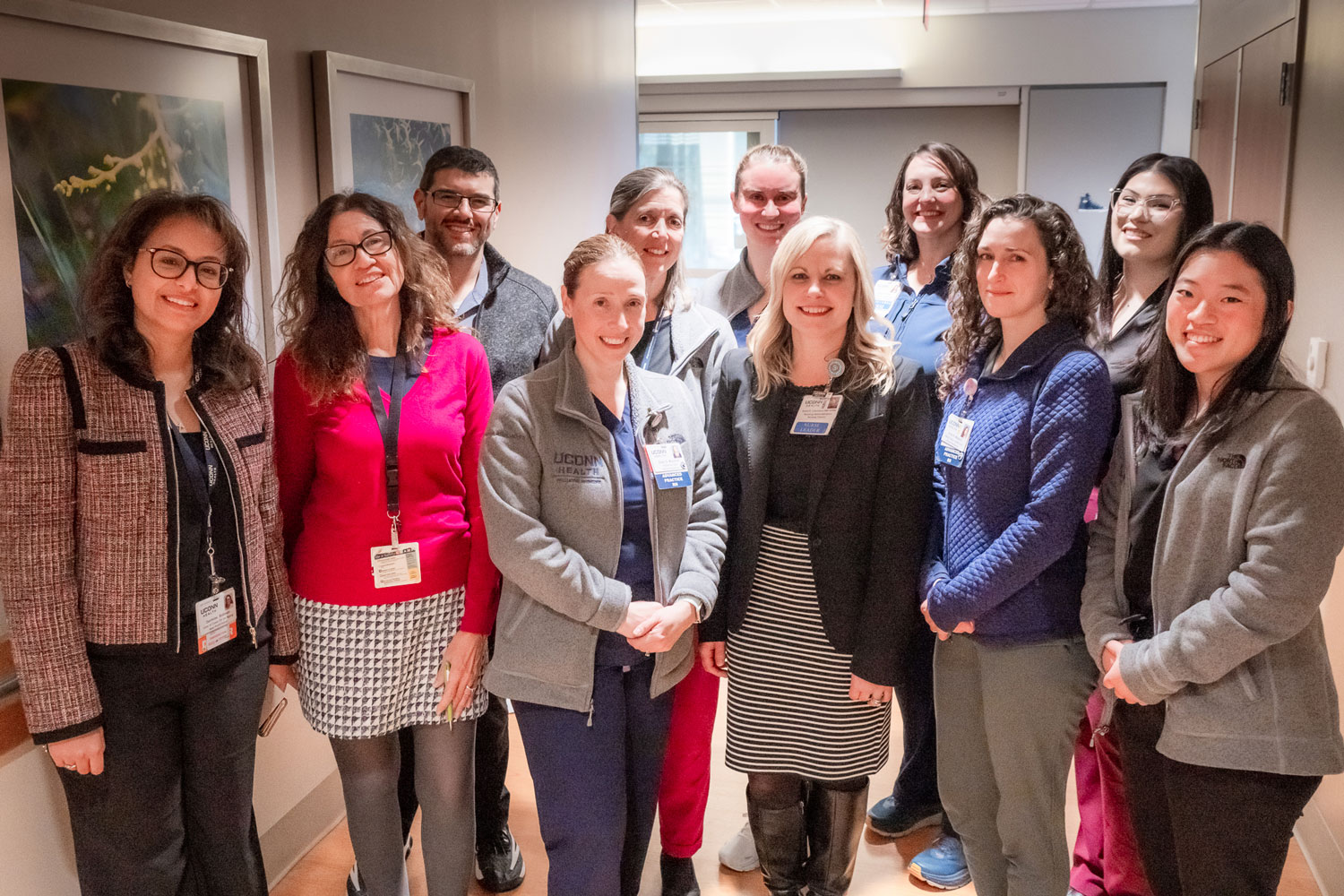
As a group, in addition to patient care, they also make education a priority.
“Because our work intersects with so many disciplines across the institution, the request for our interprofessional team to take on learners is quite high,” Loschiavo says. “We work with medical students, residents, pharmacy residents, nurse practitioner students, and occasionally other students. We’re always eager to share our expertise, and our team is highly skilled at creating meaningful learning experiences that learners can carry forward into their future work.”
While palliative care is associated with hospice, or end-of-life, care, the terms are not interchangeable. Rather, hospice care is a subset of palliative care.
“I sometimes like to think of palliative care as a ‘both and,’ which is distinct from hospice, which is a little bit of an ‘either or,’” Buss says. “The hospice medical benefit is designed primarily for delivery, for care in the home, because patients are too sick to leave the home, and it requires them to limit access to some other types of care. Whereas palliative care, you can continue to get whatever other medical care you choose to have and have palliative care in addition to it.”
“I think it’s really important to dispel the myth that palliative care is exclusively end-of-life care,” Loschiavo says. “Palliative care can be provided to anyone at any point in a serious illness, taking a truly holistic approach by addressing physical, emotional, psychosocial, and spiritual needs and determining how we can best support patients in reaching their goals.”
You’re adding an additional level of support with you to help take care of them. — Dr. Mary Buss
It can be a tough sell to patients.
“They have this preconceived idea of, ‘Somebody else had palliative care and was dead in three days. That’s not me. I don’t need you,” Buss says. “What we’re trying to say is, ‘We’re here to support your quality of life. We’re here to help you live well.’”
In the inpatient setting, palliative care consultations, often in close collaboration with the hospitalists and other specialty teams, have shown to be valuable, particularly when patients are admitted multiple times and they get to know the palliative care specialists.
“Sometimes as a disease progresses, the benefit of having palliative care involved early is that they’re already a trusted part of the medical team, we aren’t just coming in to talk about death and dying,” Loschiavo says. “By the time patients reach that stage, we’ve often spent months having conversations, meeting with the family, getting to know the patient, and building that trusting relationship. That continuity has been critical for our team as well.”
In an outpatient setting, Buss says often when a provider is on board and recommends palliative care, that can help change a reluctant patient’s mind.
“It means you’re adding an additional level of support with you to help take care of them,” she says.
But she admits, providers sometimes can need some convincing too.
“It’s evolving, but there are still a substantial proportion of health care providers who really associate palliative care with end-of-life care; and so if we don’t get consulted until after the decision to do nothing but comfort care, then you perpetuate the idea that palliative care is only end-of-life care,” Buss says. “So we are always searching for partners in other specialties to recognize the value of palliative care in the symptom management piece, in the decision-making piece, so they consult earlier and then can demonstrate to their colleague who is a later adopter, ‘Oh, I didn’t realize palliative care could do that.’”
In addition to cancer, conditions for which palliative care may be appropriate include heart failure, advanced lung disease, end-stage kidney disease, dementia, and even certain traumas. Palliative care specialists also are embedded in UConn Health’s Amyotrophic Lateral Sclerosis (ALS) and Muscular Dystrophy (MD) Program and Parkinson’s Disease and Movement Disorders Center, lending their expertise in symptom management, psychosocial and spiritual support, and medical decision-making.
Beyond the original palliative and supportive care program, which is available to patients in the Neag Comprehensive Cancer Center, any patient who has established care with a UConn Health provider is eligible for referral to outpatient palliative care services. Inpatient palliative care consultations are available to hospitalized patients through their care team.