Since the Korey Stringer Institute (KSI) opened its doors more than 15 years ago, its work has helped countless athletes, laborers, and warfighters stay safe in the heat.
KSI was established in the wake of a lawsuit brought by Kelci Stringer, the widow of Minnesota Vikings offensive lineman Korey Stringer who died from exertional heat stroke during pre-season training in 2001. KSI was founded in partnership with the National Football League and Gatorade.
UConn was a natural home for KSI, housed in the College of Agriculture, Health and Natural Resources, given the established expertise of researchers like Board of Trustees Distinguished Professor Douglas Casa, KSI’s chief executive office and professor of kinesiology. Casa has been at UConn since 1999. He also served as an expert witness in Stringer’s case for eight years, developing a relationship with Kelci Stringer.
“We were trying to expand the momentum that had already been built up at UConn regarding heat research for many years before the founding of KSI,” Casa says. “[With the establishment of KSI] We had this banner now and this greater opportunity. You had this catapult forward with this instant credibility.”
KSI’s work focuses on the three populations most susceptible to heat-related illnesses: athletes, laborers, and warfighters.
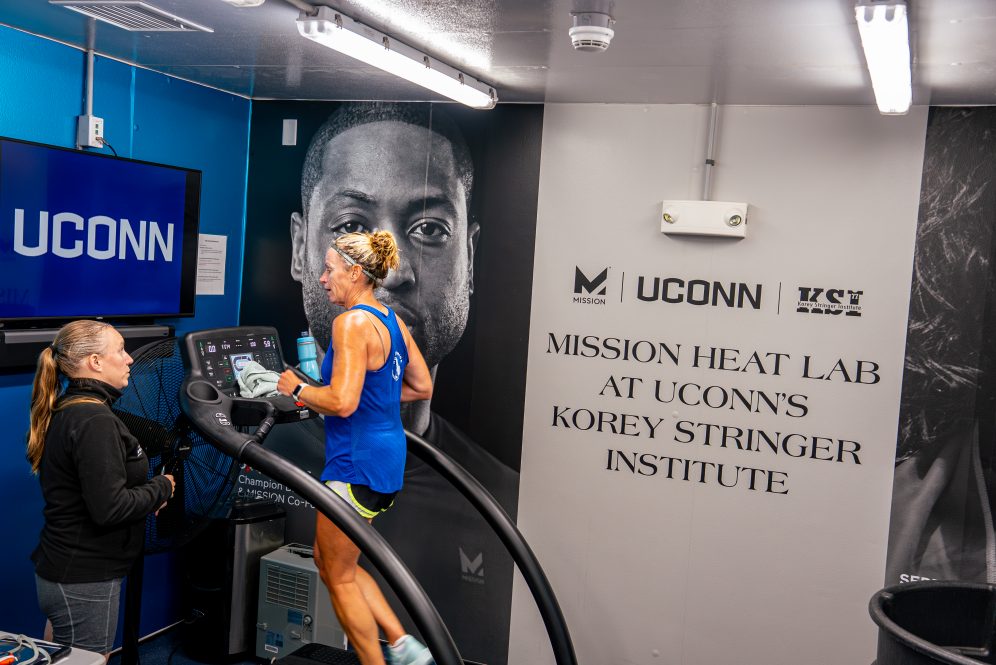
KSI opened the MISSION Heat Lab, its first state-of-the-art heat safety laboratory, in 2017.
We had this banner now and this greater opportunity. You had this catapult forward with this instant credibility. — Douglas Casa
Over the past 15 years, KSI has established itself as a global leader in the prevention, recognition, and treatment of exertional heat stroke. KSI has worked with the NFL, International Olympic Committee, World Athletics, FIFA, U.S. Soccer, the U.S. military, UPS, and Delta Airlines, to name just some of the partners that have sought out its expertise over the years.
In 2010, KSI had just three employees. Now it has over 100 — 30 staff members and 70 volunteers, largely undergraduate researchers.
Existing within a university gives KSI the unique advantage of having access to a pool of talented, committed undergraduates.
“We have this built-in super smart, motivated, passionate workforce,” Casa says. “So, we can get so much more done. You could donate $1,000 to KSI and get $10,000 worth of product.”
KSI has led 150 grants, totaling approximately $34 million in funding. KSI researchers have published more than 300 peer-reviewed papers and given countless presentations over the past 15 years.
Critically, KSI’s work has always included both research and outreach.
“One of the things we’ve really been able to do successfully is pulling together all of the community partners and stakeholders,” says Rebecca Stearns, KSI chief operating officer and associate professor-in-residence of kinesiology.
One key outreach initiative is Team Up for Sports Safety (TUFSS) which was established in 2017. Through TUFSS, KSI staff work with state lawmakers to advocate for policies that keep high school athletes safe. TUFSS is supported by the NFL and National Athletic Trainer’s Association.
To date, TUFSS has helped create or modify more than 460 policies or laws throughout the U.S. focused on improving athlete safety including heat safety and emergency action planning.
Cassandra Snow is an athletic trainer at St. Paul’s School in Concord, New Hampshire. New Hampshire legislators crafted preventative policies to keep student athletes safe and healthy.
“KSI leaders were instrumental in catalyzing this progress and providing state leaders and stakeholders with the resources needed to manifest changes to prevent nearly all sudden death in secondary school athletes in the United States,” Snow says. “In New Hampshire, leaders used the information provided by KSI through the TUFSS initiative to draft a bill that was later passed into law and is currently the most comprehensive athletic health and safety policy known.”
The program is now moving into the TUFSS 2.0 phase, which will focus on implementing these policies.
“The unique thing about KSI that I love is that we’re not only the charity and nonprofit, we are a team of experts in the topic area and the scientists that are doing the research. We take the initial research idea and the question that needs to be answered through every stage – from publishing it, presenting it, educating on it, to getting the actual interventions applied and executed for the end users,” Stearns says.
Through innovATe (Improving Needed Nationwide Opportunities & Value of Athletic Trainer Employment) KSI provides school districts across the country with funding, provided by the Education Fund established as part of the NFL Concussion Litigation settlement, to hire athletic trainers, who play a key role in preventing, responding to, and helping athletes recover from injuries. The program has supported more than a dozen districts around the country.
KSI has forged the same kind of connections between research and outreach in its work on labor. They have partnered with companies and work with state and federal policymakers to support evidence-based labor safety measures.
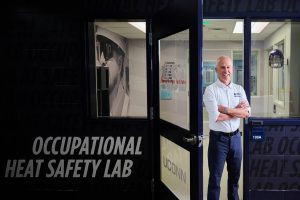
KSI recently opened a second state-of-the-art heat safety laboratory that will focus on laborer safety in Gampel Pavilion. The National Laboratory for Occupational Heat Safety at UConn’s Korey Stringer Institute Powered by Magid & MISSION will also allow KSI to extend into altitude research.
KSI is expanding its work in the wearable technologies space as well, especially those that evaluate hydration status and body temperature. KSI researchers are evaluating products designed to improve safety and performance in the heat in collaboration with industry partners.
KSI has worked on 18 Department of Defense grants, focused on keeping warfighters safe in the line of duty.
“That’s an example of research done in our environmental laboratory, while at the same time we were out, boots on the ground, at America’s largest bases,” Casa says.
In 2025, KSI opened a satellite facility at the University of North Florida in Jacksonville. This new lab will allow KSI researchers to study populations that live in hot, humid conditions every day.
“We need laborers, athletes, and soldiers who are in the heat all day, every day” Casa says. “The physical stresses are very different when you are doing intense activity in the heat most days of the year.”