Connecticut gets snow in the winter, but that’s about it for bad weather.
Right?
It’s an enduring myth about the Nutmeg State, one that doesn’t hold true in a time of global climate change and increasingly intense weather events.
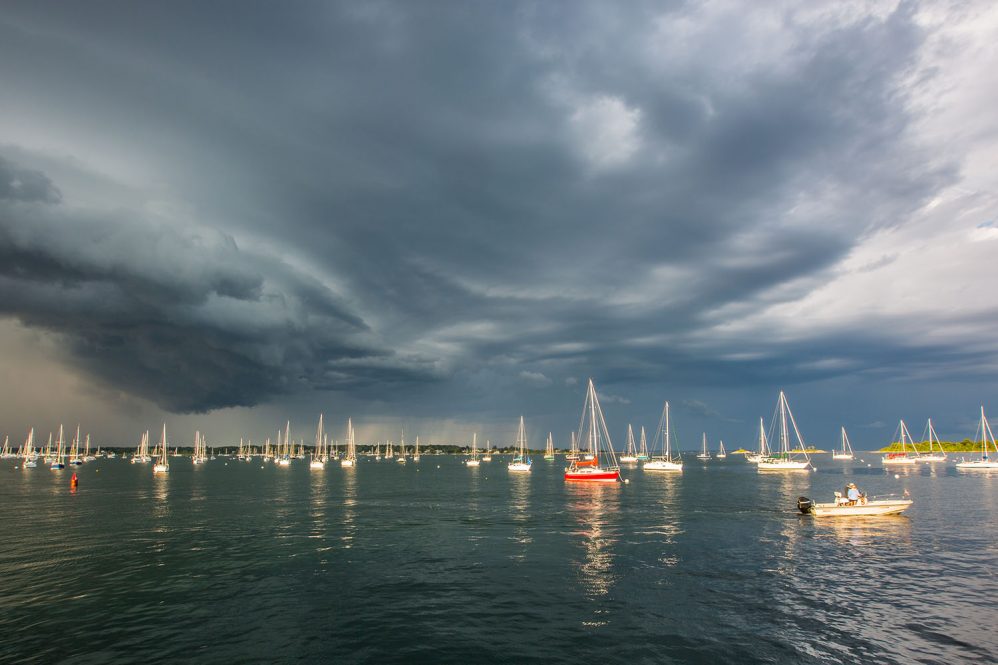
Sure, the state has experienced hurricanes over the years, but now when they strike the Connecticut coastline, flood risks are greater. The damage can be severe. Tropical Storm Isaias dropped 8,800 trees onto powerlines across the state in 2021, knocking out electricity to 750,000 customers, some for more than a week.
And though a tropical storm surge directly impacts the shore, inland communities aren’t immune from impact. Extreme rainfall in 2024 devastated the town of Oxford, washing out roadways, flooding homes, and causing two deaths as the region received 10 inches of rain in 24 hours, according to the National Weather Service.
Tornadoes seem more common now. The state has recorded more than a dozen touchdowns in municipalities across the state – from Sharon to Somers to Stonington – since 2020 alone.
And every new year seems to bring a new risk of drought. With drought comes fire, and what once seemed like a crisis just for California now hits home here as well, with the state experiencing record wildfire activity in 2024 – 605 fires burning more than 500 acres, according to the Department of Energy and Environmental Protection.
The economic and personal cost of these extreme weather events is well-documented, but people are busy and news moves fast.
It’s easy to forget what happened last year or five years ago, and it’s even easier to fall back on those good ol’ Yankee stereotypes: New Englanders are hardy. People in Connecticut are independent.
And if there’s a weather emergency? Well, we know how to take care of ourselves.
Right?
“Connecticut is not a state that gets much attention when it comes to climate change and weather extremes,” says Eleanor Shoreman-Ouimet, an assistant professor of environment and human interactions with UConn’s Department of Anthropology and associate director of UConn’s Institute of Environment and Energy (IoEE).
“We’re seen from afar as a state where, ok, you get snow, but that’s pretty much it,” Shoreman-Ouimet says. “You’re not having massive forest fires. You’re not dealing with all the repercussions of things that we’re accustomed to hearing about around the world. And our averages, socioeconomically, look really good, right?”
Wrong.
Steady Habits
The reality – as most Connecticut residents, elected officials, town managers, and emergency management directors know well – is that Connecticut is a state where wealth often resides just a few miles away from poverty, and where many cities and towns have both ends of the spectrum within their own, individual borders.
“Connecticut is one of only three states in the United States that doesn’t have county-level governance,” says Shoreman-Ouimet. “Instead of having county-level seats that dictate how we allocate resources to towns, each town is dependent upon its own tax base to support social services. And so, we have drastic differences from one town to another in terms of things like food banks. Do you have child advocates? Do you have a paid emergency management director?
“Usually, when it comes to smaller, rural communities in Connecticut, the answer is ‘no.’”
For more than eight years, Shoreman-Ouimet and a multidisciplinary team at UConn have been examining extreme weather preparedness in Connecticut as well as the extent to which the state was equipped to meet the needs of its diverse populations as weather impacts continue to evolve.
Supported by a grant from the College of Liberal Arts and Sciences, the Designing Interdisciplinary Science And Strategies To Enhance Resilience, or DISASTER, research team includes anthropologists, communication researchers, engineers, geographers, and geoscientists conducting in-depth, ethnographic examinations of the state’s preparedness disparity, social vulnerability metrics, infrastructure, and perceptions of risk and support.
Their research, explains Shoreman-Ouimet, took a lot of lessons from the 2011 nuclear disaster in Fukushima, Japan.
“So much of what we learned in Japan really was about communication and, from an anthropological perspective, about understanding the motivation for action,” she says. “How do communities or a state government motivate change or eliminate the apathy of thinking, well, it is what it is and it’s fine? How do you alert to the fact that, no, things are not necessarily the way they’ve always been, and we’re going to have to take new steps and listen to instructions as to how to prepare and how to stay safe?”
It’s not an easy task, especially in the Land of Steady Habits.
To fully understand the landscape, the research team conducted surveys and interviews with emergency managers and other stakeholders in Connecticut communities. They confirmed that, especially in smaller and more rural areas of the state, emergency management and first responders largely operate on a volunteer basis.
“They’re almost exclusively white males above the age of 65,” says Shoreman-Ouimet. “And from an anthropological point of view, when we start looking at this as part and parcel of a global phenomenon where volunteerism and civic engagement in general are going way down, this has a really big impact.”
Add the lack of help and an aging volunteer population to limited and disparate sources of funding, and many communities are left with a perfect storm for problems when it comes to preparedness for major weather events.
Beyond First Alerts
Since launching their efforts, the researchers have published papers detailing their findings on how environmental, infrastructural, socioeconomic, and racial inequities are at the root of disparities in information sufficiency, self-identified preparedness, risk awareness, and trust.
“What you hear is a good number of residents saying, ‘I think it’s fine,’” says Shoreman-Ouimet, “but when we started to look at who’s not fine, across the board it is residents of color and it is low-income residents who were saying, ‘We know we don’t have enough information.’”
In their most recently published study, research team member Kenneth Lachlan – the head of the Department of Communication in the College of Liberal Arts and Sciences and an expert in crisis communications – looked closer at several communities in the eastern areas of the state and surveyed residents to learn more about how they received information during weather emergencies.
“We started thinking about subsample studies, and looking at smaller geographic areas that might experience different vulnerabilities than others, to see if processes played out differently,” Lachlan says.
The researchers surveyed 519 people from four different U.S. Census tracts known to experience social and structural vulnerabilities.
“We knew from some geospatial data that parts of southeast Connecticut and the eastern half of the state might be especially flood prone, particularly along the coast and along the Connecticut and Thames River valleys,” Lachlan explains. “We decided to look at what that might mean for flood vulnerability and vulnerability to extreme weather, in general, and we also knew that there were some towns in eastern Connecticut that might have infrastructure or social inequity concerns that may play a role in vulnerability and emergency response. So, it seemed like a good place to test this idea.”
They found that residents’ perceptions of information sufficiency and preparedness varied greatly depending on where they lived. Two of the tracts examined represented extremes – one where people felt extremely confident in their preparedness and one where they did not – but two in the middle indicated more malleability in their opinions, according to Lachlan.
“People who are relatively comfortable and people who I presume are very uncomfortable with their level of vulnerability seem fairly set in their ways attitudinally,” he notes, “and it’s that place in between that seems to be moving a little bit depending on what sources you gravitate toward or how you think about the first responders and emergency managers in your area.”
Older populations and those in lower socioeconomic areas expressed feeling more vulnerable, as well as people who were more reliant on traditional media as a source of information.
“People across the board are relying on electronic sources for first alerts, for initial warnings, and then when they’re adequately motivated, they go toward traditional media for updated information, for specific details, for recommendations on mitigation and evacuation,” says Lachlan.
While the relatively small sample and unique geographic characteristics at play in the study might not lend itself to more general extrapolations about other communities, especially those outside Connecticut, what the study does imply is that, for local first responders, getting information out to those who need it may require more tailored approaches, depending on what communities might be most impacted.
“As crisis communication practitioners, we’ve gotten away from the notion that if I send out an EMS message, everyone should be ok,” Lachlan explains, “and we’ve moved toward understanding what specific strains and stresses and resource-challenges people have so that we can best meet them where they are. And this was an initial effort at trying to get at some of those factors.”
The researchers are now just wrapping up a similar study in western portions of the state.
Don’t Hold Water
The goal of the research team’s work is to engage communities and stakeholders, identify and understand what the gaps in information and preparedness are in varying communities around the state, and draw attention to those issues while helping to devise solutions that can be implemented – ideally before Connecticut faces another severe weather emergency.
In addition to their research, Shoreman-Ouimet and Lachlan are engaged in a project supported by the National Oceanic and Atmospheric Administration that aims to improve preparedness for aging communities in three Connecticut coastline towns.
The group is working to develop solutions for emergency management directors in rural, low-income, and marginalized communities, which historically have suffered longer power outages during severe weather events and are less likely to have the personnel and power infrastructure to prepare in advance for and respond to severe weather events.
“When we’re talking to different residents and getting the data back from different residents, the marginalized communities, communities of color, low-income, and rural community members – they’re saying that they have a pretty good grasp of the fact that they need to be able to fend for themselves for a certain amount of time, because the situation’s pretty dire,” says Shoreman-Ouimet. “On the opposite side, you see an overconfidence and over-assurance amongst wealthier white community members who think, oh, everything’s fine, everything’s always been fine.”
Shoreman-Ouimet is also engaging students at UConn to work on solutions to the dilemma many communities face as aging volunteers step aside from local service, taking with them a wealth of institutional knowledge while leaving a leadership gap in the community.
It’s all work that isn’t likely to end anytime soon, according to Shoreman-Ouimet, as climate change continues to progress and extreme weather events continue to impact Connecticut.
“This work is a product of long-term research really looking at what the situation is on the ground in Connecticut – a situation that doesn’t get the policy attention that it needs and is reliant and continues to run on an outdated system of preparedness that assumes privilege, assumes an independence of its residents to just sort of handle things themselves, and assumes that we don’t face a lot of climate risk,” says Shoreman-Ouimet.
“And those three assumptions don’t hold water anymore in an increasingly socioeconomically disparate state – as well as one that’s really facing a rapid increase in heat, in sea level rise, in hurricane activity, in snowfall, in drought, and in forest fires.”