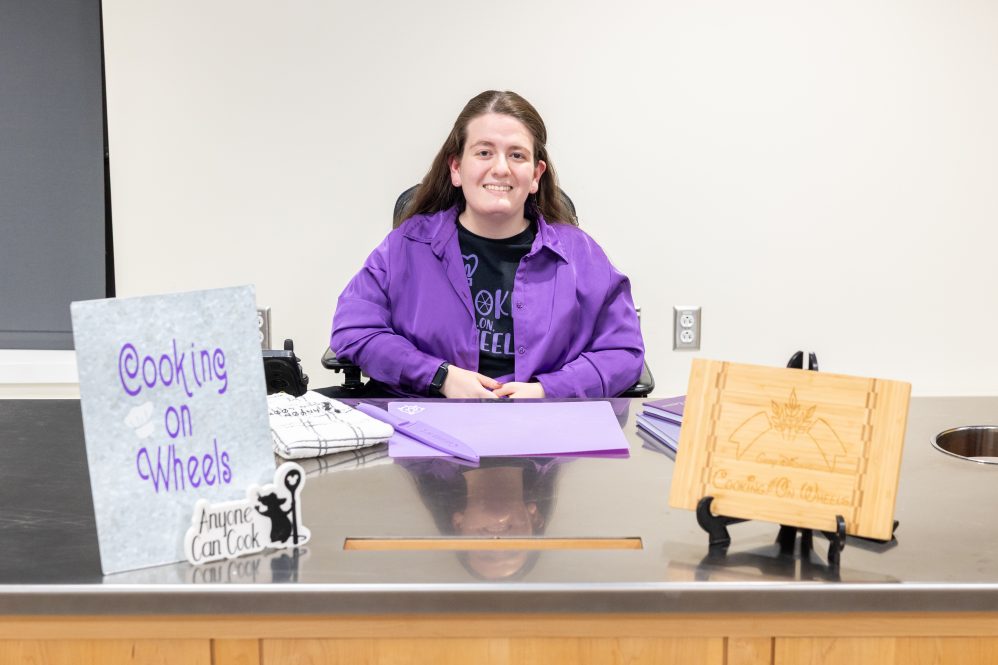
There’s no doubt that purple is Gabriella DiSalvo’s favorite color. When the UConn senior enters a room, she always has some shade with her, whether purple clothing, purple hair clip, purple manicure, purple jewelry, or purple purse.
She’s the self-described “girl in the purple wheelchair,” from a manual chair with violet wheels to a motorized chair with a purple-blue power base.
So, five years ago when DiSalvo ’26 (CLAS) started to develop her personal brand Cooking on Wheels, she didn’t think twice about the signature color she’d use to tell her story of cooking and food, advocacy and adaptation. Purple was it.
What she didn’t realize five years ago was that purple has long been associated with the disability community and advocacy for the 1.3 billion people, or 16% of the world’s population, who the World Health Organization identifies as disabled.
“It’s a good thing I chose purple,” she says.
And much as purple is the combined product of the colors red and blue, so too is DiSalvo’s individualized major at UConn, one that’s blended a courseload of journalism, communications, entrepreneurship, and other classes to form disabilities studies in media and food culture.
The ultimate goal from that plan of study? Her own cooking show, one that demonstrates the kitchen is welcoming to anyone.
A Longtime Foodie Just Passing the Time
Cooking on Wheels came to be during the pandemic lockdown of spring 2020, when the then-16-year-old from Staten Island, New York, who goes by Gabby, was bored one day and moseyed into the kitchen.
“I had been thinking even before May that year that I would love to share my life experiences with the world, I just didn’t know how,” DiSalvo says. “I’m a wheelchair user and once thought the kitchen was not an accessible place for me. But during COVID, I started cooking to pass the time. I really fell in love with it and learned quickly that the kitchen is an accessible place. It just may take some adapting and some unique and creative ways of thinking.”
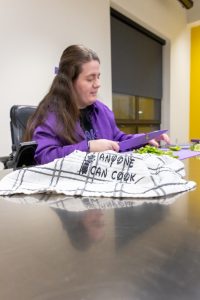
DiSalvo admits that one night – OK, very early one morning around 3 a.m. when she couldn’t sleep – she was scrolling on her phone and decided to set up a webpage to share her story. The name Cooking on Wheels just came to her, she says: “I cook. I’m on wheels. I can do anything with this.”
She started logging recipes, sharing adaptive cooking techniques, and relating her life experiences as a then high schooler, current college student, and very soon working woman.
“My parents say I was a food critic even at 4 years old,” she says. “I would go to a restaurant and get offended if the waiter or waitress handed me a kid’s menu. I wanted the good food on the adult’s menu, not the chicken fingers and French fries.”
With a father of Italian descent, meals of chicken Parmigiana and pasta e fagioli were often on the menu at home. With a mother born in Argentina, empanadas and tartas were just as common. The family’s palate was expansive.
But DiSalvo says that while she’s always loved food, cooking wasn’t always a favorite activity. Sometimes she’d help, but frankly, it wore her out – and still does.
A Personalized Blend Just for Her
“I was born with a rare neuromuscular condition called myofibrillar myopathy. In super simple terms, it’s a low-muscle tone condition that affects my whole body. Basically, my muscles are a lot weaker than the average person’s. It’s not really possible, or at least it’s much harder, for me to build muscle than it is for a nondisabled person,” DiSalvo says.
That’s one reason, she notes, why she didn’t seriously consider culinary school as a post-secondary school option. Mixing, beating, lifting, rolling, stirring – a chef’s job is physical.
DiSalvo says she can’t work back-to-back days in Connecticut Dining Hall, where she’s learning her practical skills, because she needs at least a day in between to recuperate. Plus, she never had an interest in becoming a full-blown chef or restauranteur.
She always wanted to build out Cooking on Wheels, use it as a platform for advocacy and a way to teach others like her that making something like zucchini boats or a broccoli and cheddar quiche is possible.
“Also, because my condition is so rare, we don’t necessarily know what the future will hold for me physically,” she says, noting that when she was diagnosed there were only three other children in the world born with the condition. “I needed something that gave me a little wiggle room and versatility.”
On college tours during her last couple years of high school, DiSalvo says she learned that some schools offer individualized majors, places where students can blend a little bit of this and a little bit of that to serve up a major specific to them.
Disability studies needed to be at the heart of her major, she says, adding that communications and media also needed to be large parts. Journalism classes in the College of Liberal Arts and Sciences have taught her about television and how to be in front of a camera.
The food culture part of the major has been more difficult to fit, she says, since nutritional sciences focuses on the scientific aspect of food and isn’t exactly what she was looking for. But classes like Sociology of Food have filled in the gaps, along with her work with Dining Services.
Without a disability studies major at UConn, DiSalvo has taken a bevy of classes in Women’s, Gender, and Sexuality Studies like Feminist Disability Studies and Women and Gender in the Deaf World. She’s also finished three semesters of American Sign Language courses.
Then there’s her minor in the School of Business: personal branding entrepreneurship.
“I always say these are my Cooking on Wheels classes because that’s where I really get to focus on it the entire time,” she says.
Because, remember: her goal is her own cooking show.
A Pivot Point with Rachael Ray
In October 2019, an adolescent DiSalvo went to her first New York City Wine and Food Festival to sample, yes, but also to hob-knob with other foodies. Through that, her contact information got on the right email distribution list.
A year later, as an ongoing fundraiser to help with pandemic hardships, the festival advertised the opportunity to take online classes with various celebrity chefs, she explains. Participants would get a list of ingredients and meeting link and cook alongside their favorite culinary creator.
To fill time, help a good cause, indulge a burgeoning hobby, and publicize Cooking on Wheels, DiSalvo signed up for a few, many with self-taught cook Rachael Ray, and in the chat regularly solicited advice for someone getting into the industry.
After enough times asking and receiving live answers from the host, DiSalvo says of Ray, “eventually, she remembered my name, and on-air told her husband, John, to write my name down. I lost my mind just from that.”
A week later, Ray’s assistant contacted her about appearing on the 2,500th episode of Ray’s show. They’ve been in touch since, with a follow-up appearance three years later.
And DiSalvo says she uses the advice that Ray offered during one of those early virtual lessons – preparation, preparation, preparation – especially in the filming of UCTV episodes of Cooking on Wheels.
All her cooking supplies – the purple knives and cutting boards – are stored in plastic bins in DiSalvo’s dorm room, one bin kept intentionally empty. In it, she decants only what she needs for the taping of that particular UCTV show, filmed in the demonstration kitchen adjacent to Putnam Dining Hall.
She aims for two or three episodes a semester.
“I have to walk through the whole recipe in my head,” she says. “‘OK, I’m going to have it presented on this platter. I’m going to have the ingredients on this tray and in these bowls,’ things like that.”
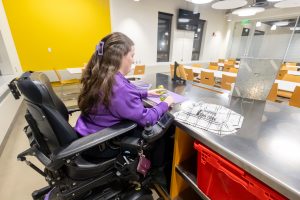
Her cache of cookware includes items like lightweight knives with plastic handles, plastic bowls and cutting boards, and a hot plate that can be used on a table rather than a too-tall stovetop.
At home, after DiSalvo’s been in the kitchen cooking, she says her mom playfully complains that only the tops to the plastic containers remain in the cabinet, all the bases in the dishwasher dirty from that day’s meal prep, since DiSalvo doesn’t use metal or glass bowls due to their weight.
DiSalvo says she doesn’t have an accessible kitchen back home but has learned to make it work. She raises her power wheelchair and adjusts the seat so she can reach the countertops. Oftentimes, she’ll lift the footplate and put her feet on the floor, so her knees are out of the way.
When she dices or juliennes, she says she does one chunk of fruit or vegetable at a time, instead of stacking a few pieces together, and goes slowly with a sharp knife. She can’t manipulate her hand into the claw shape culinary experts use, so she’s improvised and sometimes puts on a knife guard to protect her knuckles.
An Overflowing Platter of Cookies and Thanks
Adaptations like that aren’t a deterrent, she says, describing herself as stubborn and wanting to do as much as possible by herself and for herself. At home over the holiday break, this means assembling an overflowing platter of Christmas cookies.
While she doesn’t much like baking, Christmas cookies are the exception, DiSalvo says, explaining that she’ll make pignoli cookies, lemon ricotta cookies, and a sugar cookie of some kind, maybe peppermint sugar.
Last year, she experimented with an espresso martini cookie; this year, she might perfect it. And there will be two kinds of seven-layer cookies, one with jelly and one without because she’s not a fan. There also might be a pink and green cookie in honor of Glinda and Elphaba.
DiSalvo says UConn has taught her what she needs to grow Cooking on Wheels from a small blog for friends and family to a ground-breaking venture.
“Who knows? Cooking on Wheels may turn into more of a business selling adaptive cookware. The entrepreneurship possibilities are wide ranging,” she says. “Coming into UConn, I was set on one very specific idea of wanting a cooking show, but through my major I see it can go down so many different paths.”
Outside the classroom, she credits UConn with helping her grow as a person.
The last four years have been her first extended time away from home by herself – her parents a four-hour ride away, her twin brother in school all the way in Tennessee, and herself in an unfamiliar state and locale.
“I pretty much have to adapt to almost every space that I’m in, and, of course, with UConn’s help – the Center for Students with Disabilities and Res Life – we’re able to work it out. But at the end of the day, it comes down to me adapting and having that resilience,” she says.
“In that way, UConn has set me up for the future, teaching me how to adapt in the physical world, whether that’s a job scenario or in a personal situation,” she adds. “Being in college and being at UConn especially has taught me to do those things.”