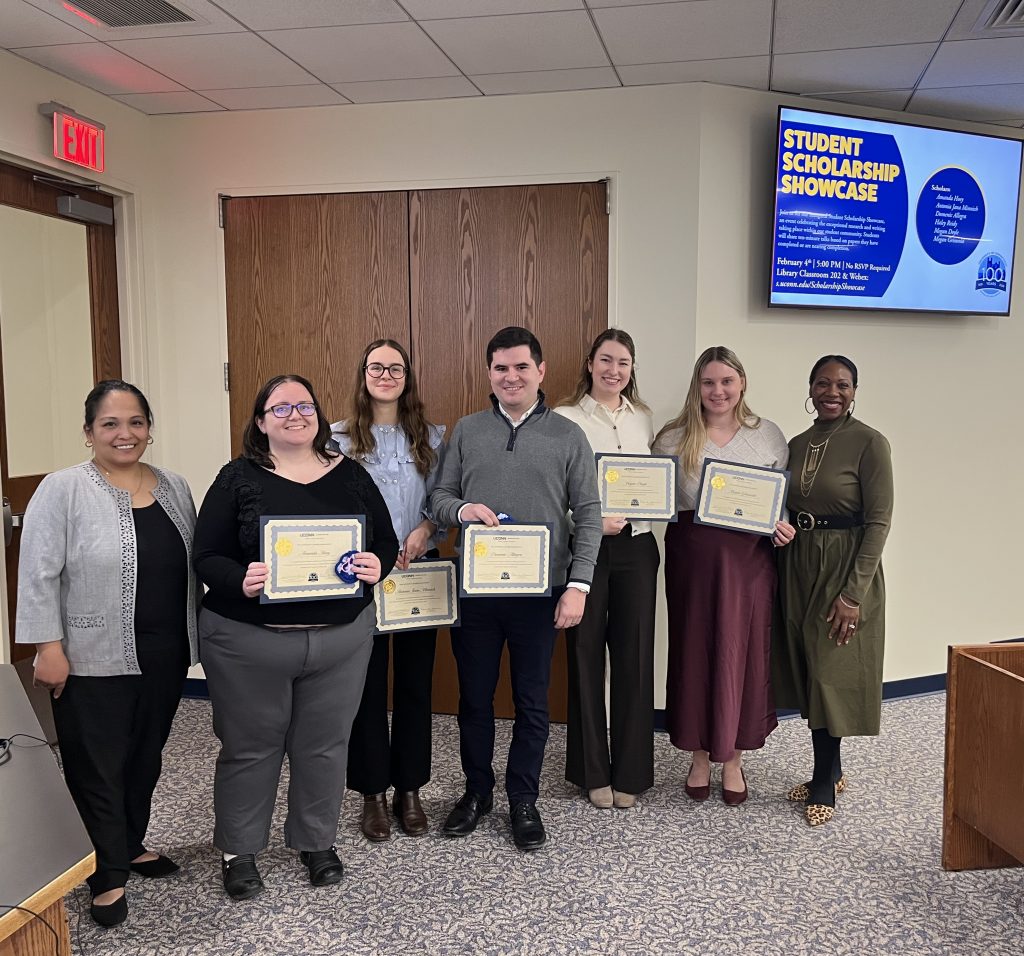
UConn School of Law celebrated outstanding student research at its inaugural Student Scholarship Showcase on February 4. Six students delivered ten‑minute presentations based on papers they have completed or are nearing completion, offering insights into timely legal and policy issues. The event highlighted the depth of student scholarship at UConn Law.
“I am definitely a proud dean when I think about the many ways that our incredible students contribute to our community,” Dean Eboni S. Nelson told the audience. “Tonight’s event showcases our students’ contributions to our scholarly community. It’s a wonderful and enriching opportunity for them to share their scholarship with all of us and for them to gain invaluable experience in presenting and communicating.”
The Showcase also served as a kickoff for the UConn Law Library Centennial, a celebration of 100 years of supporting legal research, education, and service.
Congratulations to the following student presenters: Domenic Allegra, Megan Doyle, Megan Griswold, Amanda Hoey, Antonia Minnich, and Haley Reidy.
Domenic Allegra
“Open the Courthouse Doors, HAL: The Ethics of Judicial AI Use”
Domenic Allegra examined the ethical implications of judges using artificial intelligence, particularly large language models, in legal interpretation. Focusing on a concurring opinion by Judge Kevin Newsom of the Eleventh Circuit, Allegra explained how AI was used to help define a contractual term and why this raises ethical concerns. The core issue lies in the distinction between use of AI for “legislative facts” and its use for “adjudicative facts.”
Allegra concluded that while AI can appropriately supplement judicial reasoning in limited contexts, clearer ethical guidelines and judicial education are needed to define acceptable use.
Megan Doyle
“The Aftermath of the Supreme Court’s Purdue Pharma Decision”
Megan Doyle analyzed the Supreme Court’s decision in the Purdue Pharma bankruptcy, which held that nonconsensual, non‑debtor releases are impermissible under the Bankruptcy Code, resolving a longstanding circuit split. Doyle discussed how the ruling directly affected Purdue’s proposed Chapter 11 plan, in which members of the Sackler family sought broad liability releases in exchange for contributing personal funds to the bankruptcy estate, despite having withdrawn substantial assets prior to bankruptcy.
Doyle argued that congressional action is necessary to provide clarity and balance accountability, compensation, and the viability of mass‑tort bankruptcy resolutions.
Megan Griswold
“The Lack of Guardians Ad Litem: A Call to Action”
Megan Griswold discussed the role and effectiveness of guardians ad litem (GALs) in high‑conflict divorce and custody cases, focusing on the lack of empirical research evaluating whether they meaningfully serve children’s best interests. While GALs are widely used and often influential in judicial decision‑making, Griswold noted that fewer than ten accessible studies exist, many of them decades old, leaving significant gaps in understanding their actual impact on case outcomes and child well‑being.
Griswold called for more rigorous, replicable research to determine whether GAL involvement leads to more protective, child‑focused judicial orders or merely adds expense without measurable benefit.
Amanda Hoey
“A Path Forward for Police Unions and Reforms: Lessons from Teachers Unions”
Amanda Hoey made the case that abolishing police unions, despite criticism of their role in shielding misconduct, could harm the broader labor movement without addressing the real drivers of police violence. Citing Camden, New Jersey, Hoey noted that reforms celebrated there relied on dismantling union protections, a strategy that historically leads to broader attacks on public‑sector unions. The presentation proposed following the example of teachers’ unions, which rebuilt public trust by aligning labor goals with community needs.
Antonia Minnich
“Feminist Perspectives in Climate Litigation: An Analysis through the Case of the Klimaseniorinnen vs. Switzerland before the European Court of Human Rights”
Antonia Minnich examined feminist perspectives in climate litigation through the landmark Klimaseniorinnen v. Switzerland case before the European Court of Human Rights, in which elderly Swiss women successfully argued that inadequate climate action violated their human rights. Minnich found that although the court acknowledged gender‑ and age‑based evidence, it treated these factors as purely evidentiary rather than legally relevant, concluding that incorporating intersectional, gender‑responsive perspectives would strengthen both climate policy and litigation.
Haley Reidy
“Joint Analysis of Cannabis Law: Domestic and International”
Haley Reidy compared U.S. cannabis law with international approaches, arguing that federal legalization, or at least rescheduling, is needed to resolve the gap between federal prohibition and widespread state‑level reform. Case studies from France, Germany, the Netherlands, and Thailand illustrated how different regulatory models shape access and safety. Reidy concluded that legalization must be paired with comprehensive federal regulation to ensure safety, consistency, and long‑term stability.
Together, the six presentations showcased the breadth of student inquiry at UConn School of Law, reflecting a community deeply engaged with today’s most pressing legal and policy questions.