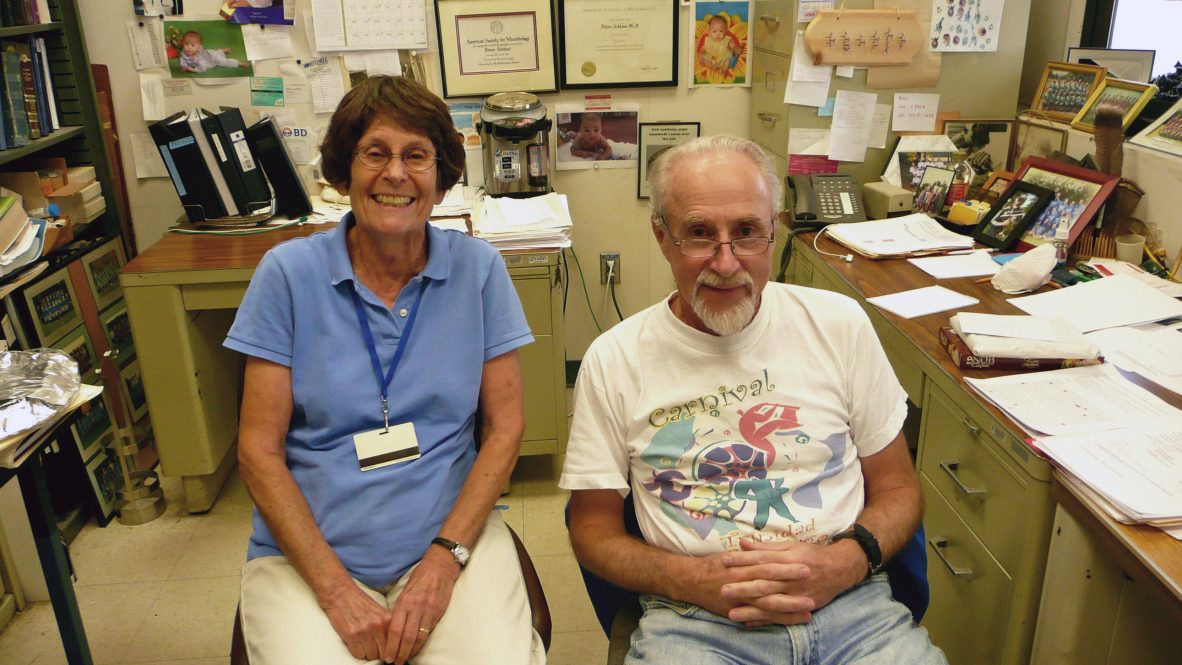
It was the summer of 1971 when Barbara and Peter Setlow arrived in Farmington, Connecticut to “climb the golden stairs” of science as UConn Health biochemistry researchers. The setting for this path to greatness was at the bottom of a hill: a cluster of prefabricated steel structures known as the Butler buildings, supplemented by semitrailers that would serve as Peter’s laboratory space.
At that point, the UConn School of Medicine hadn’t yet graduated its first class, and the UConn Health Center building was still under construction on land that had only recently been an orchard. “You could walk outside and look up the hill and see this new building,” said Peter in a past UConn Today interview. “The shell was all there. There was something up there; it was hope for the future.”
That day, just about 55 years ago, Peter and Barbara unloaded their packed-to-the-hilt Volkswagen Beetle after a cross-country odyssey from California. Barbara, pregnant with their first child, had battled morning sickness the whole way. At the time, they didn’t imagine that they’d remain for every step of UConn Health’s development, with Peter eventually becoming its longest-serving employee and both contributing their scientific minds to its rise as a major health center. Now, they’ve ensured their legacy sustains UConn Health in perpetuity through a recent gift.
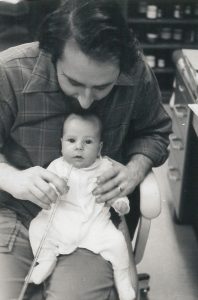
That first year, Peter set up his trailer-laboratory and Barbara conducted research for the biochemistry department chair until she couldn’t fit her pregnant belly between lab benches. They got through their first winter, Peter’s quest to pursue serious science punctuated by frozen pipes and hurried treks across the makeshift campus in biting cold to retrieve equipment. Barbara gave birth to their son, Barry, in January.
Barbara and Peter had already demonstrated significant promise as scientists, having completed doctoral degrees in biochemistry from Brandeis University and postdoctoral training at Stanford Medical School, Barbara achieving this at a time when few women dreamed of doing so.
Barbara stayed home for the next three-plus years, taking care of Barry and then their second child, Jennifer. When she was ready for a change, Peter suggested she work in his lab, and they created a carefully coordinated arrangement to enable her return to work: he managed mornings with the children while she began her days early in the lab and took over again later in the day.
Barbara dove back into her career as a driving force of the Setlow lab, which had by that point graduated from its trailer to the new UConn Health building. The lab’s work focused on bacterial spores, some of which cause food spoilage and dangerous human diseases like anthrax, and whose qualities made them of keen interest to the defense and food industries.
“She had five publications in her first month in my lab,” says Peter in a recent UConn Foundation interview. “Five. Five would be great for assistant professors in a year. She was really talented.” He attributed her success to technical expertise, editing and organizational skills, and capacity to design strong experiments, take precise measurements and notes, and pay close attention.
Some of her work from that year opened lines of inquiry still being explored today. At the same time, Barbara discovered a gift for mentoring and teaching young scientists, helping dozens of students secure their first publications. In these one-on-one connections with the diverse group of undergraduate, graduate, international, high school, postdoctoral, and visiting trainees who made up the Setlow lab, she was “kind and calm, took her time, and didn’t rattle easily,” according to Peter.
The Setlows divided and conquered lab tasks and “talked shop” over the dinner table each night — an amiable rapport that rarely faltered.
“Her experiments were set up properly, with everything lined up — ten microliters in this tube, twenty in that tube, and forty in that one,” said Peter. “When I tried to come in the lab while she was working, she’d say, ‘Peter, you come in, you make a mess, you make mistakes, and you waste our time. Don’t come into the lab and mess with stuff.’ And, eventually, I learned to listen.”
The Setlows raised their family within the fabric of the UConn Health community. In a different era, the lab doubled as a playground, with their children toying with ring stands and tubing and racing office chairs down the halls.
“Growing up seeing my parents’ shared scientific life, I became entranced by science,” says Barry Setlow. “I looked at my parents one night at dinner when I was deciding what to do with my life and said to them, ‘You have a great life together. I could see myself living that life.’” He embarked on an academic research career, where he eventually worked alongside his wife.
“For 45 years, Barbara was a constant in my lab,” Peter reflects. By the time she retired in 2019, Barbara had co-authored an estimated 123 papers with Peter. Of the countless students she mentored, she helped more than 50 get their first publications, many of whom went onto academic and research leadership careers.
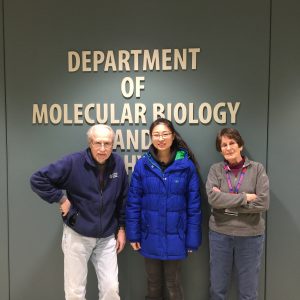
“The six years I spent pursuing my doctoral work at the Setlow lab were intellectually stimulating and challenging,” says Monica Chander ’00 Ph.D., who now serves as associate professor and chair of the Department of Biology at Bryn Mawr College. “The Setlows made their lab feel like home — they embraced all the students and post-docs as family; everyone felt supported and a sense of belonging.”
Over time, more than just their lab location changed — Barbara became an instructor while Peter went from assistant professor in what was then the Department of Biochemistry to full professor to department chair. When he started, molecular biology didn’t exist; now it’s a field in its own right, as well as a UConn Health department where Peter still serves as a Board of Trustees Distinguished Professor. Over his decades at UConn Health, Setlow estimates that his lab trained hundreds of technicians, students, and postdoctoral fellows while generating more than $20 million in research funding.
Now that Barbara has retired, Peter wanted to honor her enormous contributions to science, to students, and to his own life. He worked with the UConn Foundation and his children, both academic leaders at the University of Florida, who drew on their experience to help determine how to make the greatest impact. In December 2025, Peter made a generous $3 million gift to provide stipends for student researchers, ensuring that financial barriers don’t stand in the way of these career-shaping opportunities. The funding supports undergraduate students through the Barbara C. Setlow Health Research Program, renamed in her honor, as well as high school students through the Aetna Health Professions Partnership Initiative.
“Research experiences like these are gamechangers for that student who has the opportunity to go into that lab, get their name on a paper, get some real experience, connect with a professional mentor, and find out whether this is something they want to spend their lives doing before they fully commit to it,” says Jennifer Setlow, interim dean at the University of Florida College of the Arts.
“I’ve seen the impact that these funded research programs have on students’ lives and trajectories,” says Barry, professor and chief of research at the University of Florida Department of Psychiatry.
“I’ve seen the extraordinary impact that Peter and Barbara Setlow have had on our UConn Health students and our scientific community,” says Distinguished Professor and Associate Dean for Health Career Opportunity Programs Marja Hurley. “It’s amazing to see that impact extend to our student research programs. Every day, I see how these programs change students’ paths and enable them to see themselves as scientists. With generous funding, they can make a difference in even more lives.”
“I thought it was a worthwhile legacy for students,” says Peter, who remembers worrying about finances as a student researcher, as well as the relief of finally attaining funding. “Especially when you start to factor in the students from disadvantaged families who may not be able to afford to have their child miss out on a paid summer job for an unpaid research opportunity.”
“When I first told Barbara that I and our two children were setting up this program in her name, she asked me why we would do this for her — which is completely Barbara; she always wanted to be in the back of the room, never in the front,” says Peter. “I told her, ‘Because you deserve it, because you were phenomenally productive, improved our understanding of the biological system, and allowed trainees to go further than they thought they could.’”
“I was so proud of her, and she never understood how she’d done anything special.”
Now, the program bearing her name stands as proof that the UConn Health community sees her pioneering and invaluable legacy for what it is.