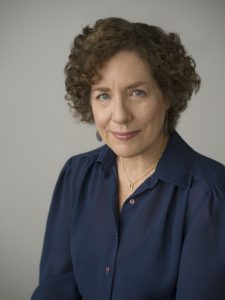
Acclaimed author Elaine Weiss will be the featured speaker at the UConn Waterbury Juneteenth Celebration, organized by the Osher Lifelong Learning Institute (OLLI), a learning program for older adults based at UConn Waterbury, and taking place on Friday, June 12 at 6 p.m. on campus. Weiss, a journalist and historian, has published three books of narrative history.
Her first book, “Fruits of Victory: The Women’s Land Army of America in the Great War,” was excerpted in Smithsonian Magazine and featured on C-Span and public radio stations nationwide. Her second narrative history, “The Woman’s Hour: The Great Fight to Win the Vote” – was a GoodReads Readers’ Choice Award winner, short-listed for the 2019 Chautauqua Prize, and received the American Bar Association’s highest honor, the 2019 Silver Gavel Award.
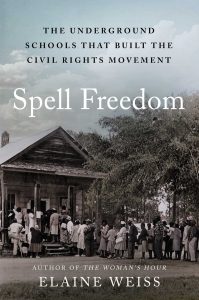
Her newest book, “Spell Freedom: The Underground Schools that Built the Civil Rights Movement,” examines the 20th-century civil rights and voting rights struggle. It was long-listed for the Carnegie Medal for Excellence in non-fiction books, and an Amazon Editors’ Best History Books of 2025 selection. Weiss recently spoke with UConn Today about her new book, and why it bears lessons that still hold true today.
In a nutshell, what is “Spell Freedom: The Underground Schools that Built the Civil Rights Movement,” about?
“Spell Freedom” continues my exploration of untold stories in American history. In this book I take readers deep into the mid-20th-Century civil rights movement, offering a new perspective on events – from the grassroots up – and introducing a cadre of American heroines and heroes, Black and white, whose names may not be familiar, but whose courage changed our nation.
Who were some of those people highlighted in the book?
I profile an unlikely team of disruptors: Septima Clark, a grandmotherly Black South Carolina school teacher; Esau Jenkins, a striving Sea Island businessman; Bernice Robinson, a vivacious Charleston beautician; and Myles Horton, a white Tennessean who called himself a “radical hillbilly.”
In the summer of 1954, they met in Tennessee at the Highlander Folk School, an interracial training center for social change founded by Horton, and united behind a shared mission: preparing Black southerners to pass the literacy test that was a prerequisite to registering to vote – and designed to disenfranchise them.
Working together, Clark – whom Dr. King would later call “Mother of the Movement” – Jenkins, Robinson and Horton created the Citizenship Schools project, starting with a single secret classroom hidden in the back of a rural grocery store. By the time the Voting Rights Act was signed into law in 1965, over 900 citizenship schools had been established in 11 southern states, quietly preparing tens of thousands of Black citizens to read and write, demand their rights – and vote. The program empowered Black southerners, making them “ready from within” for the struggle ahead, while nurturing a generation of local leaders – a majority of them women – who went on to become the organizational backbone of the civil rights movement.
Was there a specific catalyst that incentivized you?
My motivation for writing a book about Black women’s fight for voting rights began after I encountered incorrect media statements claiming the 19th Amendment only applied to white women, and after learning about the racial tensions within the women’s suffrage movement. Through my research I discovered the Highlander educational center and its Citizenship School Project, which led me to focus on Septima Clark and the movement’s voting-rights efforts.
How did you pursue this research?
I used personal letters, oral histories, and archives to bring characters like Septima Clarke to life, focusing on instrumental figures in the civil rights and voting rights movements. My process included piecing together information from various sources, including organizational records, newspaper articles, sound recordings, FBI files, and personal memoirs as well as visits to relevant locations to create a cohesive narrative that highlights the complex evolution of the civil rights movement and the role of my protagonists within it.
Why isn’t much of this history better known?
These schools, led by figures like Septima Clark, were important but often overlooked because they were quieter, community-focused efforts rather than high-profile events. The movement’s impact was widespread, touching potentially hundreds of thousands of people, though it may not have received the attention it deserves. Systemic violence and retribution against Black Americans who attempted to exercise their constitutional rights in the Jim Crow South is an often-underreported part of American history.
I also discovered two surprising findings from my research: the severe economic and physical consequences faced by those who attempted to register to vote; and the existence of state-supported sovereignty commissions that enforced restrictive laws, as well as the extent of surveillance and retribution against civil rights activists during this period.
Do you see correlations between the history you’ve written about and some of the efforts today, at the federal level and in many southern states, that appear to be aimed at restricting or limiting voting rights?
Absolutely. I’m concerned about parallels between historical suppression tactics and current political efforts, including book bans, funding cutbacks for museums and libraries, and the rewriting of historical textbooks and classroom curricula to remove important historical information regarding civil rights and slavery.
The U.S. Supreme Court has just gutted the Voting Rights Act, striking down the last remaining provisions of the 1965 civil rights law that prevents racial discrimination in voting and helped ensure that minority voters were treated fairly in redistricting. And it’s hard to ignore the federal government’s disingenuous efforts around eliminating anything they consider related to diversity, equity and inclusion – to me, it feels like pages taken from efforts to stymie the civil rights movements of the 1950s and 1960s.
Also, during my research, I explored the historical context of the NAACP being labeled as a subversive organization in the early 1960s, and how it faced targeting, legal challenges and pressure. To me, there’s a direct parallel between this period and current events, such as the Trump administration’s actions against legal firms and investigations and indictments of civil society organizations.
The pattern of labeling organizations as “subversive” or “un-American” remains prevalent in American history, with contemporary examples reflecting similar tactics, political rhetoric and past segregationist tactics used decades ago. On the face of it, the SAVE Act, pending in Congress, serves as voter intimidation. It will make it harder for people, especially the poor and minorities, to vote, and affects women who have changed their names. Some call it Jim Crow 2.0, which is not totally inappropriate, given our nation’s history.
What’s next for you?
Well, “Spell Freedom” is still fairly new, so I’ll be doing interviews, book and speaking tours, and guest presentations such as OLLI’s Juneteenth celebration on June 12 in Waterbury. I feel strongly that it’s important to continue highlighting the book’s themes, particularly in context to our nation’s upcoming 250th anniversary celebration, as it covers Black history, women’s history, civil rights, and voting rights.
Confronting difficult history is a source of strength for our nation – I want to reinforce the importance of teaching these stories and sharing real history, however uncomfortable. Also, I want to point out that the citizenship school movement trained local leaders rather than relying on charismatic national figures. The importance of local and state leadership in social movements can’t be understated, especially in these challenging times.
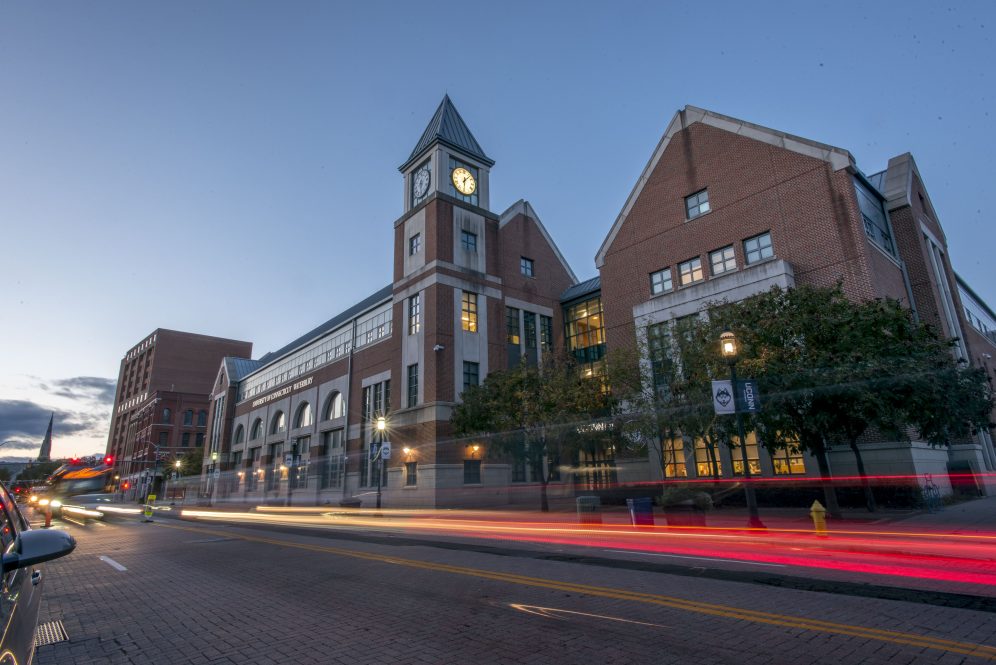
The Juneteenth program at OLLI at UConn Waterbury is on June 12, starting at 6 PM. The program is free, and parking is free, as well, in the UConn attached garage, 55 North Elm Street. The event is free, but registration is required by signing up at OLLI at Special Events, by emailing osher@uconn.edu, or by calling 203-236-9924 and providing your name, phone number and email.