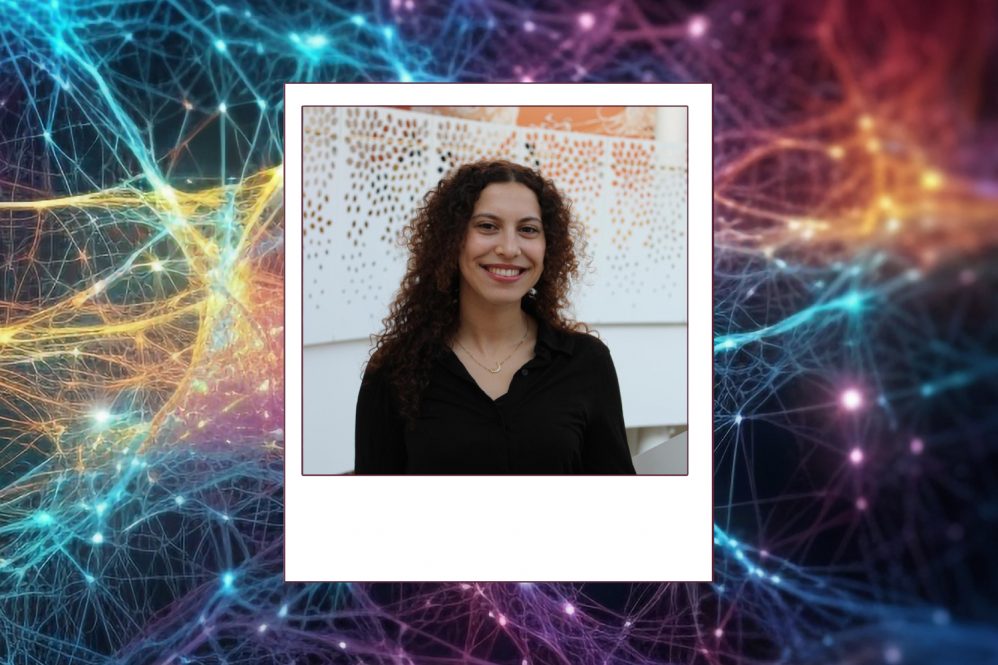
For many first-year students at UConn, finding ways to pursue research can be like one of those classic dilemmas: You need experience to get started, but you also need to get started to gain experience. This was a familiar problem for one of our Peer Research Ambassadors (PRAs), Malak Nechnach.
Nechnach is a senior majoring in physiology and neurobiology, with a minor in mathematics. When she arrived at UConn from her home country of Morocco, Nechnach was adamant on getting involved in neuroscience research, but was unsure how to begin.
“I knew I wanted to pursue research — I just had no idea how, and that was a big learning curve for me,” says Nechnach.
Since there was no one clear path to research, she decided to pave her own way.
“My freshman year was essentially a whole bunch of cold emailing, and I just did not know how to approach the whole realm of research,” says Nechnach.
Deciding to take it a step further, she began talking to her peers in similar fields and was eventually introduced to a PRA at the Office of Undergraduate Research.
“It’s so surreal now that I think of it, like a full-circle moment,” she says. “I remember the entire time I was thinking, ‘I want to be you in four years.’”
Her PRA helped introduce her to her own PI, Inge-Marie Eigsti from the Department of Psychological Sciences and the Connecticut Autism and Language Lab (CALL), who played a crucial role in helping Nechnach develop the foundational skills required to thrive in research.
“She’s amazing,” says Nechnach. “She truly helped me gain more confidence in myself and my skills and encouraged me to approach different professors.”
Nechnach’s research at CALL made her realize that she wanted to focus more on neuroscience, specifically behavioral neuroscience. After talking to one of her TAs in a course she was taking, she expressed her interest in joining the Sciolino lab and gaining more experience with benchwork, working with mice, and most importantly, conducting experiments that were captivating to her.
Working in the Sciolino lab gave her the space to explore different techniques, but it also meant starting from square one.
“I was given a start, but it came up with a lot of challenges because I had to learn a lot of new things,” says Nechnach.
What pushed her to continue was the urge to create something of her own: “I always came into research knowing that I want to have an independent project at some point. I just want to be able to build something of my own.”
Within a year, many things changed for Nechnach. By junior year, she was able to start her own independent project of a year and a half, investigating how exposure to a high-fat diet alters stress-sensitive norepinephrine circuits in the brain. By the beginning of junior year, she had become an OUR PRA, received funding from the Summer Undergraduate Research Fellowship (SURF), and became a McNair Scholar, allowing her to get a federal grant as well.
“I’ve presented in 10 conferences across the United States so far, and it has been an incredible experience,” says Nechnach.
However, the journey was not easy, with setbacks on finding the right field of research for herself, as well as gaining the connections required to get lab research opportunities. Her experience is a prime example of why the correct mentorship in a field like this is so important. Mentorship not only helps gain the right connections; it also guides to the research path you want to be a part of. And this guidance is driven by clear communication.
“The students that thrive in research are the ones that communicate to their graduate students and PI about exactly what they want to get out of this experience,” says Nechnach. “You can’t just assume both parties want the same thing.”
As a PRA herself, Nechnach’s primary goal is to ensure that students are able to get the most support possible from their mentors.
“A lot of people have suffered in research because they did not get the mentorship they needed,” she says.
This is why she believes the pairing of mentors with their mentees is a critical starting point and should not be done randomly. Having a system in place allows students to be matched with PIs who have a similar background in research and a similar schedule to ensure their goals are communicated effectively.
Her advice to current and future undergraduate students is to maintain a close connection to their major and area of interest, and to keep their eyes out for opportunities to get involved.
“Really put yourself out there,” Nechnach says. “Keep applying, catch any opportunities you see, and don’t be scared of failure. It’s worth it. It’s not something you’re supposed to realize in the moment, but it’s something you’ll realize in four years, and you’ll be glad you pushed yourself.”
Nechnach plans to implement this herself in her future career in research. After graduation, she will be joining the Massachusetts Institute of Technology (MIT) to continue doing research for the next two years as a part of the Post-Baccalaureate Research Scholars Program in the brain and cognitive science department.