This spring, UConn Hartford students gathered for presentations on public health issues affecting college-age adults, including vaping, Adderall misuse, and the effects of social media on the brain.
But the speakers were not outside experts or public health professionals. They were fellow students, using what they had learned in an organic chemistry lab to help their peers better understand the science behind those issues.
The presentations were part of a service-learning project built into an organic chemistry lab course taught by Priya Shah ’09 Ph.D., associate professor-in-residence of chemistry at UConn Hartford. In partnership with UConn Student Health and Wellness (SHaW), students in Shah’s course used chemistry concepts to create educational materials for their campus community while gaining hands-on experience in research, communication, and real-world problem-solving.
“Our goal is to spread awareness about how these things affect your brain and your body,” says Shah. “I came into it asking, ‘How can I have my organic chemistry students, who are trained to understand molecules, help people understand how these chemicals affect them in the real world?’”
For students — many of whom plan to pursue careers in health care fields — the project offers a chance to practice explaining complex scientific ideas to a broad audience while learning how chemistry can shape public health conversations in their own community.
“I love hands-on learning, but I didn’t expect to love this project as much as I did,” says Josiah Mansfield, a nondegree student who took the course to complete prerequisites for dental school. “I didn’t realize how much I loved the research until I was in it, and I learned I would love to do more of it in the future.”
Connecting Chemistry to Student Well-Being
Shah says she first began incorporating service learning into her introductory organic chemistry courses during the 2016-17 academic year. Working with the Greater Hartford Harm Reduction Coalition, students in her classes created outreach materials on health-related topics for community audiences.
After becoming a service-learning fellow through the Center for Excellence in Teaching and Learning in 2024, Shah adapted that model for her more advanced organic chemistry lab course and looked for a partner with a direct connection to the UConn community, eventually establishing a partnership with SHaW.
Because students in the lab course have either completed or are concurrently taking related biology coursework, Shah says they are better prepared to connect chemistry to broader questions about health and the body.
“If you say this drug molecule is working this way in the body, that’s not organic chemistry alone. It’s organic chemistry with biochemistry,” she says.
For SHaW, the course has become a way not only to create outreach materials, but also to engage students in conversations about health through peer-to-peer education.
“Having the chemistry background, the students are not just seeing the clinical manifestation, they’re seeing the impact at the molecular level,” says Dax Sousa ’16 (CLAS), ’17 (NUR), a regional nurse navigator at UConn Hartford, who advised the projects.
As part of SHaW’s Regional Nurse Navigators Program, Sousa provides nursing education, triages immediate concerns, and helps students navigate the health care system. He says he drew on his current work with students, along with his previous experience in pediatrics and training in psychology, to identify issues most relevant to undergraduates.
In spring 2025, course projects focused on cannabis use and its effects on the body. In spring 2026, Sousa suggested several additional topics, including some with less established research.
“Vaping is newer, we don’t have all the same data as cigarette use and long-term impact on health. I thought it would be good for students to learn about how it can impact their well-being,” he says.
Students selected their topics and developed brochures and presentations, while Sousa served as a liaison to ensure the materials were clinically accurate. The resulting materials are now used at UConn Hartford and are available to nurse navigators at other campuses.
Students also presented their topics to peers at an event on April 22, drawing dozens of attendees.
“I overheard a lot of insightful conversations peer to peer about these particular issues,” says Sousa. “I think there’s a power in having that dialogue between students rather than from health care provider to student.”

Putting Concepts into Practice
For students, the project offered a chance to use chemistry in a way that felt immediate and personal.
Rayan Al Dulaimi ’28 (CLAS), a molecular and cell biology major, focused her project on e-cigarettes and vaping products and their effects on physical and mental health. She chose the topic because she saw how common vaping had become among young people and wanted to better understand the risks.
“As kids you hear all sorts of things about how bad smoking is, so I wanted to research and present to my peers to see if it changes their view of what happens to them,” Al Dulaimi says.
Her research examined different products, the contents of vape liquid, and how vaping and cigarettes affect the heart, lungs, brain, and other organs.
“You wouldn’t think that something that people inhale would be so bad for you,” she says. “The number of metals I found in vapes, like nickel and lead, is something many people don’t even know about.”
The course also attracts post-baccalaureate students completing prerequisite coursework for medical or dental school.
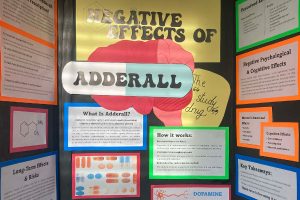
Mansfield, who previously graduated from Southern New Hampshire University with a degree in community health education, chose to study Adderall misuse among people who are not prescribed the medication.
“A lot of students are looking for ways to perform better on exams and boost their cognitive function,” he says. “Looking at the performance of people who took it on exams versus people who didn’t, I found that even though Adderall is a heavily abused drug, there are no perceived benefits from it.”
Mansfield’s research also examined negative side effects, including anxiety, memory problems, and depression during withdrawal, which he says drew strong interest from students during his presentation.
“I approached it not from the idea of, ‘I’m going to convince you that you shouldn’t take drugs.’ I approached it from, ‘I’m going to try to convince you not to take this drug because it doesn’t actually help you in any way,’” he says.
Nathan Miller ’24 (BUS), who majored in marketing and an individualized major in humane technology design, brought another perspective to the course, having previously conducted research on social media. He is currently a research fellow in diagnostic radiology at UConn Health and enrolled in the lab as a prerequisite for medical school.
“Part of my project was using TRIBE v2, an open-source model that Meta released in March,” he says. “You can feed it social media content, and it will visualize how it predicts the brain will respond.”
Miller says part of the challenge was translating technical and scientific research into language and visuals that would be accessible to students.
“A lot of times when you’re in an organic chemistry class, you see the molecules but not the applicability, so it was great to connect it to a topic I was already passionate about,” he says.
Measuring the Impact

The project has also generated scholarship of its own.
Shah says it is unusual for a 2000-level organic chemistry lab to include a service-learning component, both at UConn and nationally. Because of that, she conducted a study examining how integrating service learning into organic chemistry can deepen student understanding and civic engagement.
In February, Shah published her results in the Journal of Chemical Education. She also presented her findings at the American Chemical Society Spring 2026 conference in Atlanta in March.
Shah says the students she surveyed showed stronger engagement, a deeper understanding of chemical concepts, improved communication skills, and a greater appreciation for the relevance of organic chemistry to health care and public health.
“Most students said it helped see the connection between the classroom and the real world, and they felt proud that they were able to present their research in such a large community of peers and faculty members, which they normally wouldn’t get to do,” she says.
The students agreed that presenting their work was one of the highlights of the project.
“I loved the science overall, and I’m grateful for the opportunity to present my research and conduct it in the first place,” says Miller.