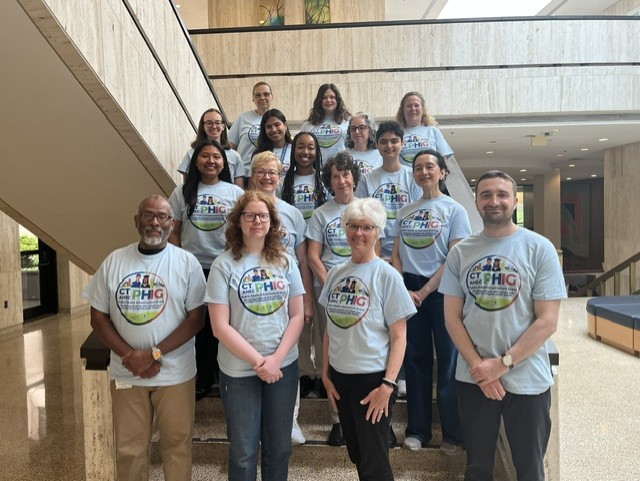
The Connecticut Area Health Education Center (CT AHEC), based at UConn Health in Farmington, is pleased to announce it will be offering new public health and public health careers enrichment programs for high school and emergency medical technician (EMT) and paramedic college students. The programs are made possible with Public Health Infrastructure Grant (PHIG) funds awarded to CT AHEC by the Connecticut Department of Health. The Centers for Disease Control and Prevention awarded 107 health departments and three national public health partners with PHIG funds totaling $5 billion to use towards strengthening public health in the United States.
“The Public Health Infrastructure Grant, otherwise known as PHIG (“fig”), is a once-in-a-lifetime investment in the public health workforce,” says Tom St. Louis, director of the Office of Public Health Workforce Development at the Connecticut Department of Health. “We’re taking advantage of this investment by working with partner organizations like CT AHEC to make students aware of public health careers as an option as they’re considering their academic studies or their career options.”
One of PHIG’s aims is to address the country’s public health infrastructure inadequacies that were exposed during the COVID-19 pandemic. “The Connecticut Department of Health was awarded funding to address gaps and needs related to public health infrastructure and systems, as well as the workforce,” says Celeste Jorge, PHIG program evaluator with the Connecticut Department of Public Health. CT AHEC is well positioned to assist because it has worked with Connecticut schools for more than 30 years to provide health education and career programming for students in grades K through 16. During the 2024–2025 program year, CT AHEC reached 18,101 individuals via programming and outreach activities.
“CT AHEC is very excited to have this opportunity because it has opened the door for us to establish new partnerships that further our health workforce development objectives,” said Petra Clark-Dufner, director, CT AHEC. “We are working with four high schools–ACES Chase Academy (Waterbury), The Gilbert School (Winsted), Highville Charter School (New Haven), and New London Multi-Magnet High School–for our high school pathways program, and with Connecticut State Community College, also known as CT State, for the EMT and paramedic public health program.”
Catalina Quesada, CT AHEC’s PHIG community-based education specialist, says the four high schools will be given the opportunity to assign a teacher to the project who will be given access to public health learning modules and support from the PHIG team. “The teachers know their students and what they need so we are there to help them tailor the learning to their needs,” says Quesada. “We will use our extensive AHEC network to help them identify guest speakers and organize field trips that will help make public health and public health careers interesting and relevant.”
In addition, the 9th and 10th grade students in the PHIG program will participate in the 2027 Connecticut High School Science and Humanities Symposium at UConn Health, designed to challenge and engage 9th through 12th grade students in science, technology, engineering, and mathematics (STEM). Individual students compete for scholarships and recognition by presenting the results of their original research efforts before a panel of judges and an audience of their peers. Ellen Ravens-Seger, CT AHEC administrative program coordinator, notes that past participants have described the symposium as the formative experience that launched them on a rewarding STEM career path. Attendees are astonished at the high level of accomplishment demonstrated in the student projects.
EMT and paramedic students at CT State Capital, CT State Northwestern, CT State Naugatuck Valley, and CT State Tunxis will be provided with eight self-paced, online introduction to public health learning modules written and presented by Brian Maguire, DrPH, MSA, EMT-P. The aim of this program is to help EMT and paramedic students explore how their future career fits into the larger public health system. “Students will come away with a deeper understanding of how public health efforts can improve health beyond treatment and transport,” says Maguire.
Renée Lavoie, PHIG administrative program coordinator at CT AHEC, says the grant allows for 225 students to advance through the programs and that funding is available for participating organizations.
“Young people need to know about public health because it promotes personal and community well-being, develops critical thinking skills for understanding health issues, and can inspire future health-related careers,” says Clark-Dufner. “Understanding public health helps students develop lifelong healthy habits, recognize how social factors influence health, and become informed citizens who can advocate for healthier policies in their communities. This program aligns perfectly with who we are at CT AHEC. We are proud to be supporting this work in Connecticut.”
For more information: health.uconn.edu/connecticut-area-health-education-center-network/home/phig/