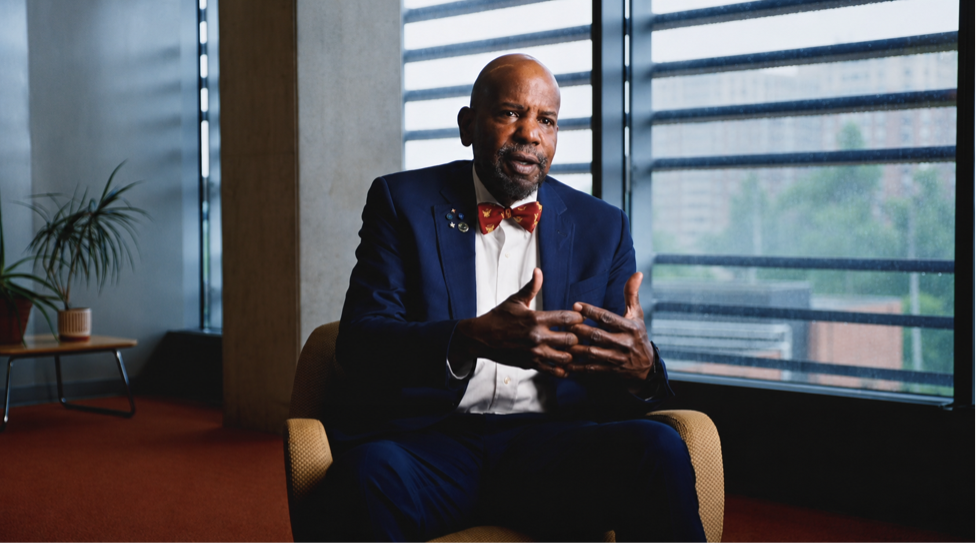
Professor Sir Cato T. Laurencin of UConn is featured in Connecting the Healthcare Ecosystem, a Biomedical Engineering Society film released as part of the USA TODAY America 250: Leading Through Innovation campaign.
Laurencin was featured and profiled in a national series celebrating important achievements in science, engineering, and medicine in celebration of the 250th Anniversary of the United States. The Biomedical Engineering Society (BMES) particularly chose Laurencin to represent the profession. Explaining the selection, John G. Falcioni, executive director and CEO of the Biomedical Engineering Society, said, “Professor Sir Cato T. Laurencin was selected to participate in BMES’s America 250 documentary because he is a unique visionary in our field. He is not only a prominent biomedical engineer leading the regenerative engineering movement but also a physician, scientist, and professor. His perspectives on the current state of biomedical engineering and its future, especially its impact on patient outcomes, are insightful and revolutionary.”
In the documentary, Laurencin explained how progress in healthcare should be measured. “We have often measured progress in health in America traditionally by how many years a person can live, but we really need to measure that progress by how many years a person lives well.”
This concept of health span refers to the years of life spent in good health and able to live as one chooses. Laurencin described biomedical engineering as a profession dedicated to improving the health span and connected that mission to regenerative engineering, the field he founded. Regenerative engineering combines areas such as advanced materials science, stem cell science, physics, developmental biology, and clinical translation to regenerate complex tissues and organ systems.
Building on that goal, the field seeks to harness the body’s natural ability to heal. Laurencin points to work in limb regeneration and other technologies as examples of how regenerative engineering restores damaged tissues and creates biological function. He envisions regenerative engineering to have an increasingly significant impact on the lives of people in America and throughout the world. His remarks reinforced the film’s broader message about advances in biomedical engineering in healthcare.
Looking beyond the achievements of the past, Laurencin said: “The future of biomedical engineering will be the convergence of technologies that may appear disparate today, but that will merge to create new thinking and new ideas.”
Laurencin’s contributions to biomedical engineering have been recognized by its community. He received the Robert A. Pritzker Distinguished Lecture Award, the Biomedical Engineering Society’s highest honor, as well as the BMES Cellular and Molecular Bioengineering Shu Chien Scientific Achievement Award and the BMES Social Impact Award. The American Institute for Medical and Biological Engineering (AIMBE) honored him with the Pierre Galletti Award for his contributions to tissue regeneration and leadership internationally in biomedical engineering, as well as the AIMBE Professional Impact Award for Leadership. Internationally, he is a fellow of the International Academy of Medical and Biological Engineering,
Those honors accompany a broader record of scientific and technological achievement. Sir Cato Laurencin is the first surgeon in history elected to all four major U.S. national academies. He is an elected member of the National Academy of Sciences, the National Academy of Engineering, and the National Academy of Medicine, and an elected fellow of the National Academy of Inventors. He is also an elected fellow of the American Academy of Arts and Sciences and of the American Association for the Advancement of Science.
Falcioni also emphasized the importance of the documentary’s national spotlight: “We are extremely happy and proud that Dr. Laurencin is a member of BMES and, through this short film, able to help us inform the public about the value of the profession. He has helped put a spotlight on the work of our members and all those involved in biomedical engineering. The breadth of his work is enormous.”
At the University of Connecticut, Sir Cato Laurencin serves as the University Professor and Albert and Wilda Van Dusen Distinguished Endowed Professor of Orthopaedic Surgery at the UConn School of Medicine. He is professor of Chemical and Biomolecular Engineering, professor of Materials Science and Engineering and professor of Biomedical Engineering. He is the chief executive officer of The Cato T. Laurencin Institute for Regenerative Engineering, an Institute created and named in his honor.