On the Right Track
Can Formula Racing Open Doors for Students?
The first time he visited UConn, it was pouring rain. It’s an understatement to say Jake Gannon was not sold on the University.
“After that, I didn’t really want to go to UConn,” says Gannon ’27 (ENG).
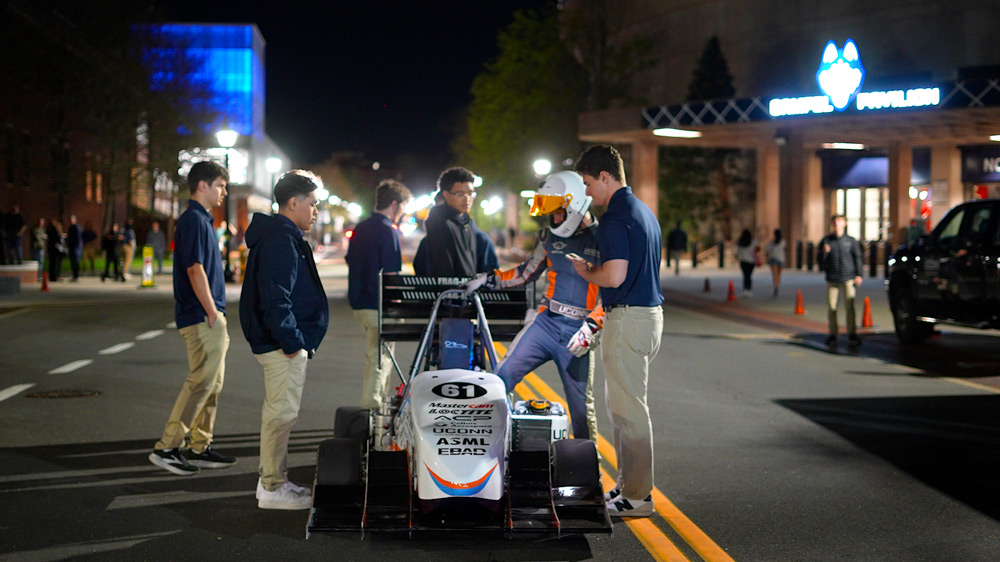
Still, he applied, was accepted, and gave UConn another chance at UConn Bound day, the open house for admitted students. UConn Formula SAE, a student organization that builds and races their own Formula-style cars, had a car on display on Fairfield Way. After talking to students in the group, the deal was sealed for Gannon, who aspires to a career in motorsports.
“I actually came here because of this club,” he says.
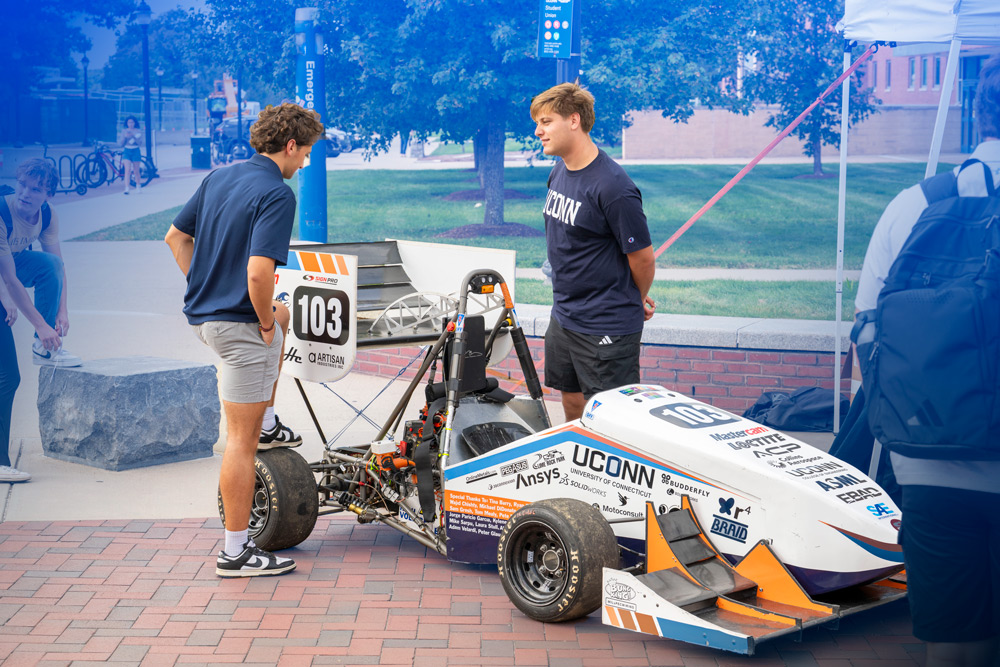
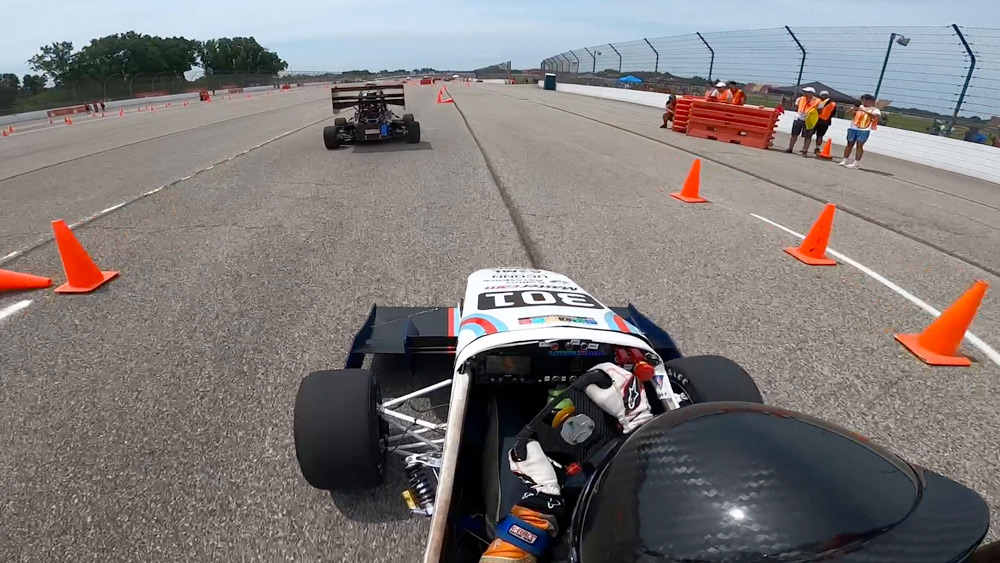
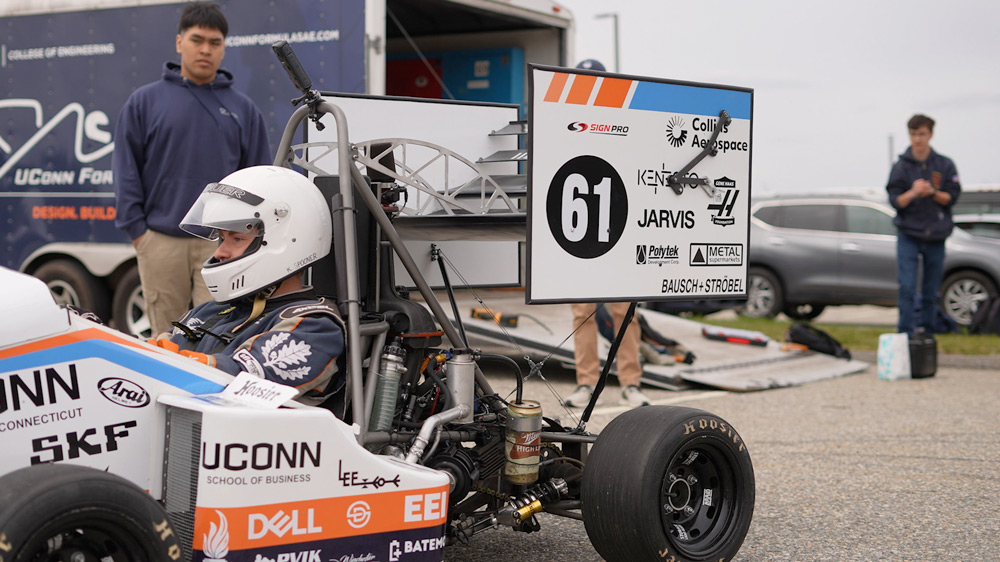
Today, Gannon is president of the organization, which this summer was the only U.S.-based team to place in the top 5 for both its electric and internal combustion vehicles at international competitions sponsored by SAE International, formerly known as the Society of Automotive Engineers.
The annual contest challenges college students to conceive, design, fabricate, develop, and compete with formula-style vehicles. “Formula” vehicles are small, single-seater race cars characterized by a low-to-the-ground aerodynamic design, an open cockpit, and exposed wheels. These high-performance vehicles can reach speeds over 110 mph on certain tracks.
Each year, more than 100 UConn students studying engineering, finance, marketing, and other disciplines across the University work together to design, build, test, and fine-tune the two cars — and to manage every other piece of the program, from finance and sponsorships to operations and data analysis.
“The UConn Formula SAE Club isn’t just a club for learning about race cars. It’s also a club about building leaders,” says Gannon. “We do all work in-house … It’s all student work, student-led, student-run. So not only are we cultivating the next generation of students, we’re also building up leaders that are going to lead in some of the biggest companies in Connecticut and across the world.”
Past president Abhiemanyu Sukumaran ’24 (ENG) went onto a master’s degree in motorsport engineering from Oxford Brookes University in the U.K. before landing a role as a performance analysis engineer at McLaren Racing, winner of 2025’s Formula One team championship.
Other recent alums have gone onto careers at SpaceX, RTX Corporation, Boeing, and Lockheed Martin.
“We have countless success stories, ranging from individuals starting their own startups because they’ve learned so much about business management and … what the industry needs,” Gannon says. “Everyone that comes in here can admit to themselves that they want to learn more, they want to apply themselves harder, and they want to develop themselves, either an engineer or a student as a whole.”
Many of the team’s sponsors see the club as a ripe pipeline for talent, given the skills demonstrated by members.
“One of our biggest goals is to kind of guide these students toward the future in the industry,” Gannon says. “You’ll see plenty of members get jobs in the most prestigious engineering firms, business firms, and more here in the state and around the world.”
In a sprawling old industrial building tucked at the back of UConn’s Depot Campus in Storrs, shells of the club’s former cars hang from the ceilings — it has built 20 vehicles since the club was reinvigorated in 2006, after an active stint in the 1990s. Each competition year, the team takes apart the previous year’s vehicles to recycle parts. Beginning in 2022, Formula SAE added a second team to create an electric vehicle.
The team begins designing a car about a year prior to competition, in the summer. Then, much of the academic year is spent on the actual builds and testing, refining, and perfecting to ensure peak performance on each race day. Many members come to work on their aspect of the project three times a week, and club members form close social connections, according to Gannon.
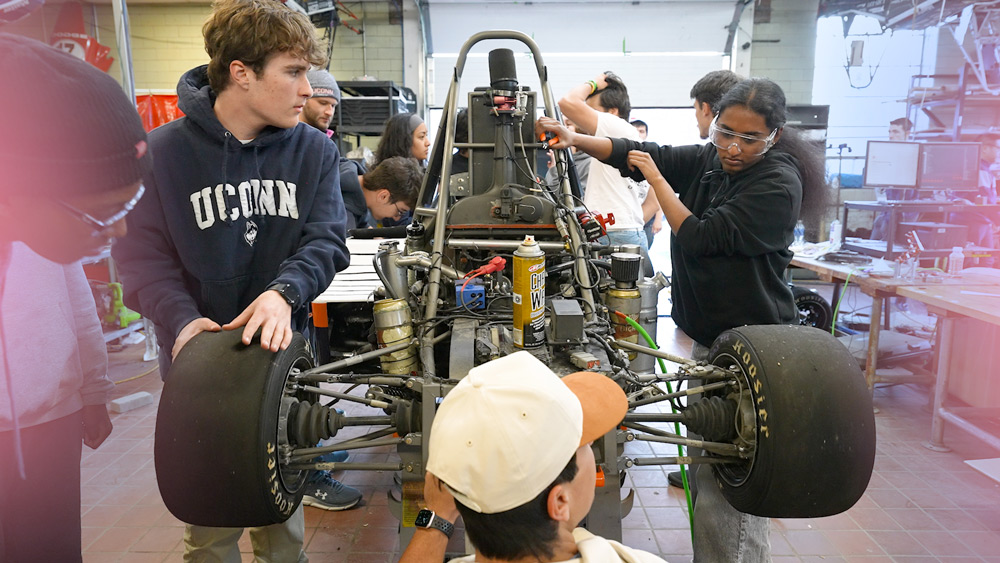
“I do love what happens on the track, and so do many other people, watching the cars drive and race,” says Gannon, a lifelong racing fan. “The off track really is the most important because that’s what keeps us going year after year.”
Students gain hands-on experience that they can’t always get in the classroom — Formula SAE has 13 subsystem groups to handle every aspect of the project, including designing the car using CAD; welding physical parts; and engineering and manufacturing the chassis, powertrain, and electrical systems. Business and finance teams are key to success in competition, as teams are rated on cost, efficiency, and a business presentation in addition to performance metrics.
“Formula SAE gives students an opportunity to apply most of the knowledge they’ve gained in the classrooms to a real engineering challenge,” says faculty advisor Wajid Chishty, a professor-in-residence in the School of Mechanical, Aerospace, and Manufacturing Engineering within UConn’s College of Engineering. “From design and manufacturing to testing and competition, every success is earned through teamwork, persistence, and technical excellence. Seeing our students compete at such a high level is incredibly rewarding.”
Beyond that, it’s an unmatched opportunity to build leadership, communication, project management, and other soft skills that are vital to success in the workforce.
When the rubber meets the road, Gannon says, “the point of the club is to teach, develop, and grow these engineers, businessmen and women, and more into better students first, by working hand-in-hand with people from all different disciplines to build something bigger than themselves.”
Big ideas come from out of the blue.
Behind every breakthrough, there’s a story of creativity and commitment. One where individuals come together, fueled by a shared vision and sustained by imagination and persistence.