As political polarization, voter fatigue, and public distrust in institutions continue to shape the national conversation, Shannon R. Lane believes one message is more important than ever: democracy only works when people participate.
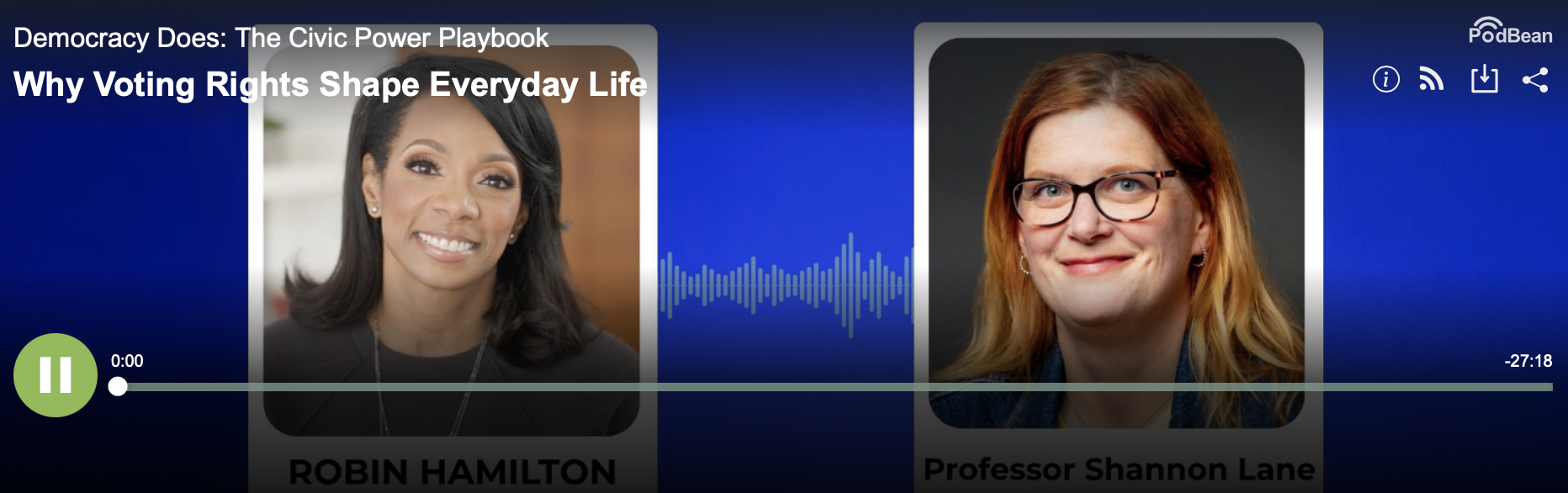
Lane, director of the Nancy A. Humphreys Institute for Political Social Work at the UConn School of Social Work, recently shared that message during an appearance on Democracy Does: The Civic Power Playbook, a podcast hosted by journalist Robin N. Hamilton that explores how public policy affects everyday life and what citizens can do to become more engaged in their communities.
Throughout the conversation, Lane drew on more than two decades of experience as a political social worker, educator, scholar, advocate, and elected official to explain why civic engagement matters—not only during election seasons, but every day.
“Policy and politics affect everything that we do,” Lane said during the interview. “If I as a social worker choose to deliberately ignore the policy arena and the political arena, then I am missing out on chances to make life better for the clients and the communities that I work with.”
Connecting Social Work and Public Policy
Lane’s career has long focused on the intersection of social work, public policy, and democratic participation.
She traced her interest in policy back to her first professional experience as a college intern for former U.S. Senate Democratic Leader Tom Daschle. Working in the Senate gave her an early understanding of the ways in which government decisions matter, particularly in areas such as healthcare and disability policy. That experience ultimately led her to pursue a Master of Social Work degree and later a career focused on helping communities influence policy decisions.
Today, she combines scholarship, teaching, community engagement, and advocacy through her leadership of the Humphreys Institute, which promotes political social work and civic engagement.
Lane noted that many people are surprised to learn how closely social work and politics are connected. While social workers generally do not advocate for specific political parties or candidates in their professional roles, they frequently see firsthand how government policies affect the people they serve.
“As social workers, we are often connectors between multiple systems in the world,” she said. “The people who are making policy need to know how it’s affecting people in their lives.”
She argues that social workers have an ethical responsibility to help ensure policymakers understand the real-world consequences of their decisions, particularly for individuals and communities whose voices are often overlooked.
Understanding the Voting Rights Act
A significant portion of the podcast focused on voting rights and the legacy of the Voting Rights Act of 1965, which was enacted to prohibit racial discrimination in voting.
“There are folks who call it the greatest achievement of the civil rights movement,” she said. “I’ve also seen it called the crown jewel of the civil rights movement.”
According to Lane, the legislation produced measurable results over the past six decades by helping narrow disparities in voter participation and increasing political representation for historically marginalized communities.
She pointed to the South as an example, where Black voter participation rates in some areas now equal or exceed those of white voters—a dramatic change from the era before passage of the Voting Rights Act.
Lane also discussed recent court decisions that have weakened portions of the law, including the 2013 Supreme Court decision in Shelby County v. Holder, which eliminated a key federal oversight provision known as preclearance. The provision had required jurisdictions with documented histories of racial discrimination in voting to obtain federal approval before making significant election-related changes.
More recently, legal challenges at the Supreme Court (Louisiana vs Callais et al) which involve Section 2 of the Voting Rights Act have raised questions about the future of majority-minority voting districts, which were designed to help ensure communities of color have equitable representation.
Lane explained that these developments could have implications not only for congressional elections but also for state legislatures across the country.
“I think it’s likely that this is going to change who is in Congress,” she said, adding that the long-term effects on representation and policymaking are still unfolding.
From Concern to Action
While the conversation addressed significant policy challenges, Lane emphasized that individuals have meaningful opportunities to participate in democracy and strengthen their communities.
When Hamilton asked what actions citizens can take, Lane offered three recommendations.
The first, she said, is making sure people are “vote ready” by confirming their voter registration status, polling locations, and election information before Election Day. She encouraged voters to use nonpartisan resources such as Vote411, operated by the League of Women Voters, to access election information.
Her second recommendation was for people to consider becoming poll workers or election protection volunteers.
Lane has worked elections in her community for more than a decade and said the experience provided insights that no classroom could offer.
“We are desperate for poll workers in the United States,” she said, noting that election systems depend heavily on local volunteers and workers who help administer elections and assist voters.
For those unable to commit to working at polling places, she highlighted opportunities through election protection organizations that connect voters experiencing difficulties with legal and procedural assistance.
Her third recommendation focused on something increasingly difficult in a digitally connected world: building relationships in person.
“We’ve got to lean into community,” Lane said.
She encouraged people to attend school board meetings, town council meetings, and community events, and to engage with others who share their commitment to improving civic life.
“If we feel like we have to change the world alone, we will feel discouraged because it’s just not possible,” she said. “If we feel like there are other folks around us who have the same goals as us and have our backs and we’re in this together, you are much more likely to make change happen.”