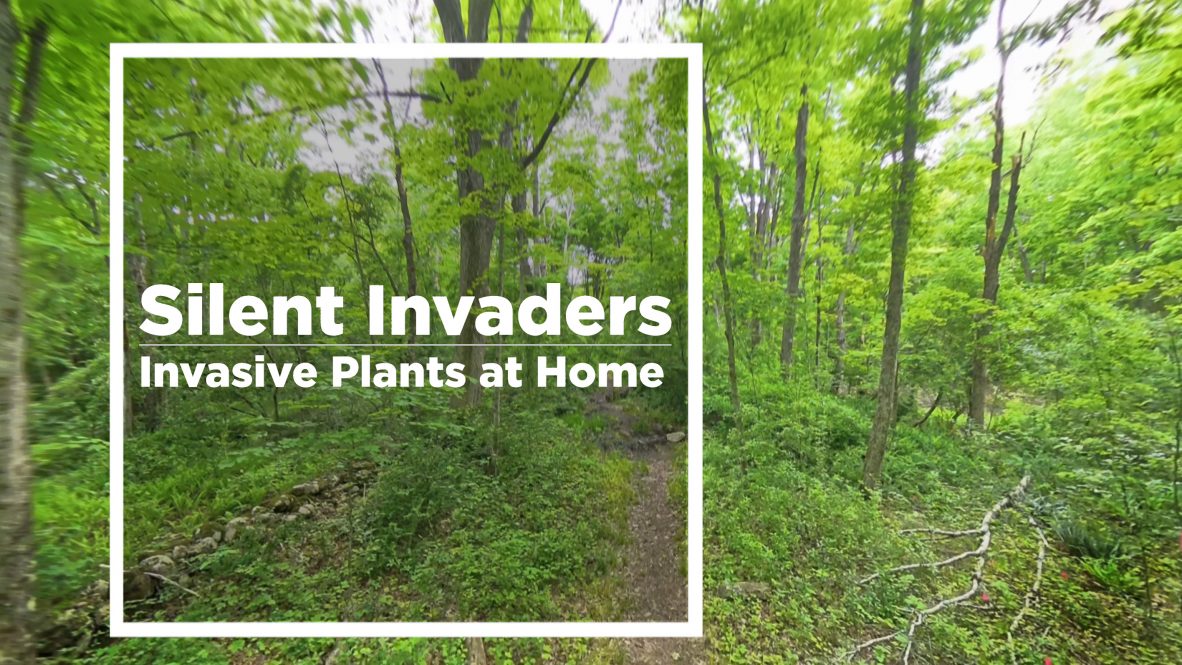
Invasive plants are a serious ecological concern. Without natural predators, they push out native plants and the wildlife that depend on them. In Connecticut, there are more than 100 identified invasive plants.
Led by Vickie Wallace, senior extension educator, members of UConn Extension’s Sustainable Landscape Program began the development of an invasive plant certificate program in 2024. In early 2026, the College of Agriculture, Health and Natural Resources (CAHNR) began offering a new online certificate program that educates residents how to identify and manage invasive plants in the state.
“There was a gap in educational opportunities in the state related to invasive plant management, while there’s a ton of interest from people who want to learn more about the topic,” says Alyssa Siegel-Miles, UConn Extension educational program assistant.
The course covers topics including which invasive plants are of greatest concern in Connecticut, how to identify these plants, cultural and chemical management strategies, determining how to prioritize removal when multiple invasive plants are at a site, restoration using native plants, and pesticide regulations.
“We developed the certificate program to focus on highlighting effective and science-based procedures involved with invasive plant management,” Siegel-Miles says. “We also wanted to make sure the program would be of interest to a wide audience. We had participants from all over Connecticut.”
The course was created to be entirely online, and participants enrolled in the course can complete the work at their own pace. The course consists of seven modules with videos, supplemental reading material, slideshows, and recordings of Extension workshops.
“We focused on case studies for some of our module topics, where we had footage of field demonstrations or of people doing work in the field,” Lauren Kurtz, invasive species outreach specialist, says. “It wasn’t just information about invasive plants; it was about practical hands-on information relayed by people with invasive plant management experience and put into practice.”
Besides the modules, there was one live virtual class that students could join synchronously or watch as a recording on their own time.
“[The course is a] wonderful new world of knowledge for me, which I intend to use as a member of my town’s land trust,” says course participant Paul Mills. “The live virtual session was great, with relevant information and providing real-world solutions.”
Participants enrolled in the first certificate program included landowners and home gardeners as well as people working for municipalities and conservation organizations either professionally or as a volunteer.
“I had little to no knowledge of Connecticut invasives going into this course,” Virginia Chirsky, a course participant and volunteer with the Quinnipiac River Watershed Association, says. “All that I learned will be beneficial in both my volunteer and personal gardening.”
In the launch of the first program, which ran this year from February to May 2026, 180 people participated in the course.
The course will be offered again in the winter of 2027. Organizers are looking to incorporate the option for in-person workshops. They also plan to add more information about reintroducing native plants and restoring an area after invasive plants are removed.
Those interested in learning more about the Invasive Plant Certificate Program or signing up to be notified about registration for 2027 can visit the course webpage.
This work relates to CAHNR’s Strategic Vision area focused on Fostering Sustainable Landscapes at the Urban-Rural Interface.
Follow UConn CAHNR on social media