
SeungYeon Kang, an assistant professor in the UConn School of Mechanical, Aerospace, and Manufacturing Engineering, is working to transform how microscopic electronic devices are built. This research could help power a new generation of smaller, faster, and more efficient technologies.
Kang has received a prestigious National Science Foundation (NSF) CAREER Award for her project, “3D One-step Heterogeneous Manufacturing for Integrated Circuits (3D OHMIC).” This award will help support her research on advanced manufacturing processes that operate at the micro and nanoscale.
“At its core, this project is simple but fundamental,” says Kang. “We build most electronics in flat, two-dimensional layers, even though the world around us is three-dimensional. This makes devices harder to miniaturize, slower to produce, and more resource-intensive.”

The NSF Faculty Early Career Development (CAREER) Program is one of the foundation’s most competitive award for early-career faculty. The program recognizes researchers with the potential to serve as academic leaders while also advancing impactful education.
For Kang, the award supports her research as the intersection of ultrafast laser nanofabrication, light-matter interaction, and energy harvesting, areas that could create new possibilities for producing high-performance electronic and photonic devices.
Kang’s research aims to overcome these limitations by developing new ways to fabricate tiny structures in three dimensions using ultrafast lasers. Her work combines precision laser processing with advanced materials and manufacturing techniques to create highly detailed microscale and nanoscale structures that would be difficult to produce using traditional methods.
“My goal is to develop a fundamental understanding that enables a new type of 3D printing technology that can build complex electronic systems, such as circuits and sensors, directly in three dimensions, in a single step,” says Kang. “This approach can also be extended to photonics, enabling the creation of integrated optical components and devices with enhanced performance and new functionalities.”
By rethinking how these structures are made, there is potential to make manufacturing faster, cleaner, and significantly more flexible.
A key component of the project explores how ultrafast lasers interact with materials at extremely small scales. Kang explains that we can use light as a tool to build materials from the ground up.
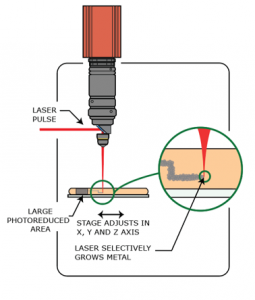
Using ultrafast lasers, researchers can control how light interacts with matter at small dimensions to “write” metal structures inside materials with extreme precision. Kang’s team combines this with high-speed 3D printing to push the boundaries of what can be manufactured.
“What makes our approach unique is that we’re not choosing between speed or precision, we’re achieving both in one system,” Kang says. “That’s something that hasn’t been possible before, and it opens the door to an entirely new way of making devices.”
The potential applications span a range of industries, from electronics and communications to energy and medicine. The technology could enable devices that are smarter, smaller, and more efficient, including improved sensors, medical implants, and communication devices.
“More broadly, this research supports a shift toward more resilient and sustainable manufacturing,” says Kang. “We want to produce advanced technologies locally with fewer steps and less material waste.”
Education is a big part of this project as well. Kang doesn’t want students to just learn about advanced manufacturing; she wants them to get first-hand experience with it.
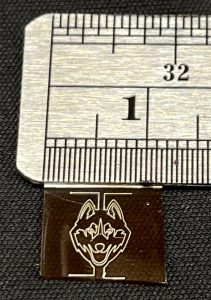
In Kang’s classes and lab, students design their own 3D-printed structures, connecting advanced engineering theory directly to practice. The NSF CAREER Award will expand these learning experiences by supporting new educational tools and interactive materials.
“We’ll engage with students at all levels,” says Kang. “From middle school outreach to graduate research, helping engage and inspire the next generation of innovators.”
This award is incredibly meaningful to Kang, helping her fully invest in developing this new technology, while also supporting students and a research program that can make long-term contributions to advanced manufacturing.
“Receiving this award isn’t just about funding,” Kang says. “It’s a strong vote of confidence in both the vision of the research and the potential impact it can have.”