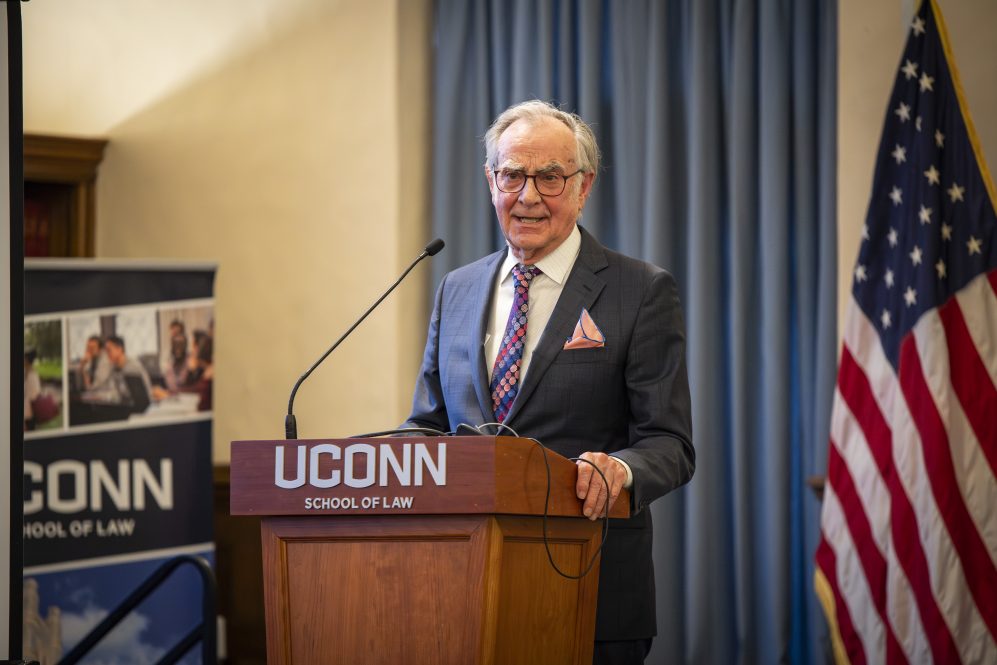
Wes Horton ’70 JD remembers the feeling of arguing a case in front of the Connecticut Supreme Court as a student in a law school competition — and winning.
“It was a moment when I really felt I was practicing law, as opposed to just learning law. I realized this was what I wanted to do with my life,” says Wes, who has become a nationally known attorney. “It gave me this feeling that I was doing something important for society as a whole simply by arguing my point. That was a real feeling of empowerment.”
Wes’s opportunity came through the moot court competition, where students practice presenting cases before higher courts in a high-stakes environment.
In reflection of the School of Law opportunities that shaped him, Wes and his wife, Chloe Horton, recently made a generous $500,000 gift to UConn School of Law programs that give students competitive opportunities to practice law and represent clients in simulated legal proceedings, like moot court, mock trial, and negotiation and dispute resolution programs.
To honor Wes’s commitment to the School, the Connecticut Moot Court Board named their spring competition in his honor in early 2026.

To Wes, these competition programs are critical proving grounds for students and important ways to meet industry needs by fostering the next generation of highly skilled lawyers. The Hortons’ gift will give these programs more resources to send teams to competitions and cover travel and lodging costs. Wes hopes his support will also help these programs train more students and hire trainers.
“Thanks to the Hortons’ generosity, we’re better positioned to do well in competitions and represent the School of Law on a national stage,” says Ian Russell ’26 JD, executive director of the Connecticut Moot Court Board.
Wes’ moot court competition was the beginning of a distinguished career in appellate law, a field that involves bringing cases before higher courts to review lower courts’ decisions, often interpreting constitutional rights in the process. “There’s so much you can do as a lawyer that handles appeals to change society for the better,” Wes said.
His competition experience even helped him learn how to conquer nerves as a young and aspiring lawyer, a skill that would serve him when he would later argue — and win — the eminent domain case Kelo v. New London before the United States Supreme Court.
The case he is most proud of, however, wasn’t at the highest court in the land, and not even one of the 135-plus cases he’s argued before Connecticut’s own Supreme Court. He created a pioneering case, Horton v. Meskill, that advocated for his son’s and all Connecticut children’s rights to fair funding for education. “It reaffirmed people’s belief in the power of the Connecticut constitution,” he said, adding that it set the foundation for critical future cases like Sheff v. O’Neill, where he later helped UConn School of Law Professor Emeritus John Brittain challenge Hartford’s school segregation.
This belief in the importance of public education has underpinned Wes’ years-long commitment to the UConn School of Law, where he has taught a course almost every semester for the past five decades. In the process, he’s mentored countless students and enabled them to learn by doing.
“I was very fortunate to have Wes as a professor in law school,” says David Gitlin ’95 JD. “We conducted an in-depth analysis of a case that went before the Connecticut Supreme Court, examining it from both sides. Wes was deeply passionate about teaching, learning, and contributing. He’s a true icon in the Connecticut legal community.”

“When I was Wes’ law school student, there was plenty of teaching, knowledge-sharing, and coaching, but what I wasn’t expecting was the level of mutual respect — he treated me like a colleague, rather than a student, and that was a singularly empowering experience,” adds Ian Russell ’26 JD. “I know Wes has done that, not just for me, and not just for the students who have taken his class, but for countless members of the Connecticut bar. He’s been doing this for long enough that I’ve been mentored by attorneys who were themselves mentored by Wes. That’s a fantastic legacy.”
Wes’s commitment to UConn is also rooted in gratitude for the School’s role in launching his legal career. He had come to law by tragic chance: when his parents died of a car accident at a young age, he turned to the law for answers, pursuing a wrongful death case and managing their estate. The experience inspired Wes to embark on a new career path in law and enroll in the UConn School of Law as the first step.
“I knew the day I arrived at UConn Law School that it was where I belonged,” Wes says, crediting his classes, instructors, and ample opportunities to focus on a path in Connecticut law.
Now, the Hortons’ gift ensures the Horton legacy will always be part of the UConn School of Law.
“It is difficult to fully capture the profound impact Wes Horton has had on the School of Law over the past half century,” says School of Law Dean Eboni S. Nelson. “Through their latest gift, the Hortons extend this extraordinary legacy — equipping the next generation of aspiring lawyers with the skills, experience, and confidence needed to become effective advocates in the pursuit of justice. The School of Law is deeply grateful to Wes and Chloe for their generous support, which strengthens our ability to provide a transformative educational experience for our students as we build upon our legacy of excellence.”