Douglas Degges never thought he’d be the guy who, upon meeting someone, almost immediately pulls out his phone to show off pictures of his dogs.
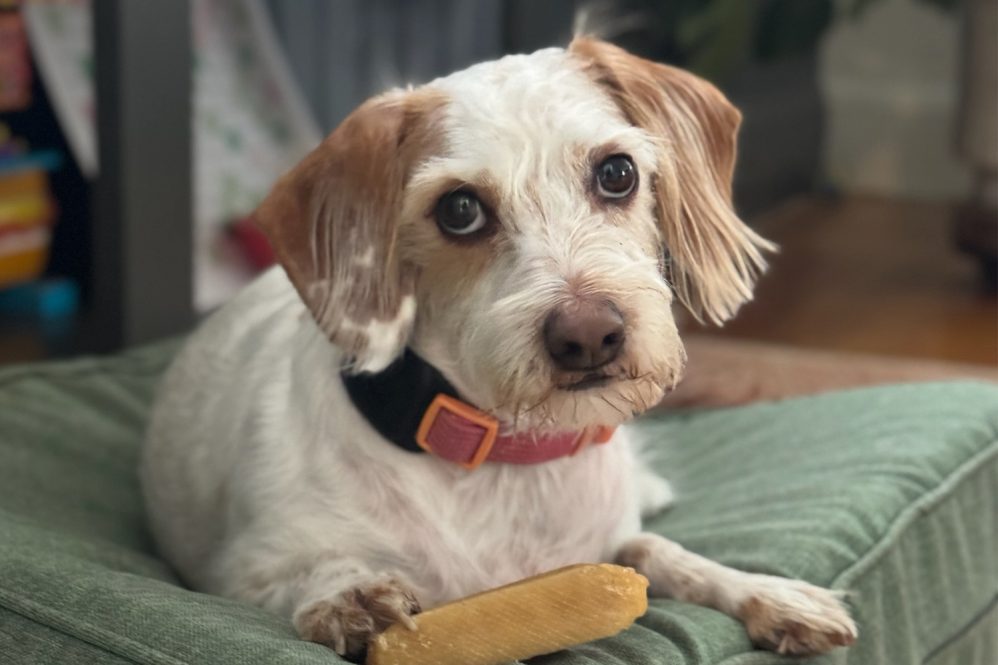
“That’s Odie. Isn’t he adorable?” Degges asks, scrolling through camera roll photos of the 9-month-old and his older brother, Cricket.
The associate professor of painting and drawing in UConn’s Department of Art and Art History stops and looks up: “This exchange we’re having right now, this is one of the things I love about creative practice. It can move with your life,” he says.
Becoming a dog dad has affected Degges more than he probably realized four years ago when he first snuggled Cricket on adoption day in a big-box store parking lot. Thanks to his pups, Degges has found inspiration for his latest work.
Like many canines, Cricket chews. The dachshund/Jack Russell terrier/poodle mix never met a rope or stuffed squeaky toy he didn’t like. And almost from the minute he went home with Degges, the destruction ensued.
“He produced a lot of waste quickly, and these things destined for the landfill were piling up fast,” he says. “I started thinking not just about how expensive dog toys are, but also how they’re design objects. They’re sold to us, not the dogs. They have beautiful shapes, colors, and considered edges. They’re sculptures, really.”
The heap of dog toys that Degges piled into a child-sized shopping cart early in his days as a dog dad wouldn’t last long, he knew. Cricket quickly was working his way through the various strengths of hollow rubber toys meant to be stuffed with treats. Few things survived his jaws.
“Dog toys by design are single-use objects. They have to participate in designed obsolescence, or they might destroy a dog’s teeth,” he says. “They have to be destructible, and my dog destroys them all.”
As that happened, Degges noted the bite marks on nylon bones – a bit like the patterned marks left behind on the next page of his sketchbook. He also started to think that ripped fabric, pulled stuffing, and shredded strings might just make a dog toy more visually interesting than the neatly secured edges from the outset.
Since 2009, Degges has enjoyed making collaborative art with other artists and family members, beginning with Hamlett Dobbins, a former professor turned mentor who works with him through the mail to produce work jointly. So, looking to Cricket – and now Odie, a beagle/toy fox terrier/Pekingese/pug mix – as a co-creator wasn’t so far-fetched.
“When they’re playing and I can’t be in the studio because I’m at UConn teaching, if they’re chewing on a toy, I’m simultaneously in the studio,” he says. “I love the idea of getting time out of time. If my dogs are at home doing their thing, then, in a way, I am also working in my studio.”
‘Abstraction invites speculation’
But what does Degges do with the chewed remnants of a stuffed cheeseburger?
“Right out of the dog’s mouth to a gallery wall,” he says, tossing around a former toy that now looks like a bracelet of lettuce, cheese, and burger, the bun and center patty presumably digested.
Of course, not everything from a pooch’s mouth is as neatly destructed. Most toys are mutilated – heads torn off and arms dangling.
Degges washes them all and separates them by type – textiles in one pile, filling in another, broken squeaker in the trash. He says he hasn’t yet discovered a way to reuse those.
Everything else is, or will be, turned into soft sculptures, although he talks about the possibility of one day restitching and restuffing a toy for a second and third go, if only to see if its number of lives can exceed a feline’s fabled nine.
“My parents encouraged me to make without prescribed outcome, which is how I’ve fallen in love with process and abstraction, not knowing what I’m doing but trusting that something will come out the other end,” he says. “Abstraction invites speculation. You’re not clearly telling anybody what they’re looking at. Some people perceive that as making the work less accessible. I see it as a requirement to slow down for a sustained look, co-creating meaning and showing up for the experience.”
Last fall when Degges was on sabbatical, he completed two residencies in Mexico City, Mexico. Three-quarters of his work focused on the dog toy project, and during his time there he connected with a group of dog walkers to distribute new toys for their four-legged wards. Other artists offered their dogs as collaborators, too. The returns became art.
This summer, he plans to return to finish this phase of the project in preparation for a solo exhibition during the fall at Plomo Galería in Mexico City. That show will feature a playful study of dog beds – human-sized, 6-foot-wide, stuffed, bean-bag-like beds – on which he’s painted. They’ll serve as functional dog furniture, but also as plinths to display some of the smaller dog toy sculptures.
Degges says that around the time he started the project four years ago, he read Donna Haraway’s 2016 book “Staying with the Trouble” and took to heart her questions of how to live through an ecological crisis like climate change without becoming paralyzed by it. How can one cultivate hope?
“My takeaway was to begin thinking about how to live in new and different ways with the biodiversity we share space with. For me, that was immediately my dog,” he says. “How can I live with my dog in curious, surprising ways that are going to increase my capacity to make the world less human-centered?
“Her book gave me language to talk about the work in a research university context and to think about how the arts might intersect with the social sciences and humanities,” he continues.
Artmaking Through Collaboration
These are things he wasn’t consciously thinking about growing in northern Louisiana, where young Degges spent most days outdoors learning to problem-solve without help from the internet, and to work with his hands in nature, often foraging for supplies. His mother engaged the family in a years-long project to build a retaining wall from reclaimed cement blocks they found in construction demolition piles.
When he started college, Degges majored in math, studying art on the side after having enjoyed it merely as a high school elective and taking a handful of lessons in his youth. Algebra, geometry, trigonometry – those were core classes all the way to calculus 3, theoretical math that began to push into philosophy, he says.
“My professor described waking up in the middle of the night having to urgently solve a math problem in the notebook on his bedside table,” Degges says. “For me, the relationship he had with his research felt alive in the way a sketchbook practice exists for me. This book that’s glued to my body, literally in a back pocket or my bag, is with me at all times.”
That may have been the moment he realized art was his direction and switched to a studio art major, but he notes that teaching is his calling. Being in a room with others interested in the same subject, talking with them, creating with them, vitalizes him in a way that resembles the collaborative or communal art he makes in his free time.
Yes, that started with a former professor turned mentor, but collaboration has extended now to family. Degges describes himself as a collage artist, “but in terms of identity, I think about everything through the lens and history of painting and drawing.”
His family text stream includes pictures of snake skins, the fin of an alligator gar, a grasshopper, things from nature back home. Degges sketches them in graphite pencil and often places them over colorful backgrounds he’s painted to give a collage effect. It’s an idea that came to him when a UConn student told him they wanted to draw things as realistically as a photograph would capture – Degges replied with “why replicate what a camera can do?”
Degges’ family collaborations might look abstract, even though they’re rooted in reality, because he presents a magnified view of a fish scale or berry, for instance, in the graphite drawing or painted background.
“Collaboration has always been a vehicle to turn an isolated or solo experience into something communal or social,” he says.
And that might be what makes man’s best friend the best collaborator.
“This is all just a vehicle to spoil them endlessly,” Degges says of his dog toy project. “Life is so beautiful and awesome. I’m doing a lot of things that I never thought I would be doing or certainly not in the ways that I’m doing them. I knew that collaboration and whatever happens in terms of critical discourse would be involved, but with dogs? Never.”