When C-SPAN asks UConn’s Manisha Sinha each year to participate in its ranking of U.S. presidents from best to worst, her favorite – Abraham Lincoln – often comes out on top.
“I’ve read every word he ever wrote,” she says. “I actually have the multivolume set of Lincoln letters on this shelf up here. Before it was digitized, I’d literally get sucked into Lincolnia.”
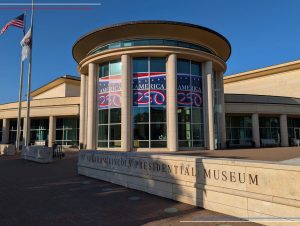
So, when the Abraham Lincoln Presidential Library and Museum asked last fall if she’d be interested in curating an exhibition, how could she say no? How could she turn down a request to commemorate the 250th anniversary of the start of the American Revolution through the lens of her latest book, “The Rise and Fall of the Second American Republic”?
Sinha was doing other work while on sabbatical last year from her UConn teaching responsibilities as the James L. and Shirley A. Draper Chair in American History, and she knew a curatorial project in Springfield, Illinois, would be a significant time commitment – especially since it’d be her first.
But it’d be an honor, she told them.
“I do as much as possible whenever people call on me to talk in public or reach a broader audience,” she says. “The New York Times has just asked me to do something for its anniversary this year. I make the time because as historians, we need to reach a broader public. I know more people will read the object identifiers I wrote for the Lincoln exhibition than will read my book, so I didn’t hesitate to say yes.”
“The Second American Revolution” is up through Jan. 17, 2027, and argues the point of Sinha’s latest book: “The refounding of the American republic took place under Lincoln,” she says. “The first republic fell with the secession of the Deep South states and the Civil War. The republic was then re-created with the passage of the 13th, 14th, and 15th amendments, which abolished slavery, gave citizenship rights and equal protections, and extended the right to vote.”
As Sinha’s exhibition considers the shaping of the country post-Civil War, one closer to home centers on the president that sometimes beats Lincoln in C-SPAN’s annual ranking – George Washington – and his contemporaries who declared war on Britain and started it all.
Finding Stories
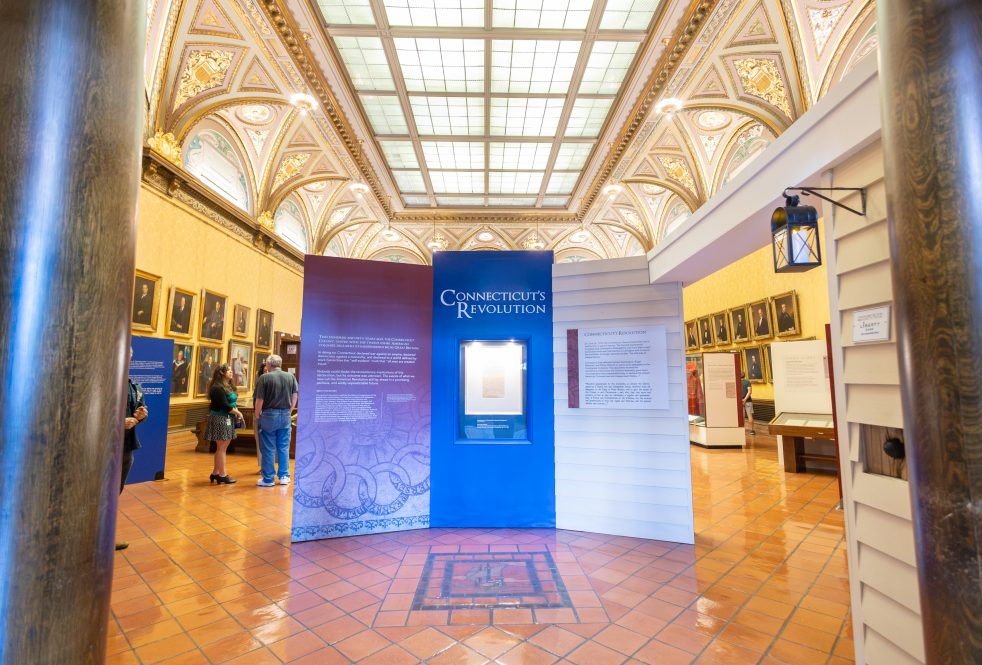
In “Connecticut’s Revolution,” at the Museum of Connecticut History inside the Connecticut State Library in Hartford, a curatorial team that included State Historian Andy Horowitz, an associate professor of history at UConn, delivers the story of the Nutmeg State circa 1776.
“I learned an incredible amount from the archivists and curators at the museum, the depth of their knowledge and research skill at being able to pull out stories from the archive,” Horowitz says. “There’s a ton of paper in there and the stories are there, but they’re lost unless you have these experts willing to do the often-painstaking work of finding a name in an enlistment record and tracing it to find what rations he was given and where he lived, what happened to his wife, and so on.”
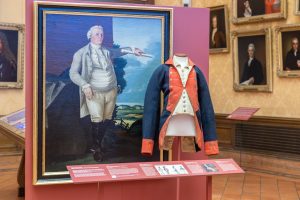
Take for instance, the pocket watch owned by Elisha Bostwick, a New Milford man who crossed the Delaware River with Washington in December 1776. The story might have been lost were it not for collections curator Beth Burgess, who found the watch in a jewelry box that was in storage and pored over military records to authenticate it.
“You’re seeing the good work of a historian and a curator and archivist to put these items into context,” Horowitz says. “Most people are aware of Washington crossing the Delaware because there’s a famous painting of it. This gave the museum an opportunity to tell that story, but to tell it through the story of a common soldier from New Milford.”
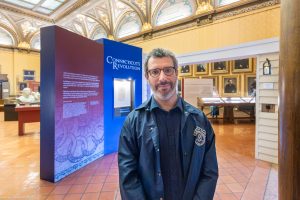
Up until July 9, 2027, “Connecticut’s Revolution” seeks to give visitors what they expect in unexpected ways, Horowitz explains.
The team, headed by museum administrator Jennifer Matos, knew people would want to see the Declaration of Independence, Horowitz says, but the exhibition offers it via the contribution of Mary Katharine Goddard, a New London native who the Continental Congress commissioned to print copies of the Declaration to give to each of the original states.
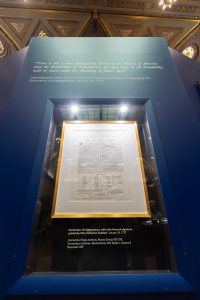
Because she was the printer, her name appears on the bottom of each copy – “Hers is the only woman’s name that appears on the Declaration of Independence,” Horowitz notes.
Ask him about his next favorite artifact and Horowitz heads to what looks like simply a chunk of metal under a glass case and debates how to start telling its story.
“Citizens of the new democracy who were moved into a patriotic fervor, or we could just call them an unruly mob,” he starts, pulled down a 4,000-pound gilded statue of King George III in New York City’s Bowling Green, broke it into pieces, and pulled it on carts into Litchfield, where it was to be melted down and eventually repurposed into 42,000 lead musket balls.
Before the group made it into northwestern Connecticut, they stopped overnight in Wilton, Connecticut, and while everyone was asleep, one or more British Loyalists took several chunks and likely buried them for safekeeping, he continues. That piece, the one on display, was found buried in a garden in Wilton nearly a century later.
“What’s so amazing is you get to imagine a Connecticut, where there are Patriots and Loyalists even here in these little towns,” Horowitz says. “It helps you see the story of Connecticut as the Provision State because even then its citizens were well aware of the material value of the lead and the immediate military use it could be put to.
“It’s also a story about history,” he adds. “You have these colonists who had inherited a history they didn’t want anymore, the history of the monarchy, and they transformed that history into a future they wanted to live in. This artifact carries all of that, and that’s why, to me, it’s one of the most moving pieces.”
Grabbing Attention
Over the last year, Sinha and Horowitz worked with professional staffs at both museums to bring their respective exhibitions to life, and they each describe experiences that gave them a deeper appreciation for the past, surreal in some cases.
For Sinha, that was the teeth marks on the pen that Lincoln used to sign the Emancipation Proclamation, an artifact on rare loan from the Massachusetts Historical Society, which used state troopers as escorts to ensure its safe delivery to the Midwest, she says.
“I’m looking at this Emancipation pen, and I’m thinking Lincoln probably put it in his mouth,” she says. “Those are the kinds of things that really blow my mind. It’s a whole different experience seeing these objects and that’s why museums are so important.”
Horowitz agrees.
“There’s an aura to every item,” he says. “To me, the most important tool that a historian has, and also our highest aspiration as historians, is empathy. We want to see the world through somebody else’s eyes. The aura of the original document or the original object helps me with that empathetic aspiration, helps me remember that these are real people. They’re people who could have been me, could have been like me, could have been my neighbors, and it makes them feel more three-dimensional.”
Sinha – who recently gained additional prominence when Supreme Court Justice Ketanji Brown Jackson cited her latest book in the justice’s concurrence on birthright citizenship and appeared as an expert on the podcast “Reconstruction: The Unfinished Promise” featuring President Barack Obama – got most of her wish list in the Lincoln exhibition.
She says she wanted the 13th Amendment to the Constitution, the one that abolished slavery, on display. The Library had the original but hesitates to display it often because the ink is fading.
“They created a darkened case, which is shut and if you want to view it, you open the case and then it shuts again,” Sinha says, describing the protections around it.
The exhibition also features blown-up images from her book; a 10-minute film with her explaining the three amendments being discussed; a chair from Ford’s Theatre, where Lincoln was assassinated; and a Red Shirt from the namesake white supremacist terrorist group that sought to overthrow Reconstruction.
The exhibition ends with 75-word biographies of 20 women who were key suffragists and women’s right advocates, think Mary Edwards Walker, an Army surgeon who wore pants; Harriet Jacobs, author of the first female slave narrative, “Incidents in the Life of a Slave Girl”; and Lucy Stone, who kept her maiden name upon getting married giving rise to the moniker “Lucy Stoners” for those who followed suit.
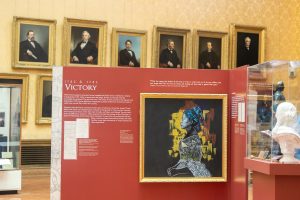
“I knew what would grab people’s attention because when I tell these stories to my students at UConn, they sit up in their chairs and really listen,” Sinha says. “When you’re teaching, you’re constantly trying to get your students’ attention. I imagined museum visitors being my average student who knows some American history but probably has no idea about the period you’re talking about in-depth.”
She continues, “I want those who see this exhibition to go away with the notion of active citizenship. If these women and enslaved people fought for their own freedom, then I don’t think we have any excuse now not to be active citizens, to keep ourselves informed, to be aware of our history, and see how our present is informed by the past. I think that’s what history does.”
The Fall 2026 Draper Workshop, organized by Manisha Sinha as the James L. and Shirley A. Draper Chair in American History, will be held Monday, Nov. 16, at 4:30 p.m. in Herbst Hall, Room 101, at UConn Storrs. A panel of experts, including Connecticut State Historian Andy Horowitz, an associate professor of history at UConn, will discuss “The American Revolution: A 250th Appraisal.” The event is open to the public.