
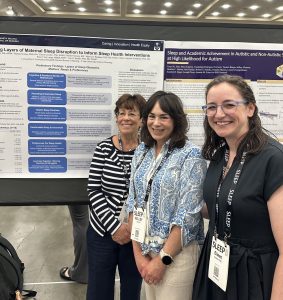
Faculty and student researchers from the UConn Elisabeth DeLuca School of Nursing shared new findings on maternal and family sleep health at SLEEP 2026, the annual meeting of the Associated Professional Sleep Societies, held June 7–11 in Baltimore.
The conference is considered the premier international meeting for sleep and circadian science, bringing together researchers and clinicians from around the world to advance sleep medicine and sleep health.
Representing UConn were Nancy S. Redeker, Ph.D., RN, FAHA, FAAN; Eileen Condon, Ph.D., RN; Yashika Sharma, Ph.D., RN; and doctoral student Kelley LaFleur, MS, APRN.
The team presented research examining how family relationships, caregiving responsibilities, and maternal well-being influence sleep health among mothers and young children.
“These presentations highlight the importance of understanding sleep within the context of family life,” said Redeker. “Our work seeks to develop interventions that are practical, accessible, and responsive to the needs of diverse families.”
Understanding Sleep Challenges Among Mothers
In a late-breaking abstract, doctoral student Kelley LaFleur and colleagues explored the experiences of mothers who serve as primary caregivers for children ages 1 to 6.
Through in-depth interviews with Black, Hispanic, Asian, and multiracial mothers, researchers identified multiple, overlapping factors that contribute to disrupted sleep, including stress, anxiety, competing caregiving responsibilities, and challenges related to their children’s sleep routines.
Participants emphasized the need for flexible, culturally responsive behavioral sleep interventions that incorporate stress-reduction strategies, developmental guidance, and opportunities for peer support.
The findings provide a framework for designing interventions that address the realities of daily caregiving demands and promote sustainable sleep health for families.
The study was supported by the National Institutes of Health through grant R01HL168770.
Examining the Connection Between Mothers’ and Children’s Sleep
A second late-breaking presentation examined sleep patterns among preschool-aged children and their mothers using a novel analytical approach known as the Actor–Partner Interdependence Model.
Researchers analyzed 7 days of sleep data collected via actigraphy and found significant associations between maternal and child sleep patterns.
The study found that a mother’s sleep schedule influenced her child’s sleep timing on subsequent nights and that maternal mental health factors, including stress, anxiety, and depression, were linked to lower sleep quality in children.
Researchers also found that stronger emotional support systems were linked to longer sleep duration for both mothers and children. The findings underscore the importance of viewing sleep as a shared family experience rather than an individual behavior.
Building the Future of Sleep Research at UConn
The research presented at SLEEP 2026 reflects UConn Nursing’s growing leadership in sleep and symptom science and aligns with plans for expanded sleep research capabilities in the School’s new academic building.
Scheduled to open in 2027, the new facility will include dedicated research spaces designed to foster interdisciplinary collaboration and innovation.
“The future sleep research laboratory planned for our new building, DeLuca Hall, represents an exciting opportunity to expand interdisciplinary collaboration and accelerate discoveries that improve health outcomes across the lifespan,” said Dean Victoria Vaughan Dickson, Ph.D., RN, FAHA, FHFSA, FAAN. “By bringing together experts in nursing, behavioral science, technology, and data analytics, we will create an environment where faculty and students can work side-by-side to advance innovative sleep research, address health disparities, and translate evidence into meaningful solutions for individuals, families, and communities.”
Plans for a future sleep research laboratory will create new opportunities for faculty and students to advance the science of sleep health. The space will support interdisciplinary research and provide hands-on training opportunities for undergraduate and graduate students, preparing the next generation of nurse scientists to tackle complex health challenges.
As sleep continues to emerge as a critical factor influencing cardiovascular health, mental health, and overall well-being, UConn researchers are working to translate scientific discoveries into practical solutions that improve the lives of individuals and families.
Additional presentations by UConn researchers at SLEEP 2026 explored a range of topics in sleep health and symptom science, further demonstrating the School’s commitment to addressing complex health challenges through innovative research.
For more information about research at the UConn Elisabeth DeLuca School of Nursing visit nursing.uconn.edu.