If you are reading this on a pleasant summer day, the chances are good that if you pause for a moment and listen, you will hear a background chorus of lawn mowers, leaf blowers, or other landscaping machinery.
Although they are the default landscaping option, manicured lawns can act as net carbon emitters, and they contribute to a host of ecological problems, including plummeting insect populations that are crucial to our well-being. Additionally, runoff is a big problem, and in Connecticut lawn-care product runoff eventually makes its way to the Long Island Sound, where excess nutrients can lead to the development of dead zones and pesticides and herbicides can negatively impact wildlife and the shellfish industry.
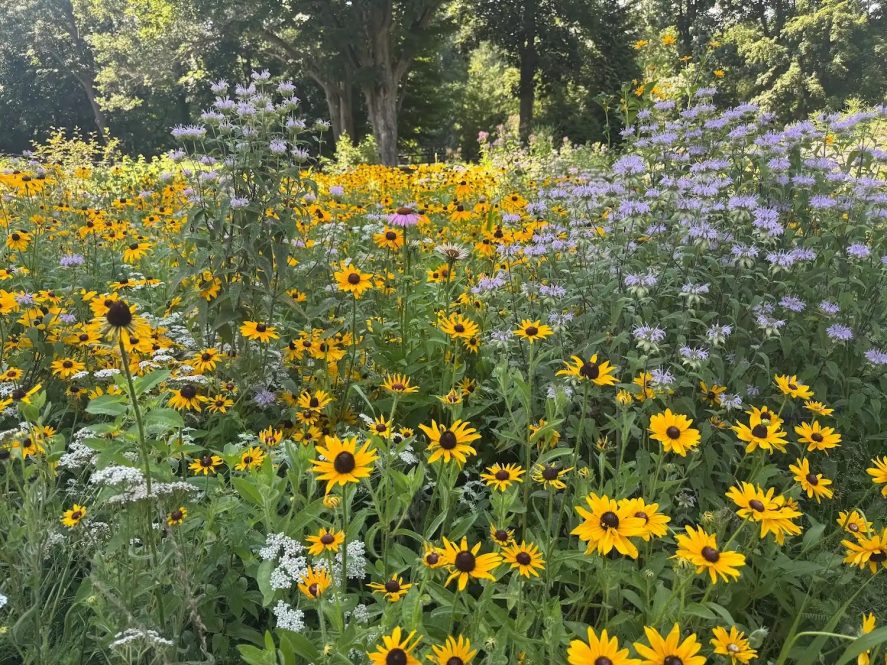
William Sweet ’29 (CLAS) is working to shift the paradigm and raise awareness about a sustainable lawn alternative — native plant meadows. Sweet is carrying on work for this project that began before he arrived at UConn where a Connecticut legislator has worked for similar legislation for two years. With an Office of Sustainability Environmental and Social Sustainability Grant (ESSG), and Department of Ecology and Evolutionary Biology Professor David Wagner as his mentor, Sweet is continuing to develop the legislation, forming coalitions, and engaging the community.

While some lawns space is needed for recreation, Sweet notes that currently there are about 40 to 45 million acres of lawn in the United States, equivalent to double the combined amount of all the fruit, nut, and berry orchards, potato fields, rice fields, and cotton fields. Lawn care is where many of the negative environmental impacts factor into the equation. The wide-ranging impacts have one positive outcome, however, in that it brings together a diverse group of stakeholders who are invested in the topic.
“There’s a problem for each specific issue that a person may care about, whether it’s birding, pesticides, or the carbon aspect,” says Sweet.
Besides coalition building, Sweet has also been speaking to people involved in successful programs from across the country, including in Minnesota and Pennsylvania, to try to find a strategy that could work for Connecticut. Current programs are based on a range of policies and legislation, including provisions about what types of turf can be irrigated with drinking water, to grants and rebates for planting water-wise landscaping, and bills to prevent HOA restrictions on pollinator gardens and other sustainable plantings.
“I have gone through about two hundred versions. Do we measure by square footage, by the linear foot, by the plant, or by the seed? Then there is verification. Who verifies it and which agency does it run through? Every expert I speak with pokes holes in it. I am grateful for that. Each hole they find now is one the bill will not have when it reaches the floor,” says Sweet.
Since every successful example he has come across so far involves instant or near-instant incentives, Sweet is exploring whether the Connecticut Green Bank, which finances home energy improvements through low-interest loans, could help solve the same timing problem for meadows. A tax deduction arrives long after the homeowner has paid for the work.
“We are also exploring the possibility of MS4 (municipal separate storm sewer system) stormwater credit stacking, because meadows can grow roots as deep as 10 to 15 feet, whereas turfgrass roots rarely exceed three inches, meadows are really good at managing the stormwater. Other states have done something similar to this, where they classify native plants as managing stormwater,” says Sweet.
This illustrates additional ways native meadows act as a sustainable landscaping option, from absorbing and filtering runoff while also providing habitat and food sources for wildlife. Sweet hopes that drawing attention to the growing list of benefits will lead more people to eagerly embrace meadows.
Technical questions are a substantial obstacle, says Sweet, such as about which plants to use are critical to address because meadows can be tricky to establish. Sweet hopes the bill will incentivize landscaping companies to help homeowners choose appropriate plants and tackle other challenges like fending off invasive plant species and deer browsing.
Although a degree of troubleshooting especially over the course of the first few years is needed to successfully establish a native meadow, once established, meadows are far less demanding than lawns, says Sweet. For example, a lawn may require 20 to 30 mowings per year, a meadow may require one or two mowings along with a few spot-weeding sessions. Though exact figures vary, studies of the cost differences in maintaining meadows versus turf in residential, corporate, urban, university spaces, and along state highways, consistently show meadows are the most budget-friendly choice. In the case of roadside mowing, Sweet says it also save lives.
“One-hundred and eight roadway workers were killed on the job nationally in 2021, and a 2024 survey of state transportation workers ranked mowing and trimming the third most hazardous of their routine activities,” says Sweet. “Every mowing pass removed is one fewer time a crew stands beside moving traffic.”
Educating the public about how meadows are viewed is another obstacle the project tackles. One person’s thriving, biodiverse meadowscape is another’s unkempt nightmare, however different strategies can help shift these perceptions. Now that we are currently between legislative cycles, Sweet’s focus is on a collaboration with filmmaker Wylie Overstreet to produce a film that can be shared and distributed by environmental groups, like Homegrown National Park, to spread the message, change perspectives, and encourage legislation. Sweet is working with a wide range of experts to ensure the messaging is well-received and as impactful as possible.
“I want to build a template for Connecticut, one that other states will then adopt. Every person already has a reason to care, whether it is birds, pesticides, water, or the cost of their own lawn. That is the whole opportunity.”