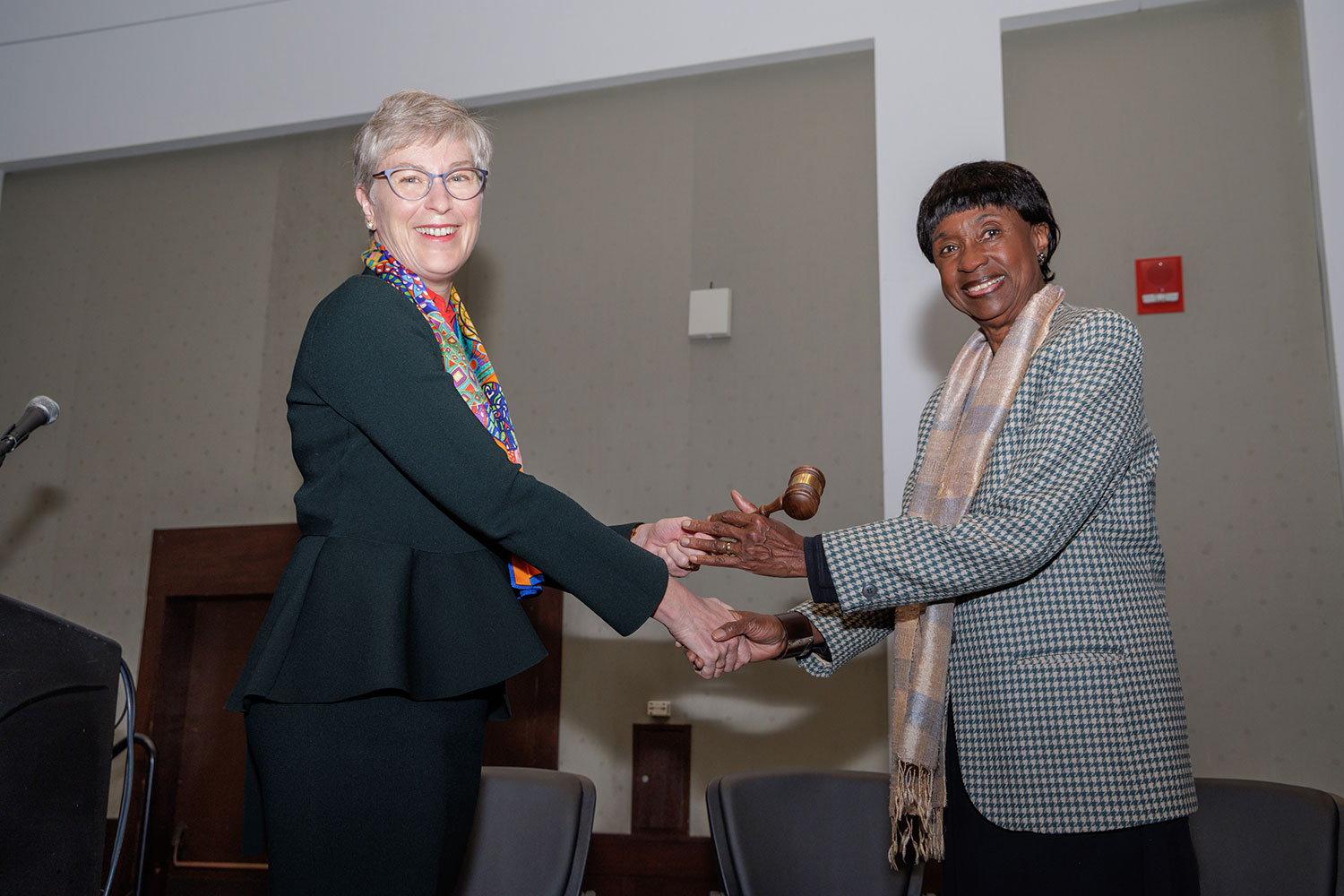
A group of research development leaders from six public research universities across New England, including UConn, has recently been honored with the National Organization of Research Development Professionals (NORDP) Leadership Award. This award recognizes the team’s outstanding contributions to advancing the field of research development.
The New England Public Research Leaders Collaborative includes representatives from the University of Connecticut (UConn), the University of Massachusetts (UMass), the University of Vermont (UVM), the University of New Hampshire (UNH), the University of Maine (UMaine), and the University of Rhode Island (URI).
Its members include:
- Matt Mroz (UConn)
- Dan Riechers (UMass Lowell)
- Bethann Valentine (UMass Lowell)
- Loren Walker (UMass Amherst)
- Jeralyn Haraldsen (UVM)
- Michael Thompson (UNH)
- Mark Milutinovich (UNH)
- Saul Allen (UMaine)
- Karen Markin (URI)
“Internally, we refer to ourselves as the NERDs, for ‘New England Research Development’ group,” jokes Matt Mroz, UConn’s interim director of research development.
The collaborative was officially convened several years ago under the leadership of now-President Radenka Maric, who was serving as the Vice President for Research at the time.
“It’s a good example of what’s possible when we have leadership that wants collaboration, and will support it, and a group of professionals that understands the value of those connections and will do the work to keep them alive,” says Mroz.
Mroz, who was a founding member of the group, recalls the initial establishment period as one of forging enduring research connections. While he acknowledges that the research funding landscape can be competitive, he prefers to look at the potential for collaboration and information-sharing across institutions.
“We realized we had a lot in common with these other New England public universities,” he says. “There was something else there that we hadn’t leveraged. We should talk to one another! So, we started getting this regular group together.”
The group meets monthly to discuss challenges and opportunities facing public institutions in the region. They also host yearly in-person summits to strengthen connections and dive deeper into tricky problems.
“We’re continuing to see a growing number of federal funding opportunities that call for regional collaboration, and that’s especially important for public research universities in New England,” says member Jeralyn Haraldsen, director of research development at UVM. “Through our regular discussions, the NERDs have built relationships and trust that allow us to connect researchers, form stronger partnerships, and position our institutions to compete more effectively for opportunities that no single university could compete for alone.”
With their collective insight, they’ve also innovated new ways to spotlight and advance the vital work of New England RD teams. Together, the group has forged cross-institutional collaborations, shepherded multi-university grant proposals, and produced an economic impact study showing that federal research dollars flowing to their universities generate nearly $1.7 billion in regional economic activity and support over 12,000 jobs across New England.
This report also revealed that every $10 of federal research expenditure in the region generates an additional $18 of economic activity.
Statistics like this help the public, as well as funding partners, grasp the immense ripple effects of university research.
“Public research universities contribute in many ways to the states they serve, often with modest resources,” says member Karen Markin, director of research development at URI. “By joining forces in this collaboration, we can have an even greater impact for our constituencies.”
New England is a national powerhouse of academic activity, including world-class public universities as well as private institutions like Yale, Harvard, and MIT. However, Mroz notes, this latter category of institution has a different sort of research mission; public universities are unique in their obligation to use their public funding to give back to their surrounding communities and states. This common interest unites the missions of New England public research institutions.
As a result of their collaboration, these universities can each be “more effective at serving the state,” says Mroz.
“We’re building collaborations that make us all better. We’re better together rather than as separate competitors,” he adds. “It’s a wonderful thing to be recognized, but the most important thing is to spotlight the cool work that’s happening” in the world of university research development.