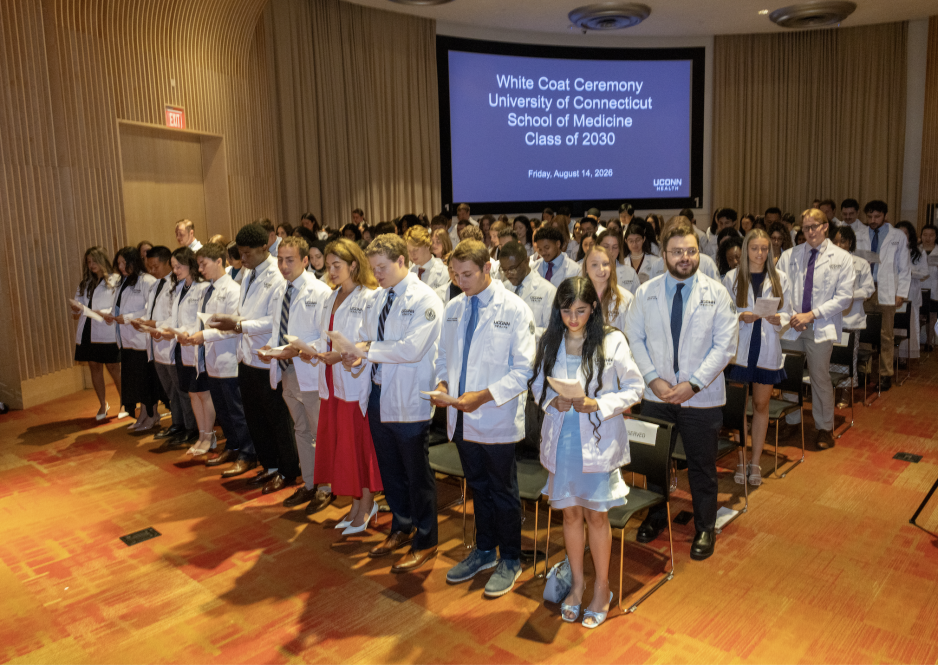
There has been a lot of talk about the new federal lending limits for students studying for graduate and professional degrees. While there is ongoing litigation about which degrees are considered professional and other aspects of the law, Dr. Anton Alerte, associate dean for Primary Care and professor of Pediatrics at UConn School of Medicine, gives his quick take on how this law may impact students and the healthcare workforce.
Q: What’s the quick background on student loans for professional and graduate students?
A: Great question. For decades students have been able to obtain loans to help support their professional education through government sponsored programs. The idea was that the country benefits from having an educated workforce so they would help support that endeavor for graduate and professional degree students, including physicians, nurses, public health specialists, etc.

Q: OK, so what’s changing?
A: Recently, loan limits have been placed on students in professional and graduate degree programs. Professional programs, which include medical school, are capped at $200,000 over the course of their studies, while other graduate programs are capped at $100,000. This was designed primarily to lower the amount of student indebtedness (which is a BIG problem).
Q: This sounds like a good thing, what’s the problem then?
A: Well, the concern is that the cap just isn’t enough to realistically support a medical student’s pursuit of a degree. For example, the in-state tuition at UConn School of Medicine is about $47,000 a year and that’s for an in-state resident. An out-of-state student would pay nearly twice that much in tuition. Here is the other part: students don’t only take out loans to cover just their tuition. They take out loans to cover all of their living and professional expenses during their education. Medical school is a full-time endeavor, so it’s hard for students to work as an option to help support their education like they might have had to do during college.
Also, the classification of professional degree programs vs. graduate degree program could be problematic. For example, nursing, physician assistant, and public health programs are considered graduate programs and have a lower cap. Yet, there are huge workforce shortages for nurses and public health professionals.
Q: Are there any other concerns?
A: Actually, there are and they relate to the potential of students being priced out of a medical education or other graduate education because they can’t afford tuition and living expenses. Students of more modest means may simply be “priced out” due to the unsupported gap. The “American Dream” of you can be anything you want to be if you work hard, just may not be possible for students from lower-income backgrounds.
Q: But, wait a minute, so the federal cap is about $200,000 for medical students, but can’t they just borrow from other lenders, like private lenders?
A: Yes, they can, however, there are a couple of downsides: First, the interest rates on private loans can be higher-much higher. There may be less protections for borrowers and no options for loan deferment or income-based repayment. Although federal programs offered loan forgiveness and deferments in response to the realities of medical students not earning much during their next stage of training (residency), private borrowers don’t need to do that. In addition, many private lenders require strong credit histories or co-signers, creating additional barriers for students from lower-income backgrounds.
Q: Are there other potential downstream effects?
A: Yes, one of the concerns is that loan burden can influence what kind of doctor students choose to be. Important fields, such as primary care, pediatrics, family medicine and internal medicine simply don’t pay as much as other fields and those imbalances may push students to think financially and choose fields, which will help them pay their loans down faster. This can be a big problem because we currently face a severe shortage of primary care physicians, especially in Connecticut and especially in our rural towns.
Also, coupled with the lower loan limits on nursing and other health graduate degrees, there could be even further stress to the healthcare system with vast shortages of necessary healthcare professionals.
More information about how UConn is addressing this issue specifically is available via the Office of Student Financial Aid at 860-679-1364.
The Public Issues Council (PIC) was founded by the faculty at UConn School of Medicine. PIC champions scholarly activities in public health, preventive medicine and health education. It identifies critical health and disease issues for the region and state, prioritizes them and focuses broad faculty effort to improve both healthcare delivery and health education on these issues, as well as provide dissemination of these efforts and pertinent information to the public.