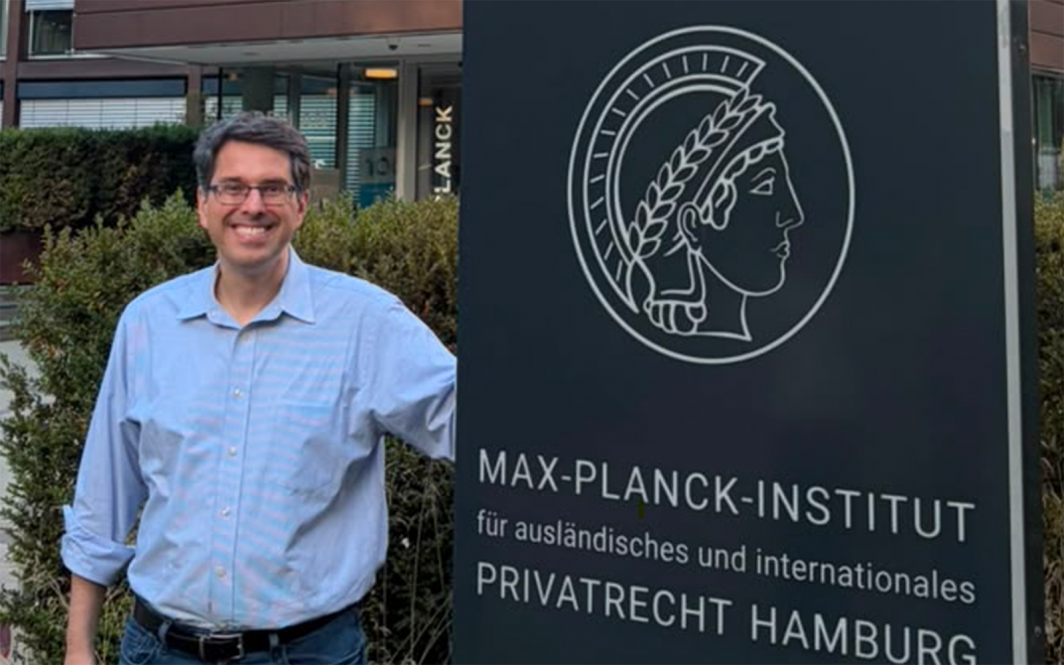
Business law professor Robert Bird gave two lectures last month at the prestigious Max Planck Institute for Comparative and International Private Law in Hamburg, Germany.
The Institute is a top global center for foundational comparative legal research and is renowned for its academic rigor and expert policy advising.
“This visit was helpful in building important networks around the world,’’ Bird said. “Following my presentations, I received invitations to speak at universities in Spain, Serbia, and Japan. This engagement and significant interest in sustainability and competitive advantage reinforces our leadership in business law.’’
Bird spoke to a large group of students, educators, and other professionals about sustainability as a value-creating legal strategy. He referenced his 2025 book, “Legal Knowledge in Organizations: A Source of Strategic and Competitive Advantage,’’ which emphasizes how companies can use legal knowledge proactively to create business value and competitive advantage.
“The transition to sustainable practices is one of the most difficult challenges facing the world today, and it is also an important topic for both business and society,’’ he said. “Companies can and should employ ideas that will not only help save the planet but also build a better business. Sustainability is not merely a burden, but an opportunity for value creation.”
Bird also addressed doctoral students in an informal workshop on research development.
“Both sessions were received with high interest, visited by researchers from the Institute, international guests from all over the world, and friends of the Institute from other legal research institutions in Hamburg,’’ said Vincent Hoppmann, a doctoral student and research associate at the Institute.
“We took away a lot, not only on the strategy behind designing your own research career, but also on the connection of legal strategy with corporate sustainability.,’’ he said. “Drawing on his background within a business faculty, Professor Bird’s perspective provided practical, refreshing insights that resonated strongly with our legal researchers.”