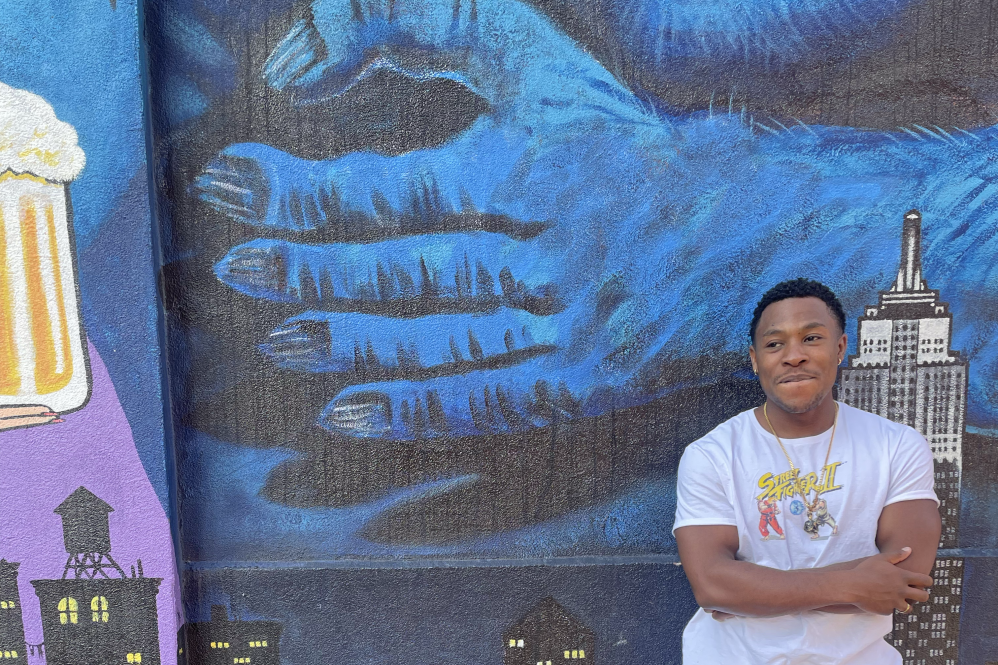
UConn School of Social Work student Sean Excellent wants to help young Black men find a stronger sense of identity, purpose, and well-being — something he knows can be difficult to navigate alone.
Now a second-year master’s student concentrating in Individuals, Groups, and Families, Excellent is preparing to offer that support to others as a future social worker. Along the way, he is finding guidance of his own through UConn’s new Black Male Mental Health Professional Mentoring Program.
A joint initiative of the UConn School of Social Work and the Neag School of Education, the program pairs graduate students with mental health professionals committed to supporting Black men and boys. Through mentorship, training, and professional development, it aims to help students establish lasting careers while strengthening a network of practitioners serving the Greater Hartford community.
For Excellent, the opportunity to learn from another Black man working in mental health is particularly meaningful.
“I know the mentorship will provide me with the knowledge, power, and sense of community that other Black men carry, whether they are my age or older,” he says.
Building a Network of Support
The pilot, formally titled Girding the Roots: A Mentorship Model for Practitioners and Student Trainees to Support Black Male Mental Health Wellbeing, is supported by Greater Hartford Gives Foundation and Beta lots Boule Foundation. The program is open to UConn master’s-level students currently enrolled in mental health training programs, such as counselor education, social work, psychology, or marriage and family therapy.
“Black men and boys can experience unique pressures and challenges, and as social workers, we need to understand how discrimination, economic inequities, family dynamics, and societal expectations around masculinity can affect their mental health,” says Milagros Marrero-Johnson, MSW, adjunct faculty and senior director of strategic initiatives and community engagement in the UConn School of Social Work.
Equally important, she says, is the need to demystify mental health by reducing stigma, fostering open dialogue, and challenging misconceptions that often prevent Black men and boys from seeking support. By increasing awareness and promoting culturally responsive approaches, “social workers can play a critical role in creating environments where Black men and boys feel empowered to prioritize their mental well-being and access needed resources.”
Marrero-Johnson(opens in new tab) and Latoya Haynes-Thoby(opens in new tab), project PI and assistant professor of counselor education in the Neag School of Education, oversee the program.
“This project aims to increase access to mental health services for Black men and boys through the development of concrete supports that aid in the retention of students enrolled in counseling, social work, psychology and marriage and family therapy programs, as well as the career longevity of practitioners that are committed to serving Black men and boys in the Greater Hartford area community.” Haynes-Thoby says. “Counselors understand the importance of not only celebrating all that Black men and boys contribute to our communities, but also the necessity of creating real avenues to support their long-term mental health and wellbeing.”
Learning through Experience
Excellent grew up in a single-mother household and lacked guidance of a father or other male figure in his life.
He attended a private school in Stratford, Connecticut, where he was the only Black person among the student body and faculty.
“I received wisdom from the women in my life, but I had my own journey in establishing who I was as a Black man,” Excellent says. “I was never taught our culture, only the pain and stereotypes we have to endure.”
His program mentor, Maurice Eastwood, LMSW, of Seek Therapy in Hartford(opens in new tab) and author of The 5 Bags: The Tools to Building a More Superior You, understands how their relationship offers an opportunity to help an emerging social worker recognize both his abilities and the impact he can have.
“Sean is a great young man,” Eastwood says. “He’s very prompt, he shows up, and he consistently overachieves. But beyond those qualities, it means a lot to me to be able to mentor another man of color, especially in a field where you still don’t see as many men of color represented.”
Mentorship, Eastwood says, extends beyond navigating coursework or choosing a career path.
“I want Sean to understand that his presence matters and that the work he does can open doors and create opportunities for the young men who come after him.”
That consistent connection is central to the program. Students and their mentors meet at least once a month, creating space for guidance and support throughout the year. Separate retreats for mentors and mentees help participants connect with their peers and build community.
Students also complete training in child sexual abuse prevention and trauma-informed counseling. Four professional development roundtables bring together experts from across the mental health field to share strategies and practical perspectives on supporting Black men and boys, while helping participants expand their professional networks.
Each student receives a $4,500 stipend to help offset the cost of education and participation.
I know the mentorship will provide me with the knowledge, power, and sense of community that other Black men carry, whether they are my age or older. — MSW student Sean Excellent
Preparing the Next Generation of Mentors
For Excellent, the experience is an opportunity to strengthen his advocacy and clarify where he wants to practice. He hopes to help young Black men recognize their value and possibilities, regardless of their upbringing or the expectations placed on them.
Eastwood hopes Excellent carries that sense of purpose into his work — and recognizes that the example he sets can matter even when he does not realize someone is watching.
“Ultimately, I hope he walks away from this experience with confidence, a stronger sense of purpose, and an understanding that being a man of color in social work isn’t just about having a seat at the table,” Eastwood says. “It’s about making sure there is room for the next person to sit down too.”
Excellent already envisions returning to the program as a mentor himself.
“I hope to become a stronger advocate and build community with those around me,” he says. “This will allow me to have a clearer focus on where exactly I want to practice and how to engage the conversation regarding Black male mental health, even if possible, reentering this program as a mentor to repay the favor!”
Applications are accepted until all program slots are filled. Eligible students must be entering the final year of a master’s program in counselor education, social work, psychology, or marriage and family therapy; reside, work, or attend school in Greater Hartford; and demonstrate a long-term commitment to supporting Black men and boys. Learn more about the program and how to apply.