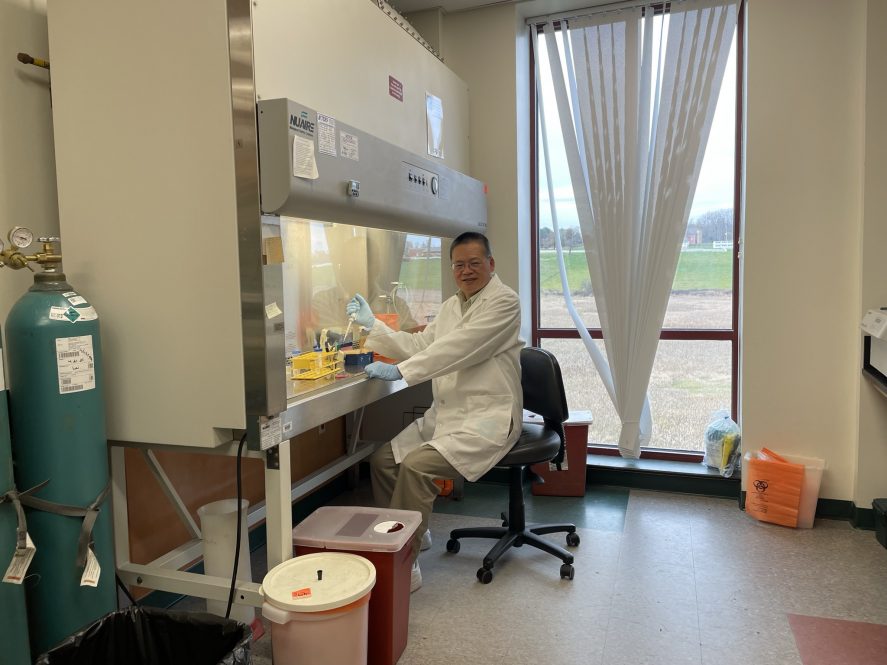
Laijun Lai, research professor of allied health sciences in the College of Agriculture, Health and Natural Resources (CAHNR), has received a $3.5 million grant from the National Institutes of Health (NIH) to develop a novel therapy aimed at improving immune function in older adults. Laura Haynes, professor of immunology at the UConn Center on Aging, is a co-investigator on this five-year grant.
As we get older, our immune function naturally declines. This is why a virus that causes a cold that clears in a few days in a younger person can cause life-threatening illness in older people. This decline also makes vaccines less effective, and increases one’s susceptibility to developing cancer as the body cannot fight off malignant cells as effectively.
“Aging affects multiple organ systems, and the immune system is among the most significantly affected,” Lai says. “Age-related T-cell immunodeficiency can be further exacerbated by chemotherapy, radiation, infections, and conditioning regimes associated with organ transplantation.”
The root cause of this decline is found at the cellular level – a process called thymic atrophy. Thymic atrophy is the shrinking of the thymus with age. The thymus is an organ in the chest where T cells (an essential component of the immune system) mature. As it shrinks, the thymus gradually develops fewer and fewer T cells, leading to a weakened immune system.
“Among age-related changes in the immune system, thymic atrophy is one of the most dramatic and consistent,” Lai says. “Restoring thymic function in older adults could have important therapeutic implications.”
Lai is using human induced pluripotent stem cells (hiPSCs) to develop thymic epithelial cells (TECs). The qualitative and quantitative decline in TECs with age is one of the key causes of reduced thymic function. Thus, restoring TEC levels with well-functioning cells offers a promising route for improving thymic performance.
Lai’s lab previously demonstrated the ability to produce TECs from embryonic stem cells and successfully transplanted them into animal models. In this study, however, he is turning to hiPSCs because they can be taken directly from patients, using blood samples. Both embryonic stem cells and hiPSCs can self-renew indefinitely and be induced to develop into a variety of cell types. Using hiPSCs reduces the risk of a patient’s body rejecting a transplant.
“hiPSCs offer an important advantage for potential clinical applications because they can be generated from a patient’s own somatic cells,” Lai says. “The ability to reprogram human somatic cells into hiPSCs provides a potentially unlimited source of patient-specific cells for disease modeling and regenerative therapies.”
In this grant, Lai’s lab will be using human patient samples to produce TECs and testing their efficacy in animal models. They will analyze the number and function of TECs, as well as the number and function of newly generated T cells. The latter will be evaluated by challenging the model with an influenza virus and seeing how well it fights the virus off.
The development of a therapy to restore thymic function would be the first successful approach for preventing or reversing age-related thymic atrophy and T-cell immunodeficiency.
“We hope we can eventually generate hiPSCs-derived TECs that can be used in the treatment of severe T-cell immunodeficiency,” Lai says. “Currently there are no approaches to address T-cell immunodeficiency in older adults.”
Lai has another active NIH grant looking at using this approach for improving thymic function in people with a genetic disorder called CHARGE syndrome that causes T-cell immunodeficiency. This new grant brings his total funding for this research to more than $7 million.