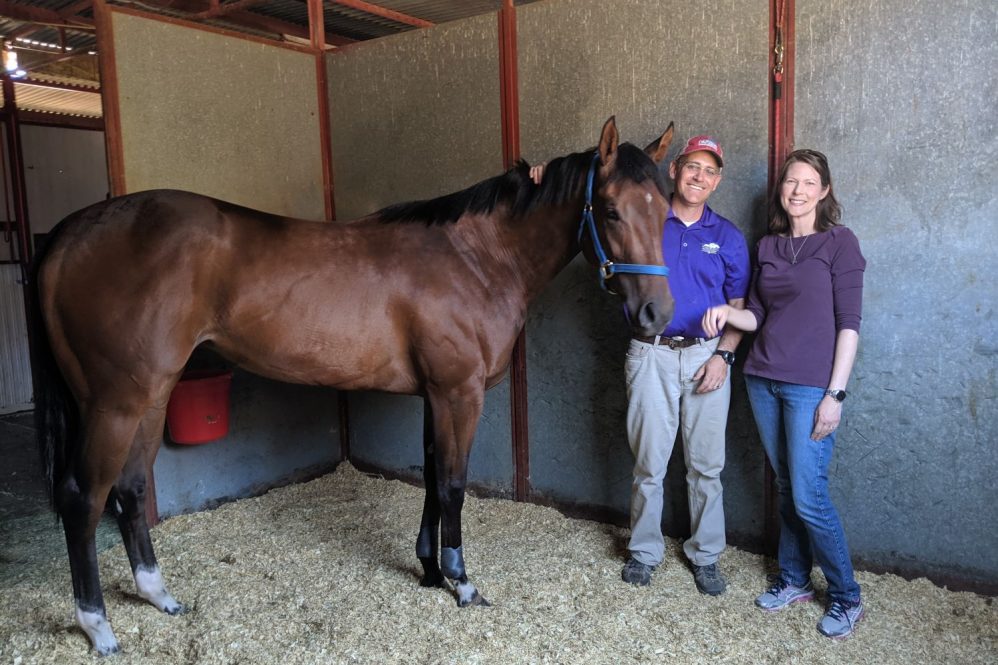
Clayton McCook ’05 (CAHNR) always knew he wanted to work with horses. Doing a master’s degree in animal science at UConn helped McCook who now works as an equine veterinarian, get there.
“I feel so blessed,” McCook says. “I love horses. I don’t remember a time when horses weren’t a part of my life, and so being able to make my living working with and serving horses and taking care of them is just a joy.”
McCook grew up on a small farm in Texas and comes from a long line of farmers and ranchers on his father’s side. Both of McCook’s maternal grandparents worked in healthcare.
“That combination of being around medicine and science and also growing up in the country, it was an easy fit for me to think about being a veterinarian,” McCook says.
After completing his undergraduate degree at Texas Christian University, McCook wasn’t quite ready academically to go straight to veterinary school. This led him to UConn.
“I’ll never forget the first time I drove on campus,” McCook says. “I was shocked…Coming up over the hill and seeing the Dairy Bar and seeing the animal science program. I thought, this is more in line with what is comfortable for me, being a kid from the country.”
McCook worked in the lab of Kumar Venkitanarayanan, now dean and director of the College of Agriculture, Health and Natural Resources (CAHNR). McCook says Venkitanarayanan served as a mentor to him, and the other graduate students in the lab and helped create a supportive environment.
McCook also worked as a necropsy assistant in the Department of Pathobiology and Veterinary Science.
“I was a long way from home,” McCook says. “It was a culture shock in so many ways to be up there. But I felt like so many people just rallied around me and took me in, and I will always be grateful for that.”
The academic rigor of UConn’s program gave McCook the skills he needed to succeed in a veterinary medicine program.
“It really laid the foundation for me to get the maturity that was required to not just get accepted into vet school, but to actually handle that school,” McCook says.
McCook now works as a partner at Equine Sports Medicine and Surgery in Oklahoma. He says his research experience at UConn has also given him a leg up as a professional.
“If an interesting paper comes out, I feel like I have a really good handle on how to interpret and how to read it,” McCook says.
A large part of the McCook’s work centers on racehorses. He is at the track every day during the racing season, working closely with trainers to provide both primary care for the horses and addressing concerns related to their sport performance.
“Our goal and our job is to make sure that these amazing athletes are healthy and they’re sound, and they have all the tools they need to perform at their best,” McCook says.
While most people know about Thoroughbred racing, McCook also works with a much more niche group of racehorses – Quarter Horses.
Compared with Thoroughbreds, Quarter Horses are much faster across shorter distances. The name “Quarter Horse” refers to the fact that their traditional racing distance is just a quarter of a mile. Quarter Horse races can be over in just 20 seconds.
“The training is different,” McCook says. “Everything is different from the way they look – my patients tend to be shorter, stockier, they look like sprinters.”
From a veterinary perspective, this also means Quarter Horses are more prone to certain racing-related ailments than Thoroughbreds, and vice versa.
“It’s a real balance to try to figure out how do we train appropriately, but how do we not push them to the point where we’re actually causing issues with our training,” McCook says.
McCook says he values the inherently collaborative nature of veterinary medicine.
“Equine medicine is a real challenge,” McCook says. “It’s not something I could every think about doing on my own. [I’m so happy] to be able to work with an amazing group of talented people within our practice, from experienced track vets to our surgeons and internist. We work very hard to provide the best care possible.”
This work relates to CAHNR’s Strategic Vision area focused on Enhancing Health and Well-Being Locally, Nationally, and Globally.
Follow UConn CAHNR on social media