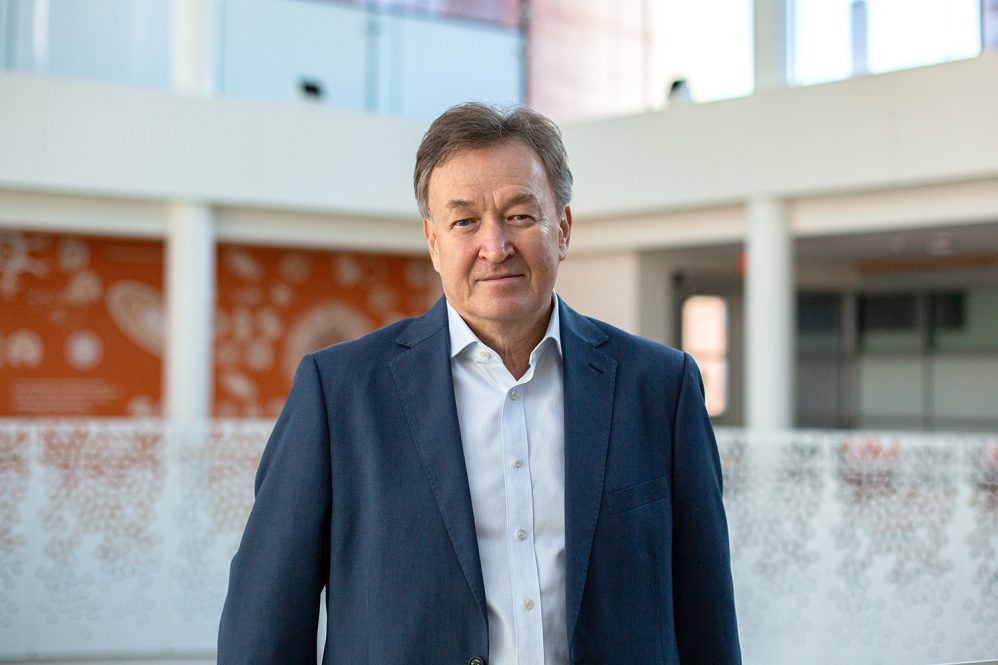
Dmitri Kharzeev, professor of physics in UConn’s College of Liberal Arts and Sciences, has been awarded the American Physical Society’s 2027 Herman Feshbach Prize in Theoretical Nuclear Physics.
Presented annually, the prize recognizes outstanding research in theoretical nuclear physics and is among the field’s most prestigious honors.
Kharzeev was selected for his pioneering contributions connecting fundamental properties of quantum chromodynamics, the theory describing the interactions of quarks and gluons, to observable phenomena in high-energy nuclear collisions and quantum materials. He was also recognized for opening new interdisciplinary directions in nuclear physics and condensed matter.
“This award is, foremost, a testament to Dr. Kharzeev’s intellect and groundbreaking contributions to theoretical physics,” says George Gibson, professor and head of physics. “It is also a gratifying affirmation of why we recruited Dr. Kharzeev to join UConn during this exciting time of ferment in all things quantum. We are very fortunate to have him here in the Department of Physics.”
Kharzeev is an internationally recognized theoretical physicist whose research spans quantum information, nuclear physics, quantum field theory, and condensed matter physics. Before joining the Department of Physics in 2026, he was a distinguished professor at Stony Brook University and was head of the Nuclear Theory Group and RIKEN-BNL Theory Group at Brookhaven National Laboratory. He also held research positions at the European Council for Nuclear Research (CERN) in Switzerland and the Istituto Nazionale di Fisica Nucleare in Italy.
A fellow of the American Physical Society and the American Association for the Advancement of Science, Kharzeev has also received the Alexander von Humboldt Foundation’s Humboldt Prize and was elected a foreign member of Academia Europaea.
At UConn, Kharzeev is helping advance the University’s interdisciplinary quantum research initiatives, including the UConn Quantum Institute and the NSF-funded QuantumCT Engine, which brings together academic, government, and industry partners to advance quantum research and innovation in Connecticut.
“I am deeply honored to receive the Herman Feshbach Prize, and I share this recognition with my mentors, students, and collaborators who made my work possible,” says Kharzeev. “I am grateful to UConn for welcoming me so warmly, and I look forward to helping build the new UConn Quantum Institute alongside colleagues I admire.”