UConn has found its ideal expert to advance its rise as a leader in interdisciplinary quantum research.
Internationally renowned quantum physicist Dmitri Kharzeev has joined the UConn faculty as a professor of physics in the College of Liberal Arts and Sciences. He brings to Connecticut a distinguished career as a quantum researcher, educator, and fellow at the Brookhaven National Laboratory. He comes to UConn directly from Stony Brook University in New York, where he was a distinguished professor of physics.
Lindsay DiStefano, UConn’s interim vice president for research, innovation, and entrepreneurship, is excited to welcome Kharzeev to UConn.
“He will help us build a network that connects investigators across disciplines through compelling and groundbreaking research,” DiStefano says. “Already, we see UConn researchers excited about building quantum algorithms to rapidly identify the best treatments for diseases, creating innovative materials through quantum technologies, and developing innovative strategies using quantum computing that enhance our financial and insurance sectors. Through Dr. Kharzeev’s leadership and expertise, UConn researchers will develop transformative new applications of these technologies to help solve our toughest scientific and technical challenges.”
With UConn and the State of Connecticut’s burgeoning development as a quantum research and technology accelerator, Kharzeev says the time was right for his move. Additionally, he has connections with many UConn faculty members and looks forward to collaborative research in quantum and other disciplines.
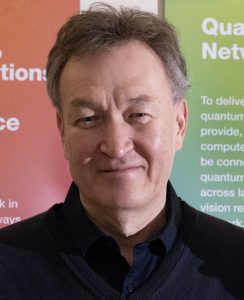
“Quantum science is often described as following a familiar path from fundamental discovery to transformative technology. My view is a little different,” says Kharzeev. “What we are witnessing today is not simply a one-way transition from science to technology, but a synthesis of the two. Fundamental discoveries are giving rise to powerful new quantum technologies, while these technologies, in turn, are becoming new tools for exploring nature and making fundamental discoveries. It is this continuous interplay between discovery and innovation that makes the quantum revolution so exciting.”
Kharzeev comes to UConn at a pivotal time, with record-breaking federal and state funding supporting the growth of quantum research and infrastructure. He will help lead the UConn Quantum Alliance, an interdisciplinary group of dozens of faculty members all conducting research in quantum-related disciplines.
In the bigger picture, Kharzeev will be an important figure in the UConn-led QuantumCT Engine. The National Science Foundation (NSF)-funded program synergizes academia, government, and public and private industry to advance Connecticut as an accelerator for quantum innovation that can deliver broad societal and economic benefits.
In July, UConn was awarded a two-year, $15 million NSF Regional Innovation Engine, one of only 12 projects nationwide to be funded. The grant could potentially grow to $160 million over 10 years, with an additional $121 million of state investments already made or promised to build Connecticut’s quantum infrastructure.
“You’d be hard pressed to find a more qualified quantum physicist than Dmitri Kharzeev,” says UConn Provost Pamir Alpay, the principal investigator in the QuantumCT Engine. “His distinguished career as a fellow at Brookhaven National Laboratory and as a faculty member at Stony Brook University has earned him great respect within the international quantum community. I am confident he will significantly advance UConn’s research initiatives in quantum science and engineering, and he will play an important role in the QuantumCT Engine as we work with our partners to build the quantum future.”
Kharzeev led the Nuclear Theory Group at Brookhaven National Laboratory and served as director of the Center for Nuclear Theory at Stony Brook University, where he also headed Stony Brook’s efforts within the Co-design Center for Quantum Advantage (C2QA), a U.S. Department of Energy National Quantum Information Science Research Center.
Now at UConn, Kharzeev says he is excited by the strong quantum research infrastructure already in place—and even more by what is coming next. New facilities and capabilities are being developed both at UConn and across Connecticut, creating an increasingly powerful ecosystem for quantum research, education, and innovation.
Unique to Connecticut, he says, is a strong industrial base that is well positioned to benefit from advances in quantum science and technology, including computing, materials, financial technologies, pharmaceuticals, cybersecurity, national security and defense, energy, and communications. Kharzeev sees an important role for UConn in connecting fundamental research with the challenges facing these industries, creating a two-way exchange in which scientific advances enable new technologies while real-world problems inspire new directions for research.
“I think the potential here is outstanding,” Kharzeev says. “Quantum computers, quantum sensors, and other emerging quantum technologies are not simply applications of what we already know—they are new instruments of discovery and innovation. They allow us to tackle problems that were previously beyond our reach, from understanding fundamental laws of nature to solving some of the most difficult problems facing industry. In turn, pursuing these new frontiers in science and technology drives the development of even more powerful quantum tools.”
“The goal of the Quantum Alliance is to bring together researchers who develop quantum technologies, scientists who use them to explore fundamental questions, and industry partners who can turn new capabilities into real-world impact,” he continues. “I believe some of the most exciting advances will happen at these interfaces.”
Connecticut’s quantum future depends on educating its students and workforce with the skills they will need to be competitive and fulfill the demands of rapidly evolving industry. Kharzeev says that is an important challenge for UConn.
“UConn is one of the best public universities in the country, and educating the next generation is a crucial role for us to play in building Connecticut’s quantum future,” Kharzeev says. “The quantum workforce will require scientists and engineers who can work across traditional boundaries—connecting quantum science with computing, materials, chemistry, engineering, and other fields. UConn should become an important source of quantum talent for Connecticut and for the nation.”