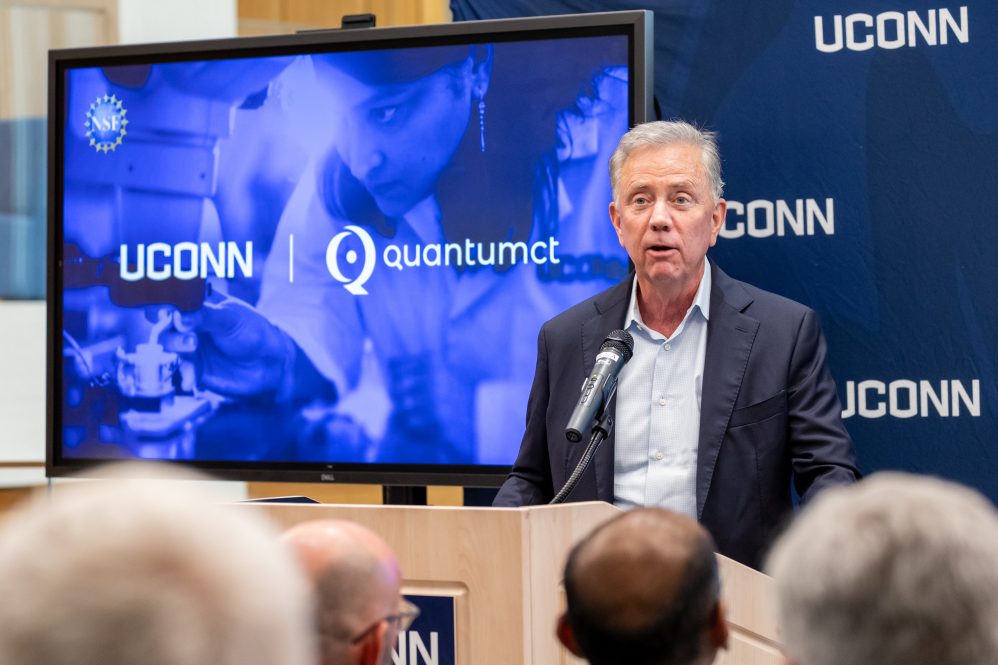
After four years of close collaboration and sustained effort, UConn and its QuantumCT partners are heralding a key milestone in Connecticut’s emergence as a “capital for quantum.”
On Wednesday, state officials and partners of the QuantumCT Engine gathered at UConn Hartford to celebrate the award of a National Science Foundation (NSF) Regional Innovation Engine. Earlier this week, the NSF Quantum Technologies Engine in Connecticut was one of 12 teams nationwide to receive an NSF Engines award, which could total $160 million over a 10-year period.
“I am really proud of the team here. There were [more than] 250 applications for this and here is Connecticut standing,” said Government Ned Lamont, continuing, “This is how Connecticut stays ahead of the curve. We have always been one of the most innovative economies, and to keep our industries ahead of the curve, this is what have we to do.”
UConn, the awardee, partnered with Yale, Southern Connecticut State University, Connecticut State Community College, ConnCORP, CT Innovations, industry leaders, nonprofit and educational institutions, and the state on the proposal. The Engines award positions Connecticut as a leader in American quantum innovation, securing the domestic quantum supply chain by accelerating the commercialization of quantum technologies for national defense, biotechnology, and financial services. Through innovation, applied research leading to new technologies, support for inventors and entrepreneurs, and workforce development, the NSF Quantum Technologies Engine is advancing quantum sensing, secured communications, computing, and advanced materials through applied research, shared testbed, deep-tech incubator, and translation pathways.
This is how Connecticut stays ahead of the curve. We have always been one of the most innovative economies, and to keep our industries ahead of the curve, this is what have we to do. — Government Ned Lamont
The QuantumCT Engine was the only quantum-related proposal to receive an NSF Engines award. Connecticut is on a transformative path as the state economy embraces the potential of quantum technology.
“The competition among states for quantum leadership is fierce. And now Connecticut has entered the competition. And as all of you know, Huskies play to win,” said UConn President Radenka Maric.
By conservative estimates, quantum is expected to generate between $450 and $800 billion over the next 15 years. Applications are numerous across industries including advanced manufacturing, national security, finance, medicine and healthcare, and pharmaceuticals – all of which are critical to Connecticut’s economy. Leaders from several of the state’s top companies, including Travelers, General Dynamic-Electric Boat, RTX, Biohaven, and Boehringer-Ingelheim, were on hand on Wednesday to celebrate the award.
“With this grant, Connecticut has an opportunity to establish itself as a leader in quantum technologies and their real-world applications,” said Carine Boustany, senior vice president at Boehringer-Ingelheim. “It is an exciting example of how our state is investing in the future and creating an environment where breakthrough innovation can thrive.”
Connecticut Commissioner of Department of Economic and Community Development Dan O’Keefe has championed the QuantumCT Engine from the start.
“We have a right to win here. I am just so incredibly proud of how we all came out. We showed one Connecticut. QuantumCT is more than just a public-private pipeline. QuantumCT is representative of how it works when we all come together and compete to win,” O’Keefe said.
Building an Ecosystem
UConn faculty are highly active in quantum research, as exemplified by the Quantum Alliance of interdisciplinary experts. Among them is Provost Pamir Alpay, principal investigator (PI) on the Engines award, who along with Yale Vice Provost for Research and Engines co-PI Michael Crair, saw the potential for quantum as Connecticut’s pathway to economic impact through technology innovation.
That collaboration began with an NSF call for proposals in 2022, which attracted partners statewide and resulted in a $1 million engine development award. The development award laid the foundation for the larger innovation engine effort and established QuantumCT, a nonprofit, public-private partnership established to build the quantum ecosystem in Connecticut. UConn, Yale, Southern Connecticut State University, industry leaders, and the Connecticut Department of Economic and Community Development shape the QuantumCT nonprofit by serving on its governing board.
The proposal for the NSF Quantum Technology Engine in Connecticut was submitted in early 2025 following a highly competitive process. Nearly 300 ideas were initially submitted to NSF, kicking off a high-stakes competition for billions of dollars in federal funding that supported regional innovation.
The state demonstrated its commitment with an investment of $61 million to support building a quantum corridor, headquartered in New Haven. Governor Lamont promised another $60 million to QuantumCT if the NSF proposal was successful.
By the fall of 2025, only 15 proposals remained as finalists for the Engines awards. NSF conducted site visits across the country to meet with proposing teams, with Connecticut hosting NSF reviewers in December 2025. While waiting for a decision, the state continued building the quantum ecosystem and preparing for the award’s impact. Meanwhile, UConn and its public and private partners engaged in levels of collaboration unprecedented in the state’s history.
On Tuesday, July 14, all that work was recognized. Alpay and Crair traveled to Washington for an NSF Engines orientation event and Capitol Hill press conference announcing the program’s awardees, including the QuantumCT Engine. As a result, neither was able to attend Wednesday’s event in Hartford, though their collaboration was heralded as a major achievement.
“With this transformative award, NSF has recognized the scale of QuantumCT’s ambition and its potential to accelerate the quantum revolution for our state, region, and the United States as a whole,” said Yale President Maurie McInnis. “I am so proud of this effort to develop real-world solutions that enrich our communities and of the spirit of collaboration that it represents. Together with our partners at UConn and across the state, we have been able to drive innovation and unleash economic growth, while fulfilling Yale’s vital mission of research and education.”
Quantum Education and Workforce Development
One of the most important goals of the QuantumCT Engine is to educate Connecticut students and workers on quantum to prepare them for jobs in the quantum economy. While the science is advanced, quantum has already impacted many technologies that touch people’s daily lives, such as their phones and televisions. On a grander scale, scientists and engineers are improving manufacturing, enhancing national security, and improving deliverables of lifesaving medicine and diagnoses.
Leading world economies including the U.S. are prioritizing quantum research and development. As technology continues to improve and quantum takes on a larger role in industry, it will become increasingly important for Connecticut students and workers to have the skills needed to employ the concepts in their professions.
“The breakthroughs that will come from quantum technologies over the coming decades will not be achieved by technology alone,” said Christine Broadbridge, executive director of research and innovation for Southern Connecticut State University and a co-PI on the proposal. “They will be driven by talented people who are prepared to ask questions, solve problems, and work across disciplines. Many of those future innovators are sitting in classrooms and laboratories across Connecticut right now.”
State Representative Toni Walker, the co-chair of the General Assembly’s Appropriations Committee, said research is key and quantum education must begin early.
“I want quantum technology to be vocabulary words for every 5th grader in Connecticut,” said Walker. “That is where we are going to start.”
Meeting Benchmarks
The NSF’s initial Engine award to UConn is for $15 million for two years. The QuantumCT Engine must meet benchmarks to qualify for additional funds totaling up to $160 million. Engine leaders will work closely with NSF program managers who regularly review progress, including formal program reviews at year 2 and year 5. Maric said that if there are no other milestones to reach after five years, it means that QuantumCT has done its job.
“We are going to be the capital of quantum, not just the capital of basketball,” Maric said.