Pedro’s first job in the United States was on a farm. He was just 14 years old.
“I was still a child,” he says in Spanish, but he’d moved from Mexico in search of the American dream. Which, for him, meant going to work – he didn’t have the opportunity to seek an education.
He grew up in the U.S., later met his wife, and together they had three children. It took time, but his extended family – parents and siblings – all moved from Mexico as well.
He came to work at UConn in 2006, and over the past 20 years, he’s encountered many, many students.
At his post in Werth Tower, Pedro was there when they started their UConn journeys, as they made new friends, as they learned how to be independent – many for the first time in their lives – and as they celebrated wins and struggled through challenges.
But a lot of those same students probably never even noticed Pedro.
And if they did, they might not have known his name.
And if they knew his name, they likely did not know the story of a 14-year-old boy going to work on a farm in a new country, of a father seeking better opportunities for his own children, and of a member of the UConn community who takes nothing but pride in his work and in witnessing the successes of those around him.
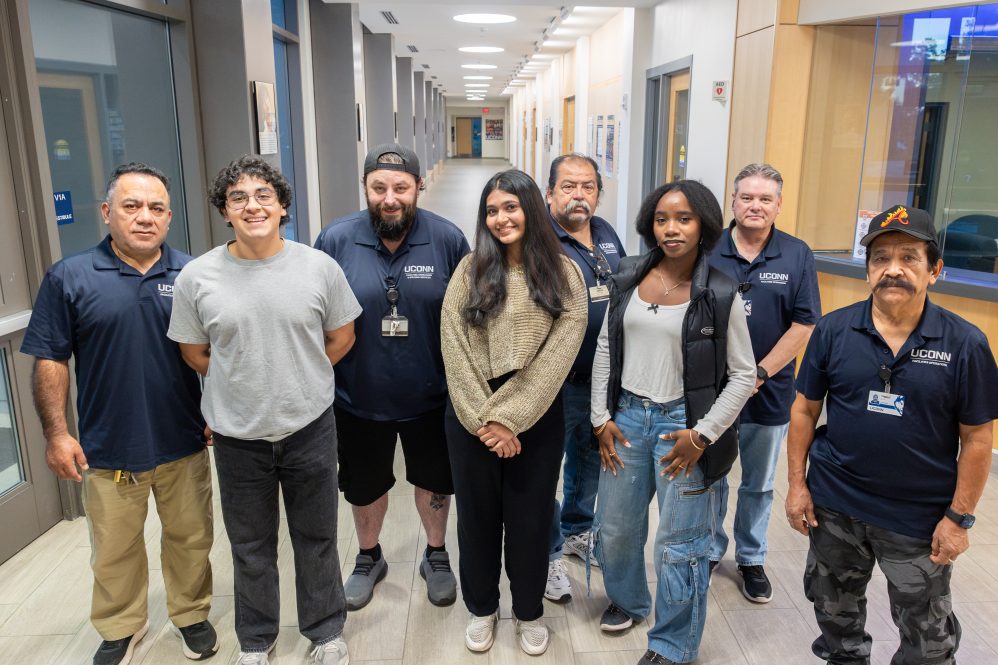
But Ricardo Andrade ’28 (CAHNR), Pierrette Lusamba Cisasayi ’28 (CLAS), and Tanisha Varkala ’28 (CLAS) know Pedro’s story– all three are students who previously lived in Werth Tower as part of the Public Health House Learning Community.
And the trio of Andrade, Lusamba Cisasayi, and Varkala want other students to know Pedro, too – but not just Pedro.
They want their friends and classmates, students who live in Werth and in other places on campus, to also know Rigoberto. And Aaron, and George, and Jesus.
Because these staff, the students say, are the “silent pillars” of the UConn community, serving in essential roles, but often going unnoticed – a dynamic they want to help change.
“Imagine a house, or a building,” says Varkala. “Imagine the building is UConn. Without them, without pillars, the building will fall. There’s no foundation.
“UConn without its custodial staff, without people who work in the kitchens, without the people who garden – all of that would fall with nobody to do the job that is needed.”
Something So Beautiful
Andrade also moved to the United States as a teenager, though with different opportunities from Pedro. He’s studying allied health sciences and wants to pursue a career as a cardiovascular perfusionist – a specialized healthcare provider who operates a heart-lung machine during open-heart surgeries and other procedures.
When he got to know Pedro, Andrade found he could relate to a lot of Pedro’s story.
“Pedro was one of the biggest influences,” Andrade says. “He sees us as family.”
“Every time you see Pedro, it’s a nice smile or ‘hi’ or a conversation,” says Varkala, a pre-med molecular and cell biology major who hopes to specialize in obstetrics or pediatrics in the future.
Through Pedro, the students – who had formed a friendship while living together in the learning community – met other members of the custodial staff in Werth Tower and found commonalities in life experiences with all of them.
“We’ve all had family members or people who we care about come from places where their work is not recognized, even though they put in so much hard work,” Varkala says. “Because of that, we’re all very close with the custodial staff at Werth.”
Lusamba Cisasayi – a pre-med physiology and neurobiology major who says her dream is to start her own medical practice one day – experienced it herself, she says, when working at a campus food truck as a sophomore – people would pass by as she worked without seeming to even notice she was there.
“Everyone was going about their lives while I was carrying trays,” she says. “It’s kind of like everyone’s just walking parallel with one another.”
After the students learned about the staff and their lives, their work at UConn, and how they felt about the young people living and learning around them as they worked each day, they decided they wanted to do something to help recognize the people who had over time become important in the trio’s own lives – even beyond the work that they did as staff to keep living spaces clean and well-maintained.
So, they started planning.
“When Ricardo suggested that he wanted to look into these people who really just go unnoticed,” says Lusamba Cisasayi, “I thought it was something so beautiful, because it would go beyond their job. It would take us into their lives.
“We had a clear goal,” she continues. “We wanted to focus on the staff. Initially it was staff everywhere around UConn, all the custodial staff around UConn, but we wanted to essentially get their stories, to share who they are.”
All Of Us, Together
Lusamba Cisasayi, Varkala, and Andrade do not have any technical experience with video production – they don’t regularly produce multimedia projects, edit raw footage, or conduct formal interviews.
But that’s exactly what they decided to do.
“We wanted to put the spotlight on them,” says Lusamba Cisasayi.
They spent a lot of early mornings – before the staff started their shifts at 7:00 a.m. – meeting and getting to know the staff even better, and getting them to agree to the recognition. They also spoke to leadership in facilities at UConn, to make sure what they planned was alright.
Though their ambitions were initially high – they wanted to feature staff from all around the University – they decided instead to start a bit smaller.
“We were thinking about the library, Garrigus, everything around there,” Lusamba Cisasayi says, “but we settled on Werth, just because that’s where our home base was.”
They also decided to seek support from the Office of Undergraduate Research through a Co-op Legacy Fellowship Program Change Grant.
Change Grants provide undergraduates with the opportunity to engage in projects that make an impact and express the core values of innovation, leadership, and service. UConn undergraduates in all majors can apply for up to $4,000 in funding to support student-designed and student-led social impact, service, applied research, advocacy, or social innovation projects.
The team was awarded a Change Grant for their project last fall.
“The Change Grant was 100% a strong backbone for us – yes, you have this amazing idea, and we’re here for you,” says Varkala. “But we did have an agreement that, even if we don’t get it, we’re still going to do this project, because we liked our idea so much.
“The grant gave us a lot of credibility and accountability,” Varkala continues, “because people were expecting things from us. We needed to get this done.”
And they did. Starting with Pedro, of course.
The team worked for months to put together their initial series of videos into a collection called “Silent Pillars: Honoring their Stories, Impact, and Lives.” They presented their documentary video vignettes, featuring five Werth Tower staff members, at a project showcase in September.
The team hopes that the stories of resilience will resonate with other members of the UConn community, Andrade says.
“They show how hard work will bring you to where you are in life,” he says, “which is something I love about them.”
“They work long hours, they’re understaffed all the time, they don’t get the recognition they deserve, but you will never see them complaining or having a frown on their face,” says Varkala. “Every time we passed them in the hallway, or even made the smallest eye contact, their faces would light up with the biggest smiles. It was such a simple gesture, but one that made you feel seen and cared for.”
The trio doesn’t consider their project finished, though.
In fact, this is just the beginning, they say. They want more students to join them, more staff to share their stories, and more work that goes unnoticed to be recognized.
To continue their project, the team is launching Silent Pillars as a club. UConn students are invited to join them in their effort to use storytelling, media, and community engagement – no experience required – to help build stronger connections within the University.
“If just the three of us were able to make this beautiful project,” says Varkala, “imagine what all of us put together could do.”
Silent Pillars is an ongoing, student-driven project focused on highlighting the stories of the often-unrecognized staff of the University – you can find all of their features on their YouTube page.
To connect with them, or to join them in their efforts, find them on Instagram @silent_pillars_uconn.