Electricity use at data centers throughout the U.S. is expected to more than double in the next five years. To fully achieve quantum computing’s transformational benefits for science and society, those centers will need on-site power generation that is sustainable, dependable, and cost-effective.
The University of Connecticut was built for this moment.
UConn’s pioneering work in fuel cells at its campuses provides tangible evidence of how this technology can be used to support the important work underway at data centers nationwide, and to meet their rapidly increasing need for electricity in a scalable, efficient, and clean manner.
Throughout the United States, data centers used about 4% of all electricity in 2023, according to the Department of Energy, and that use is expected to exceed 9% by the year 2030. That’s higher than the combined amount needed to manufacture all energy-intensive goods (aluminum, steel, cement, and chemicals), according to the International Energy Agency.
Where better to assess the benefits of fuel cells to generate on-site electricity than at UConn, which serves both as a living laboratory for the technology and home to some of its most renowned research experts?
UConn’s work in fuel cells dates back decades, with its Connecticut Global Fuel Cell Center founded in 2001 as the precursor to today’s Center for Clean Energy Engineering (C2E2).
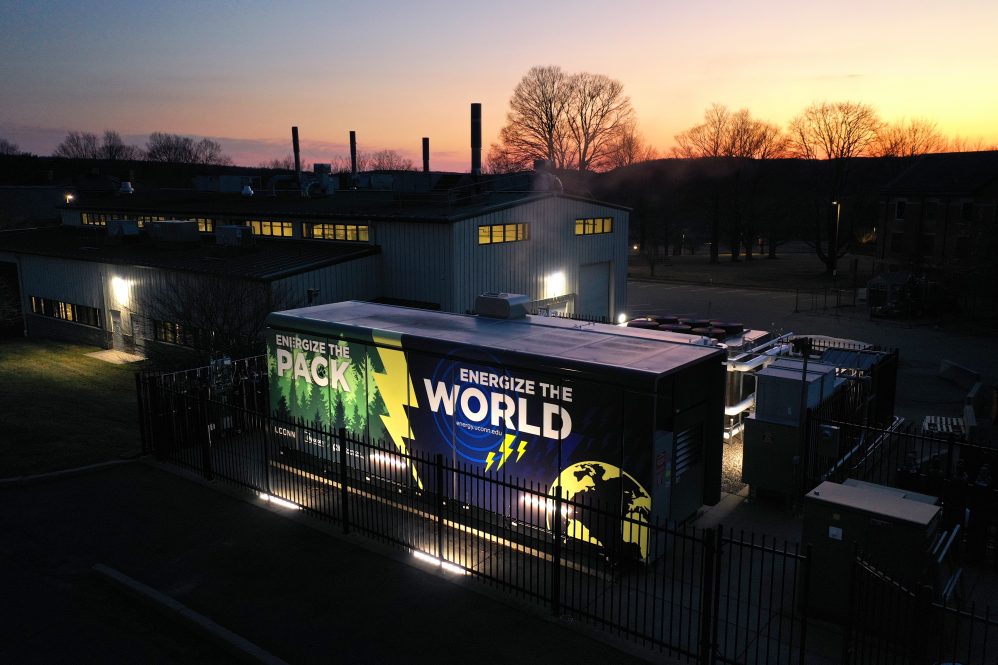
The University debuted its first fuel cell in 2012 on its Depot Campus, which now runs fully on the technology — including a HyAxiom 460-kW unit, which recovers about 1.7 million BTU/hour of useful heat for C2E2 labs. Notably, that’s exactly the CHP profile that data centers want.
In 2024, UConn and FuelCell Energy announced fuel cells for the UConn Tech Park’s Innovation Partnership Building on the Storrs flagship campus. The same year, InfraPrime donated 8 solid oxide fuel cell units of 1.5 kW each for education and research, making UConn uniquely capable of advancing SOFC technologies.
Also at Storrs, UConn’s Central Utility Plant is adding advanced turbines capable of utilizing 30% to boost output and reduce the operating costs. The University expects to save nearly $180 million on energy costs during the plant’s life.
UConn’s work with fuel cells isn’t limited to its Storrs flagship campus.
In fact, it has engaged in partnerships at UConn Stamford and the UConn Health complex in Farmington to operate fuel cells at both sites, providing substantial portions of the energy needs at those campuses and saving millions annually by reducing its reliance and demand on the local energy grid.
UConn’s “living-lab” model also plays an integral role in its rapid growth in research awards, including the record $367 million granted in fiscal year 2024.
All told, the fuel cell research is a critical part of UConn’s broader annual economic impact in Connecticut: About $8.5 billion annually, including UConn Health, supporting about 32,000 jobs and about $320 million in state and local taxes.
More than 100 UConn faculty are working on energy-related projects — including President Radenka Maric, a world-renowned clean energy expert — as part of a commitment to ensuring that UConn remains at the forefront of new knowledge in these critical areas.
Their work spans materials, cell architectures, systems, and modeling for data-center power, transportation (including hybrid electric aviation), stationary storage, and campus baseload. In fact, UConn’s recent breakthrough in direct carbon fuel cells (DCFCs) is achieving record efficiency and power, putting carbon-to-electricity commercialization within reach.
People power the fuel cell activities. In addition to President Maric, others at UConn who are substantial contributors to research in those activities and electrochemical energy include Stoyan Bliznakov, Wilson Chiu, Jasna Jankovic, Jeongho Kim, Anson Ma, Jeff McCutcheon, Ugur Pasaogullari, Sung-Yeul Park, Julia Valla, Xueju “Sophie” Wang, Yudong Wang, Nengneng Xu, Xiao-Dong Zhou (C2E2 director).
They work alongside industry-experienced adjunct professors including Len Bonville, David Daggett, David Tew, Hossein Ghezel-Ayagh, and Tianyu Zhang.
At UConn, fuel cells move from lab to load: firm, quiet, and grid-smart, operating to provide reliable and sustainable power real buildings under real constraints. The university’s fuel-cell and energy team is well positioned to advance materials, cells, systems, and modeling of fuel cells all the way to operation.
UConn stands ready to put its expertise to use to support and advance the growth of data centers, the promise of quantum computing, and the centers’ behind-the-scenes need to provide the best on-site power generation.
Bring the workload; UConn will keep it online.
—
Xiao-Dong Zhou is a professor of Chemical and Biomolecular Engineering in the UConn College of Engineering, and director of the Center for Clean Energy Engineering (C2E2). He also serves as Special Advisor in Sustainability to UConn President Radenka Maric; holds the Nicholas E. Madonna Chair in Sustainability; and is the Connecticut Green Bank Professor of Green Hydrogen and Fuel Cells.