Conversations about menstruation can be tough.
Issues surrounding women’s reproductive health, and menstruation in particular, are often shrouded in stigma and shame – so much so that, in some surveys, one third of parents have said they felt awkward talking about periods with their own children.
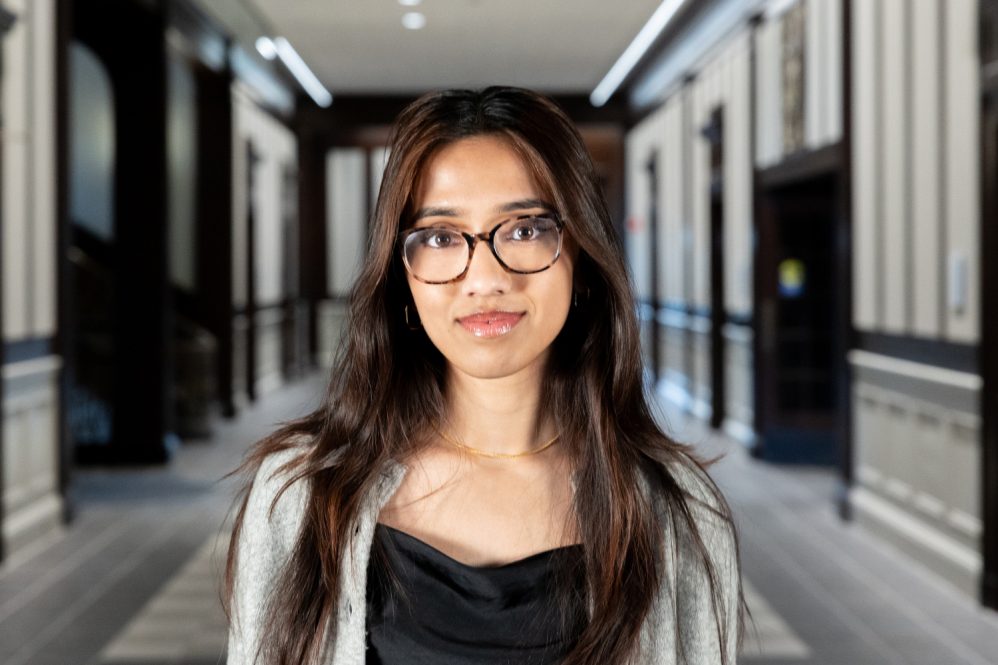
“I stumbled upon information online at a young age, which really shaped my early understanding of menstruation,” says Suheera Haq ’26 (CLAS/IMJR), a pre-med student from Shrewsbury, Massachusetts, who wants to help make those uncomfortable conversations a bit less awkward.
“I love making people laugh,” she says, “and I like to use humor to connect with people. I want to make people feel at ease, which I think is essential for the field – making challenging topics more approachable.”
At UConn, Haq is studying molecular and cell biology, but she also has an Individualized Major in social determinants of reproductive health, which she developed after her first year in Storrs.
The two paths of study, she says, have been critical, offering a firm base in the biological foundations of medicine and a deeper appreciation of the social factors that affect health outcomes.
Volunteering with UConn Health Leaders, a community-based pre-health professional program, gave her an early exposure to the impact that things like socioeconomic status and economic stability, access to education and educational quality, social support systems and community context and environments have on an individual’s health outcomes.
“I knew I wanted to go into health care, and I was really drawn to reproductive health and sexual health and women’s health – it’s something I’ve always advocated for,” Haq says. “By having that experience with UConn Health Leaders, I was able to learn about the theories and framework of social determinants of health. And that’s also the point of the major, to see the social aspects of health care that influence health outcomes, that aren’t necessarily a diagnosis or a biological mechanism.”
The experience with UConn Health Leaders also inspired Haq to find opportunities to work in health care in her local community while still a student.
Haq began volunteering with the Worcester Free Care Collaborative, a nonprofit organization that offers free medical programs for residents of the Greater Worcester area regardless of income, insurance, or housing status.
Through her volunteer efforts, she noticed that a lot of patients struggle with multiple, compounding barriers that impacted their access to health care resources and information. Which gave her an idea.
“Many people lack access to health insurance due to social determinants of health,” says Haq, “which prevents them from getting the care that they need and the necessary education to prioritize their health. When I saw the Change Grant, I thought it’d be a good idea to use that funding to provide some sort of health benefit or health intervention. I wanted to create a simple intervention that would have a feasible impact with the resources I had.”
Offered through UConn’s Office of Undergraduate Research, Co-op Legacy Fellowship Program, Change Grants offer undergraduate students an opportunity to engage in projects centered on innovation, leadership, and service. Students from any major can apply for up to $4,000 in funding to support student-designed or student-led social impact, service, applied research, advocacy, or social innovation projects.
Haq’s idea went back to that uncomfortable topic, the one she wants to make more acceptable to talk about for more people – menstruation.
Single-use menstrual products are expensive. Worldwide, millions struggle to afford menstrual products, and the U.S. isn’t immune – one in four teens and one in three adults in this country struggle to afford period products, according to the World Health Organization.
They have a significant environmental impact. Most manufactured menstrual products are made of 90% plastic, and they’re largely disposed of in landfills or waste incineration facilities.
But there are more sustainable options. Reusable pads and menstrual underwear, discs, and cups are all options – but they all come with their own learning curves.
“A lot of people don’t use menstrual cups, because they’re unfamiliar,” Haq says, “and it goes back to the whole idea of menstruation being stigmatized. The best way to beat stigma is through education.”
With support from a Change Grant awarded this past spring, Haq was able to purchase 150 menstrual kits, each with a small and a large size menstrual cup and a sterilizer for easy cleaning.
She also wrote an educational pamphlet with linked resources, like tutorials and articles on usage, safety, and environmental sustainability. She printed the pamphlet in three languages – English, Spanish, and Portuguese – to make it accessible to a larger number of residents in the Worcester area.
This summer, Haq partnered with the Worcester Free Care Collaborative to offer the cups for free to patients who visited. The organization, she says, gave her a green light, and they were equally excited to see how it would go. She spent her summer distributing the kits in person.
The response from patients, she says, were on a spectrum.
“Some people didn’t know what it even was, I had to explain it to them,” she says. “But they would take it, which was good. I wanted them to have it. Even if they don’t pick it up, they leave it in their room and maybe they use it in six months, that’s fine. Or maybe they don’t use it at all.
“But a lot of people were really interested and really happy to have it. And some were like, I don’t want this, and that’s totally fine as well.”
Over the summer, Haq distributed about two-thirds of the kits, as well as donating some to a women’s shelter and an autism service provider in Worcester. She’s continuing to distribute the remaining products.
While she doesn’t have a way to measure how many people use them, or give them to a family member or friend to use, she said a repeat of the project in the future might include some follow-up as part of the process.
Haq says she’s proud of what she accomplished – putting reusable, sustainable menstrual products into the hands of people who otherwise might not have been able to afford them, or might not have known that they were an option available to them in the first place, as well as offering useful educational information.
“The core of this project was to start conversations about alternative options for menstrual care and to connect people with resources to give these options a try,” Haq says. “I’m very proud of the process, because I was happy to see my project vision become an actual reality.”
Haq plans to take a gap year after graduation this spring before she applies to medical school. Pursuing gynecology seems like the logical choice, she says, but she’s not yet sure where in the medical field she might land – there’s a lot of ways she could see herself having an impact.
But expect her to keep offering information – however uncomfortable it might initially be – to help make some awkward conversations just a little more normal.
“I really do think that it gets easier,” Haq says, “but I still think there’s a lot that can be done. There’s so much more education, when everyone’s just a little bit more open.”