Kathryn Moore admits she didn’t know much about Renaissance composer Carlo Gesualdo before Bill Barclay, founder and artistic director of Concert Theatre Works, gave her a homework assignment last spring.
The assignment: Find 100 paintings that might inspire Barclay in developing the movement score for his latest show about the troubled Gesualdo, a 16th century Italian musician once destined for the clergy in the footsteps of his uncle, a Catholic saint, who later became a prince known for murdering his wife and her lover in bed and spending the next several decades a near recluse tortured by mental illness, guilt, and masochist tendencies.
Wow.
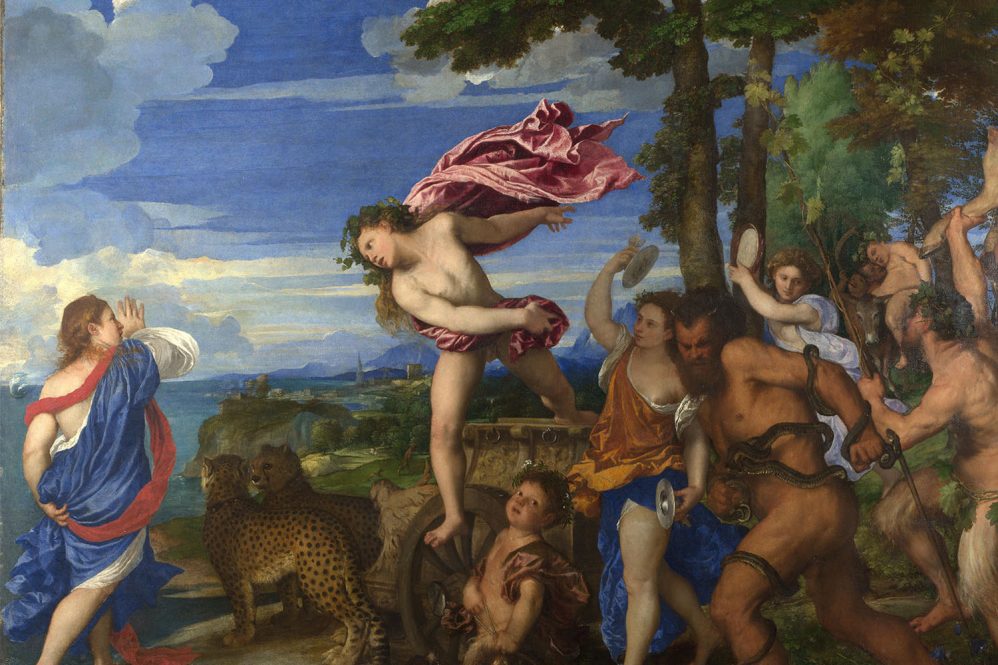
“In addition to the relationship between physical torment and psychological torment, Bill and I talked about ‘tenebrism,’ the dramatic contrast of light and dark, and how they might be able to introduce lighting features in the show,” says Moore, an associate professor in UConn’s Department of Art and Art History.
“I didn’t understand how any of it would work, of course, so I read more about Gesualdo’s life,” she continues, “and saw these comparisons to the life of Jesus, which were so fascinating, the fixation on flagellation and the ongoing torment that he suffered, especially because of his sense of guilt. I also found the parallel between chromaticism in music and color and composition in painting to be intriguing.”
Double wow.
Two weeks later, Moore delivered her assignment, joining Barclay, the show’s choreographer, and a team of actors, including Kristin Wold, an assistant professor-in-residence and head of UConn’s BFA in acting program in the Department of Dramatic Arts, and Thomas Brazzle ’14 MFA, at a dance studio in the Berkshires to help the group suss out her thought process.
The images fixed to the wall delivering almost a historical timeline of the Renaissance period, Moore says she delighted in watching the actors run between the art and dance floor to imitate the poses they saw.
“It was an amazing experience,” she says.
Bringing in an art historian like Moore to collaborate on the development of a theatrical performance is unusual, but this is no ordinary performance.
Game for the Challenge
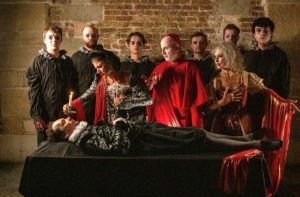
“Death of Gesualdo,” which premieres in the U.S. on Feb. 13 at the Cathedral of St. John the Divine in New York City following a world premiere in January at St. Martin-in-the-Fields in London, is being staged as a “tableau vivant,” in which the actors strike poses to tell a story.
That’s why images from historical pieces like “An Allegory with Venus and Cupid” by Bronzino were valuable to the choreographers.
“Concert Theatre Works seeks to build new audiences for classical music by creating theatrical, multidisciplinary works in concert halls with the world’s best musicians and ensembles,” Barclay explains. “We add actors, dancers, film, food, juggling, illusions, immersive spaces, sword fighting, and now tableau vivant to the music, so people not only hear great music but listen to it.”
With the musical score for the 70-minute show by Gesualdo himself – performed by the London-based vocal group the Gesualdo Six – the show uses a puppet and six actors to convey the dark, twisted story of psychosis.
“We talk about Gesualdo because of the murders, but we only really care because his music is absolutely glorious and haunting and strange and complex,” Barclay says. “Kristin and Thomas and the other four actors were just so game for the weirdness of this challenge.”
Wold says she and Barclay met years ago at Shakespeare and Company in Massachusetts and reunited at UConn when she brought him in as a composer for a Connecticut Repertory Theatre performance.
Barclay contacted Wold last spring to help with development of the movement score for “Gesualdo” and asked if she knew of an art historian who could help. That’s when she tapped her resources in the School of Fine Arts to find Moore.
“I love being in the rehearsal room with Bill and Kathryn, listening to them speak so eloquently about music and art. It’s thrilling,” says Wold, who’s playing the roles of Uncle Julio and Aurelia. “It was so stimulating and exciting as a performer to hear what they had to say. Sometimes dramaturgs on plays will bring in imagery that surrounds the time period or milieu of the play, and that’s really useful as an actor. But this was next level.”
Brazzle, who’s also playing multiple characters including the cardinal, describes the process as being “like a roadmap for us. The music would play and we’d listen, but then you’d have those pictures. It would all kind of take you over. It really allowed us to see this thing that was almost amorphous and so different. The music was so bizarre.”
Seeing It Come Together

Barclay admits the pieces that Gesualdo composed are bewildering, conceived in a late Renaissance Mannerist style that centers on “artificiality, complexity, ornamentation, and virtuosity. Dissonance and strangeness are the idea, and after listening to it all we sort of had ears of cottage cheese after a few hours because it all just starts to blend together.”
In painting, Moore says, Mannerists like Michelangelo created complex, innovative compositions – think of the serpentine-like bodies in his works.
It’s an art style she’s well versed in, yet “I had not been aware that there were interesting parallels to music. I also found the parallel between chromaticism and color and composition and painting to be intriguing. I’m not sure exactly where it will take me, but I would say it’s something that feels not very well researched yet.”
As Wold and Brazzle prepare for the New York performance – a separate cast debuted the show in London – they say that in addition to relearning the choreography, they’re eager to see it come together: the costumes, the music, their performance.
“There’s such a huge difference between hearing things and listening to things. We hear things all the time, but when we give things our full attention that’s when something like music becomes a whole brain experience and that’s when music takes on its medicinal power,” Barclay says.
Locally, Concert Theatre Works is presenting “Romeo and Juliet: A Theatrical Concert” with the Hartford Symphony Orchestra Feb. 13-15 at The Bushnell, in which Wold contributed to the show’s choreography. It’s a performance that debuted last summer at Tanglewood with the Boston Symphony Orchestra.
“I was mostly doing music before I started acting,” Wold says, “so it’s part of the fabric of me. It was extraordinary being in the shed at Tanglewood with the BSO having that live musical experience, 3 feet away from the musicians. Film and television are awesome, but there is absolutely nothing that can replace live performance and the communal experience that happens when you’re in the presence of an audience.”