As a second-year Ph.D. student at UConn, Madeline Resnick is already sharing her research with audiences beyond campus. This week, she will present her work at the International Neuropsychological Society’s 54th Annual North American Meeting, held Feb. 4-7, joining researchers from around the world to discuss new findings in brain and behavior.
Resnick, a doctoral student in psychological sciences, studies the underlying factors associated with schizophrenia as a graduate researcher in the Temporal, Theoretical, Translational Research and Neural Stimulation (3TRNS) Lab. Working closely with her advisor, Chi-Ming Chen, professor of psychology, she examines how cognitive traits associated with schizophrenia appear along a broader spectrum in the general population.
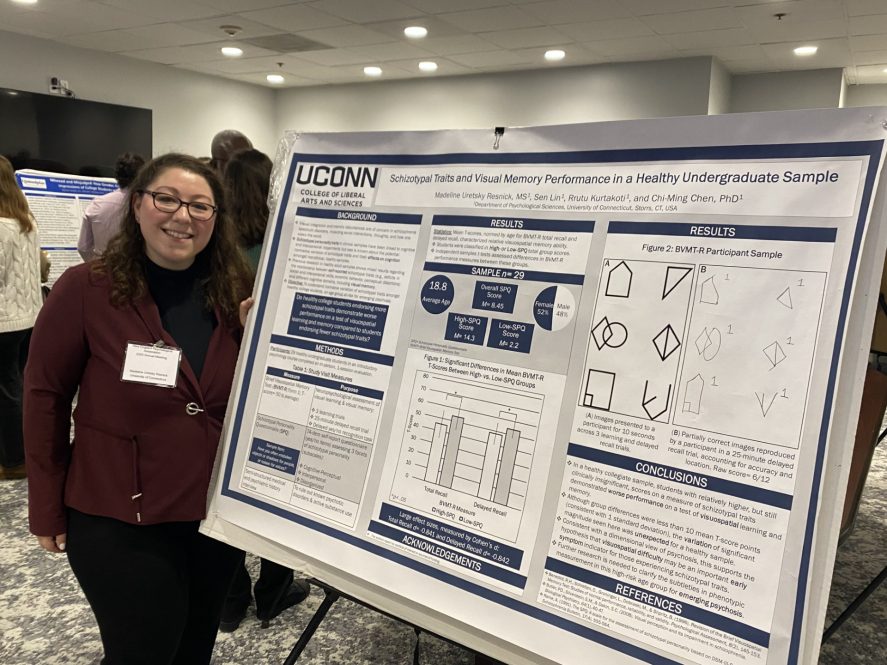
She recently presented a preview of that work during a fast-paced Data Blitz at the 28th Annual Neuroscience at Storrs Symposium, an event that brings together UConn neuroscience researchers from across disciplines. In just three minutes, Resnick shared findings from her study, “Schizotypal Traits and Visual Memory Task Performance in a Non-Clinical, Undergraduate Sample,” with an audience of peers, faculty, and community members.
We caught up with Resnick to talk about her research, her path to graduate school, and what it’s like to share her work.
What inspired you to study psychology?
I went to Simmons College (now Simmons University), a small women’s centered institution in Boston. What I found interesting is the intersection of the brain and what really makes us who we are, and how different factors contribute to how we present in the world. I became a neuroscience major and immediately fell in love with research.
It wasn’t until the end of my sophomore year that I became interested in the clinical aspect of neuroscience research, which meant going the Ph.D. route in clinical psychology. I got involved in a lab at Boston University that examined the long-term cognitive and neuropathological effects of repetitive head trauma in former National Football League (NFL) players. I worked there for eight years, and I learned so much about concussions and degenerative diseases of the brain and how that impacts our cognition. That really solidified my decision to want to go into clinical neuropsychology, which is what I’m doing now here at UConn.
What led you to UConn for graduate school?
A Ph.D. program entails a lot of intrinsic motivation and self-starting independence. I found that UConn has the environment, especially in the psychological sciences department, where they want us to succeed and feel supported.
UConn is one of the only clinical psychology programs in the northeast that has a neuropsychology focus. There are very few in this region that have this specialty, so it was exciting to be accepted into the program and have the opportunity to pursue this career.
There’s also an institute within CLAS at UConn, called The Institute for Brain and Cognitive Sciences (IBACS), that encompasses various graduate and undergraduate research and programs with excellent resources for graduate students. Dr. Chen is involved with IBACS, so I was looking forward to those collaborative opportunities as well.
How have your experiences at UConn thus far influenced your studies and your current research focus?
UConn has a great emphasis on supporting its graduate students. We are treated more as colleagues as opposed to just students. Our ideas are valued, and I really appreciate that.
There’s six of us in my cohort, and everyone is friendly and encouraging. We’re all doing different research, which is a great learning environment. The mentorship and training I’ve received thus far have allowed me to pursue various research, teaching, and clinical interests.
IBACS has been outstanding. I recently was awarded the IBACS Travel Award to be able to present my work at the International Neuropsychological Society Conference in Philadelphia in February.
Can you describe your research and the presentation you gave at the Neuroscience at Storrs Data Blitz?
My research with the 3TRNS Lab so far has looked at schizotypal traits across the general UConn undergraduate population.
Psychologists classify schizophrenia on a spectrum, with the most severe symptoms being psychosis, hallucinations, and delusions. Then, we see all of these other traits and symptoms, including cognitive changes, sensory challenges, and interpersonal difficulties.
This is important because schizophrenia is highly impairing, as many people who have it face a loss of productivity and difficulty adhering to medication. The inflection point when people tend to have that first psychotic break is around this college age. Identifying it early is important for treatment outcomes.
The study was offered as part of the participant pool for UConn undergraduates, and the lab ended up with 29 participants. I focused my research on the visual memory test that participants took, measuring how they learned features and locations of six geometric figures, and then the amount that they were able to recall and draw 25 minutes later.
The main finding was that those who displayed higher schizotypal traits actually performed worse on the visual memory test compared to participants with lower schizotypal traits.
How do speaking opportunities, like presentations, strengthen your research?
Neuroscience at Storrs was a great opportunity because, particularly with the Data Blitz section, it’s such a short amount of time where you have to figure out what the main message is. Being able to distill that down for someone without a background in your specific field allows us to think more clearly about how to write it in a paper and communicate it to a broader audience.
I was grateful for that opportunity and to be able to see such an interdisciplinary event. UConn is a big school where people are doing fascinating research. It’s easy for graduate students to get caught up in our own bubble, so being able to interact with people outside of my program was great.
What’s next for you at UConn?
I have four more years left in my program. I will be completing both therapy and assessment clinical hours at the UConn Psychological Services Clinic and at local, external sites, as well as teaching and finishing my classes. Also, as a Ph.D. program, we are required to conduct research and complete a dissertation. I’m hoping to combine my interests in cognitive assessment, head trauma and psychiatric disorders.
One highlight of the clinical psychology Ph.D. program is that we’re encouraged to present our research at conferences. As I mentioned, I will be heading to Philadelphia for INS to present my poster, “Relationships between EEG event-related potential components and visual memory among healthy college students,” which includes elements from my Neuroscience at Storrs Data Blitz, as well as my master’s thesis, which I defended in December.
I think it’s an important skill for people in academia to be able to explain and present their work to different audiences. It’s always a fun opportunity to be able to learn from researchers within and outside of the field, and to get into the larger UConn community.