
In a single week, HDI’s Menopause Equity Initiative (MEI) helped shape two key menopause bills at the Connecticut General Assembly. It also brought a groundbreaking documentary on menopause to UConn alums and the broader community for dialogue.
This coordinated push reflects a growing recognition that menopause is not just a private experience but a public health and equity issue.
“When we talk about menopause equity, we’re talking about whether women and people in midlife have access to the information, care, and workplace conditions they need to thrive,” said Trisha Pitter, director of Community Learning and Engagement at HDI. “That requires policy change, provider education, and spaces where people can finally say ‘menopause’ out loud without shame.”
Taking Menopause to the Capitol
On March 3, HDI staff, members of the Menopause Equity Collective, and community partners testified before the Connecticut General Assembly’s Labor and Public Employees Committee in support of SB 353, “An Act Concerning Reasonable Accommodations in the Workplace for Conditions Related to Menopause.” If passed, the bill would require employers to provide reasonable workplace adjustments—such as temperature modifications, flexible breaks, and scheduling—to workers experiencing menopause symptoms, aiming to reduce stigma and prevent retaliation for requesting these accommodations.

The following day, March 4, the HDI team, along with members of the Menopause Equity Collective (MEC) appeared before the Public Health Committee to support HB 5389, “An Act Concerning a Provider Toolkit for the Diagnosis and Treatment of Menopause, Perimenopause, and Postmenopause.” If enacted, HB 5389 would equip healthcare providers with a toolkit to improve their ability to diagnose menopause-related conditions and to offer timely, culturally responsive care. This aims to ensure individuals receive informed, personalized healthcare for menopause, addressing reported gaps in midlife care.
Rep. Kai Belton, a menopause equity champion and member of the Connecticut House of Representatives, serving the 100th district, has been a key legislative partner in advancing this agenda. “For too long, menopause has been treated as a private burden instead of a public health and workplace equity issue,” Rep. Belton said. “SB 353 and HB 5389 are about basic fairness, making sure people in midlife can keep working, supporting their families, and accessing quality care without stigma or dismissal. Too often, women’s symptoms are misdiagnosed or ignored, leading to unnecessary suffering and medical costs that could be prevented with better education and support.”
Testifiers included HDI team members Dr. Linda Sprague Martinez, Trisha Pitter, MS, and HDI Graduate Fellow Malia Hunt, BSW, as well as members of the Menopause Equity Collective and community advocates whose lived experiences and professional expertise helped bring the realities of menopause into the legislative record. “Testifying was both terrifying and liberating. I was speaking not just for myself, but for so many women who have quietly pushed through pain, brain fog, and exhaustion at work,” said Monika Shoham, a member of the HDI Menopause Equity Collective. She further noted, “My hope is that because we showed up and told the truth, the next generation won’t have to suffer in silence to keep their jobs or be taken seriously by their providers.”
Shredding The Silence at UConn Health
On the evening of March 4, HDI partnered with the UConn Foundation and the UConn Office for Inclusion and Civil Rights to bring the “Because of UConn Conversation Series: Shredding the Silence on Menopause” to UConn Health’s Cell and Genome Sciences Building, Grossman Auditorium, in Farmington.

According to Marinda Reynolds, Senior Associate Vice President for Alumni Engagement, UConn Foundation, “Our intent in hosting this event was to highlight UConn Health and the Health Disparities Institute by offering a relevant educational opportunity for UConn alums, particularly women. What we found was significant energy and interest in building community and support for this shared experience, and an appetite to hear from UConn alumni and faculty experts in this space.”
The event featured a screening of The (M) Factor: Shredding the Silence on Menopause, a documentary that combines personal stories with expert medical insights to illuminate menopause as a neglected global health and economic crisis.
The film shows that, in addition to navigating intense physical symptoms, women experience billions of dollars in lost wages, disrupted careers, family strain, and emotional turmoil. It calls for a revolutionary approach to women’s health worldwide.
The panel highlighted how UConn clinicians are reshaping menopause and midlife care in Connecticut. The speakers included:
- Lucinda Canty, Ph.D. NURS ’20 – Certified nurse midwife, maternal health equity scholar, and founder of Lucinda’s House: A Black Maternal Health Collective, who guided a conversation linking menopause to reproductive justice, racial equity, and women’s health across the lifespan.
- Katherine J. Coyner, MD, MBA – Associate professor of orthopedic surgery at UConn Health, director of the Women’s Center for Motion & Performance, and orthopedic team physician for UConn Athletics, who emphasized the role of mobility, performance, and musculoskeletal health in women’s quality of life during midlife.
- Carla Rae-Gunn Samson, MD, MED ’06 – Obstetrician gynecologist and acting director of Women’s Health at Community Health Services, who described how she supports patients through perimenopause and menopause in community settings.
- Lenora S. Williams, MD, MED ’86 – OB/GYN, certified menopause provider and clinical faculty member at UConn Health, shared what she sees in clinical practice and the importance of menopause-informed care.
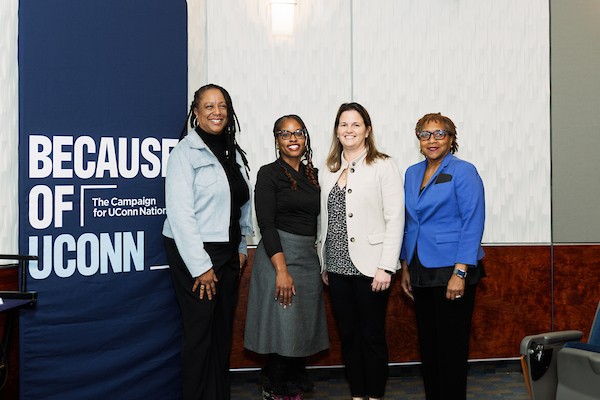
“It is time for a new paradigm in the management of the menopausal transition. Although this transition is often uncomfortable, it is physiologic—not pathologic,” shared Dr. Lenora Williams. Later, Williams emphasized, “We must actively dispel the myths and misinformation surrounding hormone therapy that persist among both patients and healthcare providers. Individuals experiencing menopause deserve evidence-based, life-enhancing, and quality-of-life–preserving care that reflects current scientific understanding.”
Panelists responded to questions from alumni, donors, and members of the wider UConn community about symptoms, treatment options, and how to advocate for better care. They also connected the discussion to UConn’s Health and Wellness of People and Planet campaign pillar.
To underscore UConn’s commitment, Dr. Jeffrey Hines, Vice President, Office for Inclusion and Civil Rights connected the event to the university’s broader vision.“Featuring ‘The (M) Factor’ in our Because of UConn conversation series was a powerful way to bring alums, donors, and the broader UConn community into an often-ignored health crisis,” shared Hines. He further noted, “This work sits squarely within our Health and Wellness of People and Planet strategic plan pillar, because when women in midlife thrive, families, workplaces, and communities across Connecticut thrive too.”
Kathleen Holgerson, Interim Assistant Vice President for Diversity and Inclusion reflected on the benefits of institutional collaboration, “This event was a great example of synergy and collaboration across UConn and UConn Health. We were able to share information about the incredible work that HDI is doing around menopause equity with our alums, students, staff, and faculty. I heard from so many participants about how much we need these spaces for education, conversation, and community building. What I appreciated most about this partnership was everyone’s commitment to engaging people from a variety of identities and lived experiences.”

Advancing Menopause Equity as Health Equity
Both the legislative testimony and the film screening are part of HDI’s broader Menopause Equity Initiative, a statewide effort to break the silence, reduce stigma, and create community-informed solutions to support midlife health. The initiative aims to ensure that menopause care and policy reflect the realities of those most impacted by inequities.
As SB 353 and HB 5389 move through the legislative process, HDI and the Menopause Equity Collective will continue to engage partners, share stories, and mobilize communities to support menopause equity, ensuring all people in the state have access to the care, information, and environments they need to thrive.
“This week showed what menopause equity looks like in action. Community members testifying at the State Capitol, clinicians sharing what they see in practice, and alums gathering to learn and talk openly about midlife health and wellbeing,” said Dr. Linda Sprague Martinez, director of HDI. “At HDI, we’re intentional about centering the voices and views of those most impacted by inequities in decision making and partnering with providers who can share their expertise and lived experience, while also making space for both truth-telling and joy so people know they are not alone, can build community, and can push forward toward systems to change.”