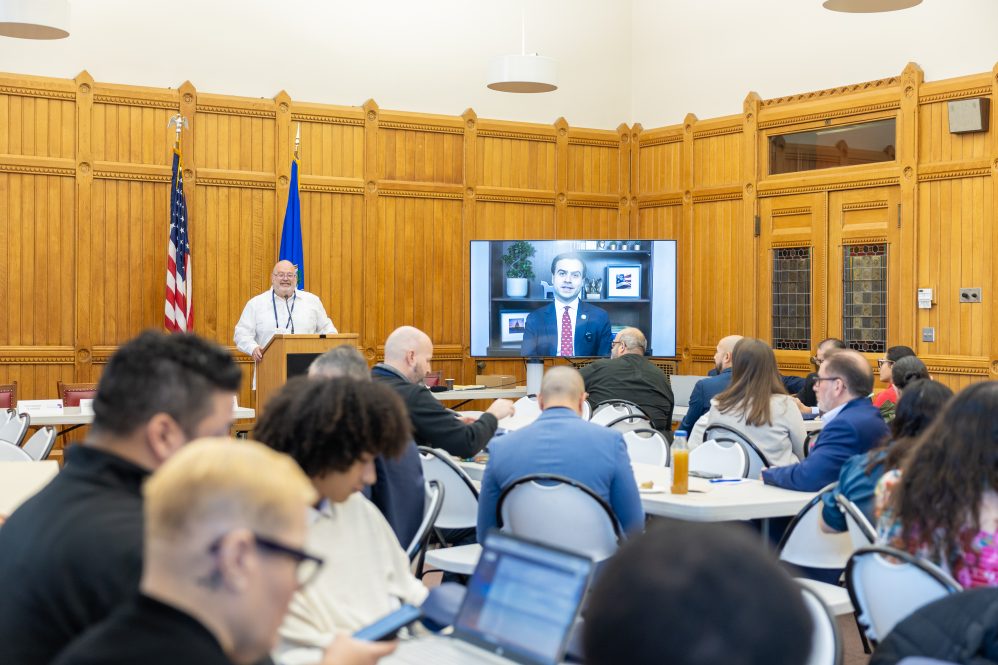
While a two-day summit addressing issues of importance to Puerto Ricans might sound like a niche event, UConn’s Charles “Rob” Venator-Santiago stressed during opening remarks Friday the ideas generated from the 300 attendees are things that can benefit everyone in Connecticut, not just its Puerto Rican community.
Take, for instance, a proposal he has that would shift the way electricity is purchased in the state, potentially reducing the cost by 45% – for everybody. It would require radical change, Venator-Santiago admitted, and might not go anywhere right now, but it’s something that has the backing of the legislature’s Puerto Rican caucus and gets the conversation started.
After all, that’s among his explicit goals of the second annual summit, Puerto Rico: Puerto Ricans in Connecticut, sponsored by UConn’s Puerto Rican Studies Initiative for Community Engagement and Public Policy (UConnPRSI) and held at the state Capitol and Legislative Office Building complex.
First, he said he wanted to bring together key state leaders to get them thinking creatively about ways they could help bolster the Puerto Rican economy.
“We want to figure out how the small business owner can participate in this conversation and engage in trade and use this as a way to launch other similar meetings,” he said, adding, “We think that we can create a strong economy that integrates people.”
Second, he said he wanted to shine a light on the actual debates happening in Puerto Rican communities around the state, even before policies are conceived so those debates can influence at the outset.
“The idea is to give exposure to some folks and say, ‘Hey, there are all these things happening, and you should pay attention to them,” he said.
To that end, Venator-Santiago — director of UConnPRSI, director of El Instituto, and associate professor in the Department of Political Science, all in the College of Liberal Arts and Sciences — structured the two-day event with distinct flavors.
Friday’s session was dedicated to discussions about trade between Connecticut and Puerto Rico, with panelists from the U.S. Census Bureau and Department of Commerce Bureau of Economic Analysis, along with Connecticut state legislators and the Puerto Rico Study Trade Commission.
Saturday’s session looked inward at key issues for Connecticut Puerto Ricans and included six roundtable discussions on subjects ranging from school closures to rent control. Numerous state legislators served as panelists, along with local nonprofit leaders, media members, and municipal elected officials.
“There are a lot of Puerto Ricans who have a lot of influence in the state,” Venator-Santiago said. “I think that after Hurricane Maria and with Bad Bunny, there’s something going on that’s energized people about Puerto Rico.”

The opening plenary on Day 1 from Edwin Meléndez, emeritus professor at Hunter College, City University of New York, focused on sustainable economic development on the island that was put under fiscal oversight during a financial crisis.
In the decade since, he said, leaders have focused on stabilizing the commonwealth’s ledger mostly by cutting costs rather than focusing on recovery and growing the economy.
Because of a high cost of living, residents are discouraged from working, he said, as paychecks just don’t cover the cost of the three overwhelming household burdens, that is energy, food, and housing.
“The reforms that they instituted … have actually backfired,” Meléndez said. “It’s worse than it was before.”
But activating the labor market can change that just by investing in three key areas.
First, he said, there needs to be increased child care options and affordability; it’s the one of the best means of encouraging people to get back into the job market. Second, the industry pipeline needs reconfiguring; past agricultural practices don’t work today, for example. And third, financing needs to be available for these projects, and there’s existing infrastructure already in place for it.
Meléndez said Puerto Rico also needs to reduce its reliance on petroleum, its largest import, and instead make investments in alternative energy sources like solar arrays, still an import but one that has sustainability. Further, it needs to have the ability to govern locally and needs advocates to continually campaign for its best interests.
Venator-Santiago said Puerto Rico: Puerto Ricans comes on the heels of a similar summit in January that centered on Connecticut Latinos and drew nearly 500 people for the single-day event. That’s one reason he opted to break this one in two: crowd management.
“UConn has a very good reputation in Connecticut,” Venator-Santiago said, “and I think we need to highlight how there are pockets of the University that are giving back or that are actively involved in the community. UConn can contribute to the conversation at a community level, on a political level, in a nonpartisan way to bring about new ideas.”