“The same problem repeats across the entire world,” Neha Shanavas ’28 (CLAS) says she discovered during her time at the 69th session of the United Nations Commission on Narcotic Drugs (UNCND). The conference united UN agencies, governments, global policymakers, researchers, and advocates to discuss global drug policy, arising obstacles, and evidence‑based responses from March 9 to March 13.
Her passion for education on substance misuse and prevention began when a student at her high school passed away from a fentanyl overdose. She said that if the school had Narcan – a medication that reverses overdose – the tragedy could have been prevented.
It was a chilling experience; Shanavas recalls being sheltered in place for hours on end. Prior to leaving school on the day of the tragedy, students had to step into a mini-inflatable pool of chemical solutions to decontaminate their shoes of any fentanyl traces potentially collected. The school went through a phase of intensive cleaning for several days, and Shanavas says that, even as time passed, that incident “made school almost never go back to normal.”
Two years later, Shanavas was a senior. After listening to a talk by The Governor’s Prevention Partnership (GPP) – a Connecticut-based nonprofit committed to reducing youth substance use – she joined the Speaker’s Bureau with the Youth Advisory Board. In her current role, she serves as an ambassador for her peers in providing local, state, and federal legislative testimony on relevant substance prevention issues. She testified for various bills surrounding health and safety initiatives for community members. In 2024, one of the bills she advocated for with GPP, Connecticut Senate Bill No. 1, “An Act Concerning the Health and Safety of Connecticut Residents,” was passed into law, advancing funding and policy change to support the co-dispensing of drug deactivation pouches alongside opioid prescriptions.
Advocacy led to purposeful action. After the bill was passed, she assisted in the distribution of 50,000 drug deactivation and disposal pouches across Connecticut, eliminating over 2 million pills from being misused.
Through her unwavering dedication with GPP, she earned national recognition from the Community Anti-Drug Coalitions of America (CADCA), a leading national nonprofit committed to coordinating substance use prevention efforts across the country. With deep appreciation for the meaningful work she has done in substance misuse prevention, she was honored with the prestigious 2025 Outstanding Youth Leader Award, cementing her place among the most influential young changemakers in the nation.
As the annual award recipient, she was celebrated during the Annual National Leadership Forum from Feb. 3 to Feb. 6, 2025, where she met Matej Košir – the chairperson of the Vienna NGO Committee on Drugs, which bridges non-governmental organizations (NGOs) and key intergovernmental and international agencies involved in drug policy and control. After connecting with him in person, and maintaining her newly formed connection through LinkedIn, he invited her to attend the 2026 UNCND in Vienna, Austria, held just one week before Spring Break at UConn in March.
Shanavas was eager to attend, curious to learn if governments across the world have a specific allocation for substance use prevention and treatment.
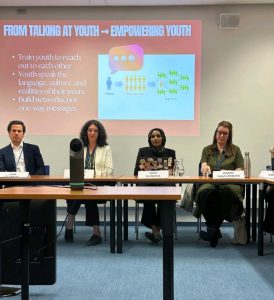
On top of her inquisitiveness driving her to participate, Shanavas was excited to make a difference on an international platform. Through established networks, she was invited to present on youth leadership’s role in substance prevention: “From ‘talking at youth,’ to ‘empowering youth,'” she says. Steadfast on the importance of including adolescents into policy decision-making, she wanted to “encourage coalitions across the world to include youth voices.”
Her presentation amplified one message: Youth-led substance prevention efforts. “When the messenger doesn’t really understand the audience, the message gets lost,” she says.
Shanavas aims to “flip the model,” where instead of adults trying to reach young individuals, adults should equip youth to reach each other.
“I hopefully reassured the adults in the room that youth leadership can be successful if executed properly, and hopefully they will go back into their communities to find youth leaders to uplift,” she says.
During the conference, she spoke with numerous member state representatives and coalition leaders. She was fascinated to learn how a coalition in Kazakhstan supports those in substance misuse recovery through a creative and holistic approach, where individuals create felt dolls or objects, steering away from a punitive practice and more focused on rehabilitation. She added she was also captivated by a side event where delegates from Kazakhstan and numerous Central Asian countries reiterated the importance of joint efforts by states and international organizations in combating illicit drug trafficking, implementing advanced security measures.
“What I found fascinating was that it wasn’t just law enforcement presenting, civil society organizations were at the table too, which tied directly into what I was talking about in my own presentation, this idea that you need multiple sectors working together,” she says. “They were talking about monitoring cryptocurrency transactions and using advanced analytics to catch drug networks, which is a totally different angle than what we focus on in the U.S. It made me realize prevention looks different depending on the country’s resources and challenges, but the need for collaboration is universal.”
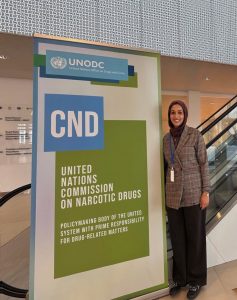
With appreciation for Kazakhstan’s nurturing framework for those in recovery and fascination with advanced technological tracing for drug transportation, Shanavas says that talk “made me realize there has to be a balance between criminalization and care because if all we do is punish our way through this epidemic, we’re going to keep losing people who needed support.”
At UConn, Shanavas is currently pursuing an individualized major, studying “Health Policy Informatics,” and learning how health policy and management function and the importance of data in clinical care.
Shanavas has been accepted into UConn’s Special Program in Medicine, and after graduation plans to work toward her M.D. at the UConn School of Medicine. Her mission is to combine clinical work with involvement in health care policymaking, “encouraging doctors to show up for legislative efforts and advocate for patients.” She is grateful for UConn’s Special Program in Medicine for granting her the “breathing room that allowed me to really explore what I care about, which led me to dive deep into prevention work, and eventually to presenting at the UN in Vienna before I even start medical school.”
Looking back on her experience presenting on a global stage, her face lit up as she enthusiastically says she feels even more inspired. Substance usage is normalized within her generation, and Shanavas aims to challenge that narrative of normalization. She hopes to partner with existing UConn student organizations or start a new one focused on promoting substance use prevention and disseminating resources for those in recovery.