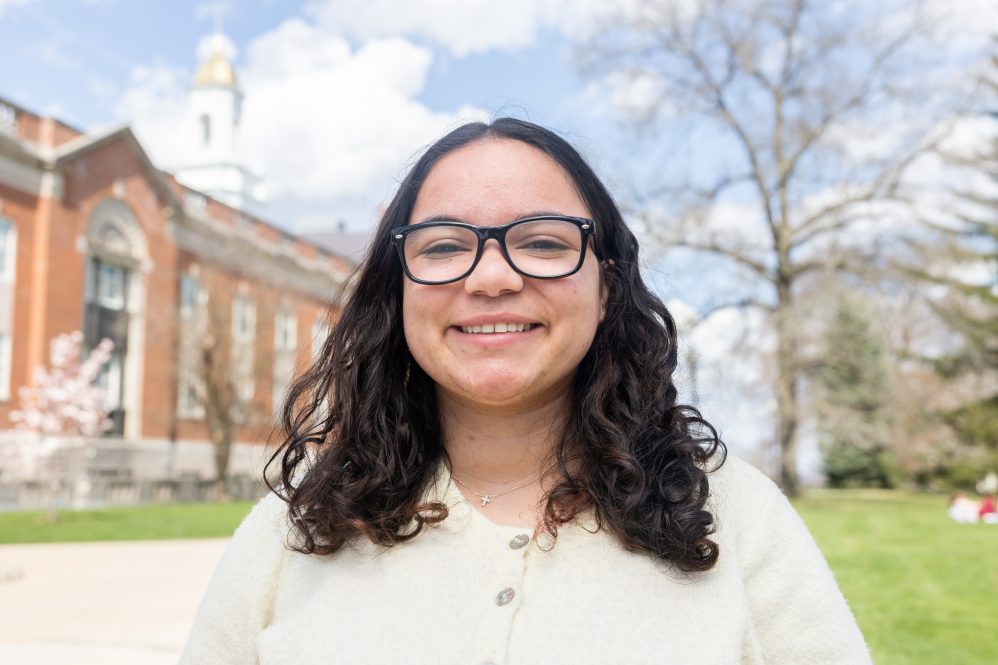
During her first semester on campus, Charisma Farrington carried around a secret much heavier than the 30-pound sousaphone she played in the UConn Marching Band.
There was a reason she couldn’t go bowling or out to dinner every weekend, a reason she filled her waking hours with work hours – only she didn’t share.
 Then, when her roommates reunited with their parents for winter break, traveling home to be with family, she stayed behind and came to learn that’s a long six weeks to spend by yourself. She realized she had a choice: keep going on alone or let others in.
From about 3 years old, Farrington ’26 (CLAS) was raised in the foster care system, shifting placements from Alabama to Massachusetts, sometimes with extended family, sometimes not. Now she was 18 and on her own, at UConn and determined to break the cycle of trauma she was born into.
She grasped for resources that first year, she says, from filling out the FAFSA to turning a dorm room into a home without any stuff, no social workers to turn to, no co-signer on student loans.
“After my first semester, I really thought I wasn’t going to be able to register for classes again. I thought I was done,” Farrington says. “And then I ended up getting an emergency funding grant. I didn’t apply for it, it just hit my fee bill and the charges went away. I thought immediately, ‘Wow, I guess I’m meant to be here.’”
Farrington, a psychological sciences and political science double major, is among the 4% of foster-experienced college students nationwide to graduate with a four-year degree.
Even as Farrington readies to leave UConn, she aims with her project, “Foster Care to Campus Care,” which was funded by a Co-op Legacy Fellowship Change Grant through the Office of Undergraduate Research, to leave a breadcrumb trail for those who follow her.
Early Stumbles, But Still Determined
“I didn’t have a role model who graduated from college, who broke the generational trauma. At some point, I recognized there had to be more out there for me,” Farrington says. “I didn’t want to end up like my parents. I wanted to create a life for myself and help other kids coming up behind me. That’s why I went to college. I knew there was more out in the world.”
With four siblings from her biological mother and three brothers from her biological father, the one of eight says that her foster placements oftentimes didn’t last long, and, yes, there was abuse, a lack of general resources, even a lack of food. At one point she ended up in a coma, diagnosed with diabetes that had gone unnoticed and untreated.
Then came the day Farrington went from 17 to 18, child to adult, and suddenly she was expected to know and do everything.
“That was when life blew up in my face,” she says. “I decided to leave my placement because it wasn’t conducive to my future, and I resolved to take care of myself from that point on. But I didn’t realize I wasn’t going to have the support I had when I was a minor, so I really had to grow up and learn how to do every single thing for myself.”
Farrington made connections in UConn’s Dean of Students Office, Office of Student Financial Aid Services, and other places around campus because there’s no repository dedicated to acclimating and assisting foster-experienced students.
“I’m very grateful to the University of Connecticut,” Farrington says. “They’ve given me so much, including the opportunity to create a resource for others like me.”
Advice From Someone Who Went Through It
“Foster Care to Campus Care” is a brochure available in offices around UConn that details precisely where foster-experienced students can go for resources. Not only does it note things like the Husky Harvest food pantry, but it also details basic tips and tricks that Farrington learned along the way.
“Students with foster care experience often qualify for accommodations due to trauma, instability, or mental health impacts,” it reads in the Academic Accommodations section.
“Attend events even if you go alone; staff will welcome you,” it reads in the Tips for Building Community section. “Build relationships with staff who feel safe and supportive.”
That last one is something Farrington did early on.
She came to UConn for two reasons: its marching band and the idea that the University would allow her to pursue her dreams, whatever she wanted. At the outset, she met Eric Rice, professor, former music department head, and Farrington’s “school dad.”
“When I would have bad moments and bad days, he was the person I could disclose everything to,” she says. “He was the first person I opened up to about being in the foster care system.”
Her work-study made her the undergraduate technical director at von der Mehden Recital Hall, which, as department head, Rice was in charge of. Farrington says he always has a dad joke at the ready and reminds her of what a father figure should be.
In considering an advisor for “Foster Care to Campus Care,” even though he’s a musician and not a clinician, Farrington says Rice was obvious.
“He’s just been a great resource throughout my college experience,” she says. “There was no better way for me to do this project than by being personal. So, choosing an advisor who I could be personal with was very important to me. That’s why I chose Dr. Rice.”
She Found Lighthouses Along the Way
Farrington says she feels like most of her biological family carries resentment toward her for leaving the brood, and with siblings who haven’t yet found a way to heal their heartbreak, she consciously has broken ties – save for her oldest brother, who calls her an inspiration and who she refers to as a mentor.
On breaks and in between, Farrington fell into a “forever family.” What started as two weeks over the summer with her best friend from marching band turned into a permanent arrangement, replete with a mom and a dad.
“I don’t have to worry about where I’m going at the end of the day anymore,” she says. “I found my forever family because of UConn. I don’t have to worry about whether I’m going to eat, things like that. They make it very known that I am their child. I’m one of the lucky ones.”
And they’ve helped guide her to answering that perennial question for graduates, “What’s next?”
Farrington has plans of going to law school to become a family lawyer who specializes in foster care advocacy. But that psychology major won’t go to waste, she says. Because she’ll soon be credentialed to have one-on-one conversations with children, she can work directly with those in the foster care system without a mediator.
That was calculated, because for a long time now, she’s been the one keeping herself on task, making sure step 1 was the right way to precede step 2, and so on.
“No matter where you come from, what your past may be, you can be successful,” Farrington says. “You can survive life’s biggest challenges, even college. It is attainable. Growing up, I never thought I’d be able to go to college, but there are resources out there. It may seem impossible, but you have to dig deep and you have to want to succeed.”
The month of May is designated National Foster Care Awareness Month.